






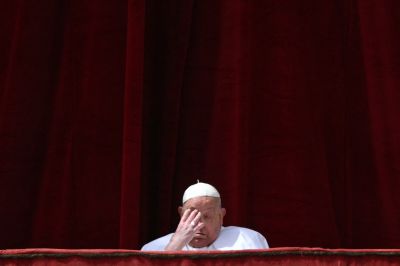
Pope Francis delivering his "Urbi et Orbi" message from the balcony overlooking St. Peter's Square at the Vatican on April 16, 2017. (Credit: Osservatore Romano/ Reuters.)






After the death of Pope Francis, it is the cardinal camerlengo who will handle current affairs, while a constitution stipulates, among other things, the duration of the funeral, nine days, and the timeframe to organize a conclave which will elect a new supreme pontiff (15 to 20 days).
The "camerlengo" will act as the "interim" pope responsible for managing the Church until the election of the new supreme pontiff, with significantly reduced and primarily administrative powers. Irish Cardinal Kevin Farrell, prefect of the dicastery (ministry) for the laity, family, and life, was chosen for this position in 2019. All the highest-ranking officials of the Church's "government," meaning the Roman Curia, must resign upon the pope's death, with only the cardinal camerlengo remaining in position to manage the Church's current affairs.
The word "camerlengo" is derived from the Italian word "camera," which means chamber. He is responsible for managing the Vatican but cannot make any decisions whose validity would exceed the duration of the vacancy of the See of Saint Peter or infringe on the exclusive prerogatives of the pope, such as the appointment of cardinals. It is the camerlengo who is specifically charged with confirming and notifying the pope's death. Until Pius XII, who died in 1958, he confirmed the death of the head of the Church by striking him on the forehead with a small silver hammer to ensure he was truly dead.
The camerlengo symbolically takes possession of the papal properties, the apostolic palace of the Vatican, the Lateran Palace, the seat of the diocese of Rome of which the pope is traditionally the bishop, and Castel Gandolfo, the summer residence of popes. He convenes the meetings of cardinals, called "congregations," and decides with them the day and time for the public display of the deceased pope's body, the date of the burial, which must occur between the 4th and 6th day after death.
This is also how the start date of the conclave, tasked with electing the new pope, is set, which must begin no sooner than 15 days and no later than 20 days after death. The funeral must take place in St. Peter's Basilica, except in case of contrary testamentary provisions.
Pope Francis wished to simplify these funerals, by planning a unique and quicker rite and a burial in a simple coffin, for greater simplicity. He also ended the ceremony of closing the coffin and the public display of the body. Unlike his predecessors, Francis has revealed he wishes to be buried in the Basilica of St. Mary Major in Rome and not in the Vatican.

