






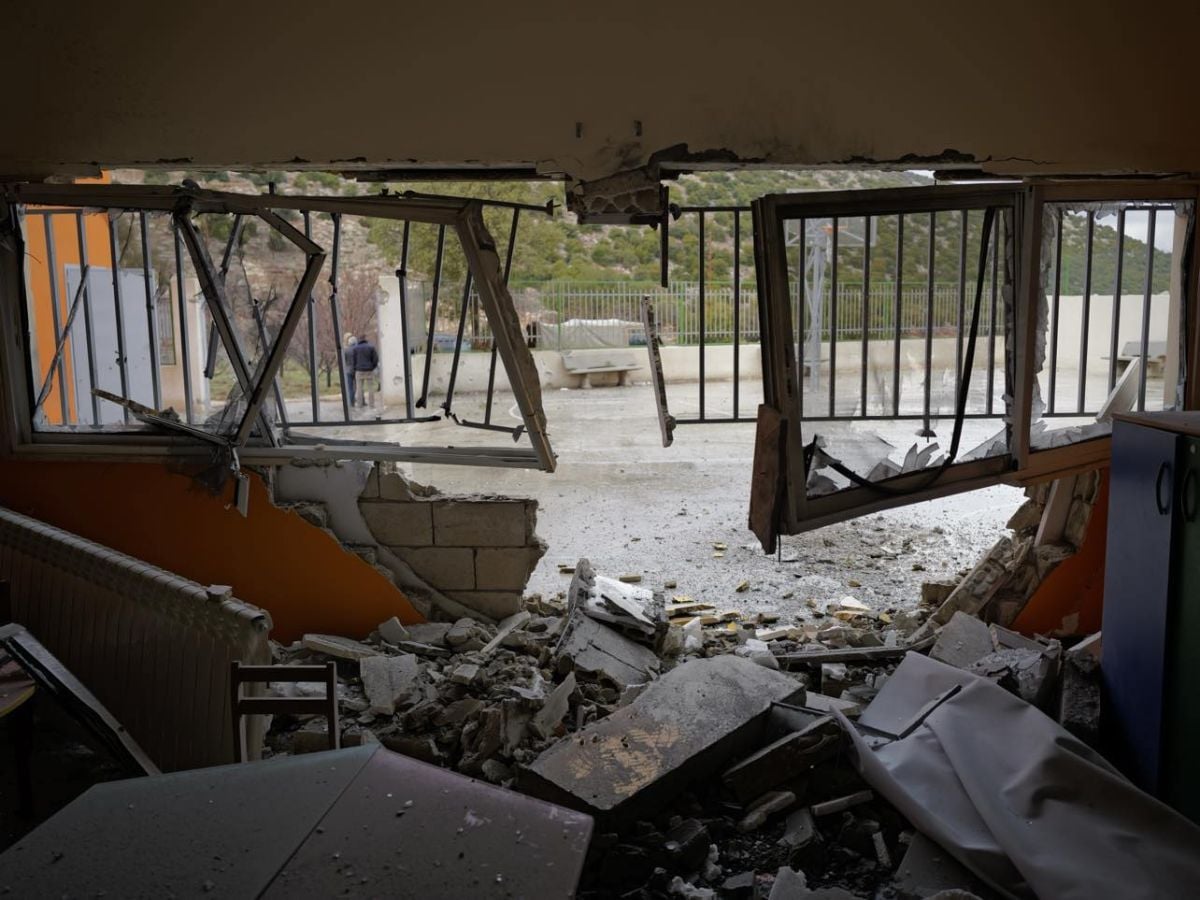
A school damaged by shellfire from Syria, in Qasr, Hermel, Lebanon, Feb. 13, 2025. (Credit: Matthieu Karam / L'Orient Today)






BEIRUT — Despite a recent decline in tensions along the Lebanese-Syrian border following deadly clashes in mid-March and early February, Syria’s newly deployed security forces briefly abducted four Lebanese-Syrian young men from the al-Radi family in Mashari’ al-Qaa, in the Bekaa, last Sunday.
According to local sources contacted by our correspondent in the Bekaa, the men were taken into Syria, interrogated for several hours over alleged smuggling activities, and later released.
While the incident underscores the ongoing risks of a border still unsecured by the Lebanese Army, it appears to differ in nature from the earlier clashes that had raised serious security concerns.

Lebanon and Syria share a 330-kilometer border, much of which remains undemarcated, contributing to ongoing security challenges for Syria’s new authorities and Lebanon’s recently elected president and government.
In mid-March, clashes erupted between Lebanese Shia clans — known for their involvement in smuggling and ties to Hezbollah — and forces affiliated with the new Syrian regime near the border, leaving at least 10 people dead on both sides. The violence began after four armed men linked to Syrian authorities attempted to infiltrate Lebanese territory near the border town of al-Qasr.
Later that month, Lebanon and Syria’s defense ministers met in Jeddah, Saudi Arabia, where they agreed on the need for enhanced security and military coordination along their shared border, including steps toward demarcation. On April 14, Lebanese Prime Minister Nawaf Salam visited Damascus, where he met with Syria’s new leader, Ahmad al-Sharaa, to discuss bilateral relations.
Mashari’ al-Qaa incident
The recent incident in Mashari’ al-Qaa differs from the March clashes. The four men abducted last Sunday are Sunni and reportedly not opposed to the new Syrian regime — unlike the pro-Hezbollah clans involved in March’s confrontations with forces that ousted former President Bashar al-Assad, who was backed by Hezbollah.
Despite these differences, the incident once again underscores that the border remains insecure, even with heightened Lebanese Army patrols and ongoing talks between Beirut and Damascus.
Describing the incident, the village mayor, Bashir Matar, told L’Orient Today on Thursday that Syrian authorities crossed into Lebanese territory, searched the al-Radi family’s homes — located about 7 km from town and only 20 to 30 meters from the border — and then took the men into Syria.
“Even if these houses were just five meters inside Lebanese territory, it’s still a violation of Lebanon’s sovereignty,” Matar said. “If people in Lebanon were involved in something illegal, the Syrian authorities should have coordinated with their Lebanese counterparts instead of crossing the border and abducting individuals.”
He acknowledged an increased Lebanese Army presence in recent days but said it remains inadequate. “We need a stronger army presence and the construction of high berms to prevent future incidents,” he added.
The Lebanese Army declined to comment when contacted by L’Orient Today.
Matar, who said he doesn’t know the exact reason for the abduction, believes smuggling could be a motive. A security source, also contacted by L’Orient Today, confirmed that the men were interrogated about alleged smuggling activities.
The Lebanese Army regularly conducts operations along the border to prevent illegal crossings and combat smuggling. At the end of March, Lebanese authorities recommended strengthening the army’s capacity to support its border mission.
Syrian forces have also ramped up their presence and established new checkpoints as part of joint efforts to control the frontier. While smuggling activity has declined, the border remains porous, especially in the north and east, where rugged and overlapping terrain allows smugglers to exploit gaps.
Risk of new clashes?
Retired Lebanese Army General Georges Nader told L’Orient Today that while Sunday’s abduction is unlikely to spark renewed clashes, sporadic incidents are expected to continue.
According to Nader, several factors contribute to such incidents, including the absence of a regular army, military discipline and a proper command structure on the Syrian side, as well as the fact that the borders remain undemarcated.
L’Orient Today attempted to contact a spokesperson for the Syrian authorities but received no response.
Still, Nader does not expect clashes to resume, especially since the outbreak was “contained last time,” and the Lebanese Army has since increased its presence at the border, with “500 special forces soldiers currently deployed.”
Aside from Sunday’s abduction, no major tensions have been reported. The Lebanese Army has deployed additional troops, intensified patrols, and continues to work to maintain stability in the area.
Reporting contributed by our correspondents in the Bekaa Sarah Abdallah and in the North Michel Hallak
