






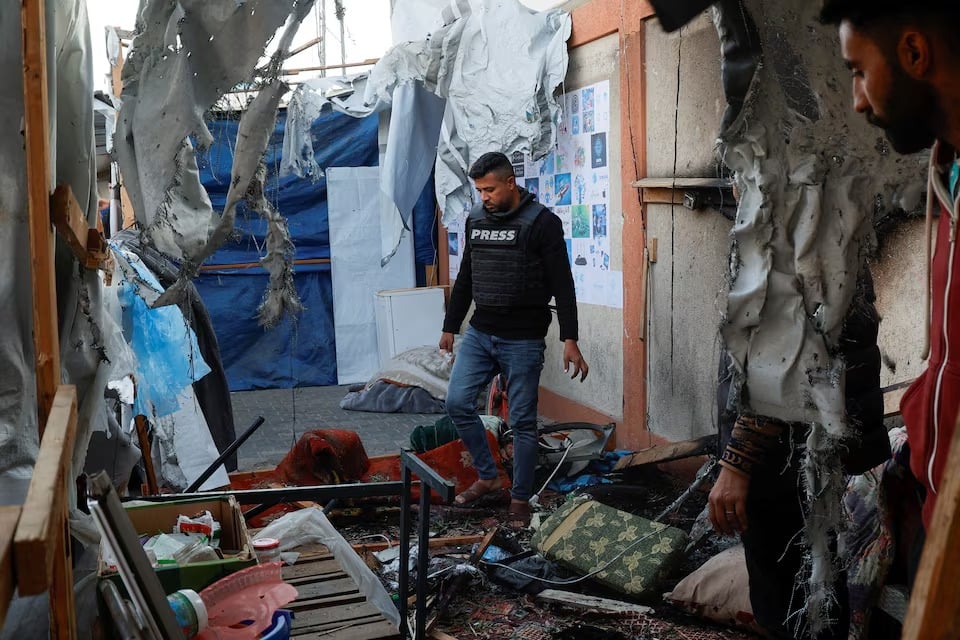
Palestinians inspect the damage to a tent housing journalists after it was hit by an Israeli strike, according to Palestinian Civil Defense, in Khan Younis, southern Gaza Strip, April 7, 2025. (Credit: Hatem Khaled/Reuters)






A statement released on Monday by Gazan journalists Hind Khoudary, Mezher Jeebat, and Ahmed Bassiouni, criticizing the ethics of reporting during the ongoing war, has sparked significant controversy.
The statement, which was later removed, condemned the "sensationalization of martyrs' images and the violation of families' privacy," accusing some journalists of "prioritizing social media engagement over human dignity."
The three journalists published a joint statement on social media, saying, "The recent aggression on the Gaza Strip has turned into a journalistic scoop that has gone beyond our Palestinian narrative. Pictures of martyrs are not a journalistic scoop!"
"Palestinians in the Gaza Strip disrupted attempts by civil defense and medical crews to evacuate the wounded and transport the bodies of the martyrs from the targeted areas to ambulances. This was all done in order to take photos and record videos as a journalistic scoop or to publish them on social media. This is a real problem that Gazans must recognize and allow medical crews to do, because our blood is not just algorithms," the statement said.
The statement was published shortly after Israel targeted a journalists' tent in southern Gaza. A Palestinian journalist was killed on Monday, and nine others were wounded, some critically, when an Israeli airstrike hit a tent used by local media in Khan Younis, within the Nasser Hospital medical complex, according to medics and the local journalists' union.
Images showing a journalist, Ahmad Mansour, engulfed in flames, and another person attempting to rescue him, were widely shared.
"Many journalists violated the principle of human dignity by conducting video interviews that conveyed the feelings and reactions of the victim's families in a moment of human weakness. Questions were posed whose answers went beyond news value and should, of course, leave the families to cry over their wounds until they regain their ability to speak to journalists, if necessary," the statement said.
'Whoever has a missile fall next to them loses control'
Amid the war in Gaza, the roles of citizen journalists and professional journalists have become increasingly blurred.
Citizen journalists, often ordinary residents or social media users, have been capturing and sharing images, videos, and firsthand accounts of the violence and destruction, bypassing traditional media channels.
While their reports are documenting events in real time, they may at times lack the editorial oversight and fact-checking typical of professional journalists, who are trained to follow ethical guidelines and ensure accuracy.
Controversy spread among journalists and citizens after the publishing of this statement, which was later removed. Some accused the statement of being "harsh."
In a separate statement, Gazan journalist Hani Abu Rezk said Monday, "The event has happened and is over, and it is right to learn from mistakes. There are wrong actions, this is true. On the other hand, there is courage from several colleagues in extinguishing the fire and saving lives.Whoever has a missile fall next to them loses control and their mind and no longer knows how to act."
"In the end, we are in a war of extermination, and it is not the fault of one or two people who want to spoil the entire situation. Let's focus on the crime and expose the occupation and its actions against our colleagues," Abu Rezk concluded.
