






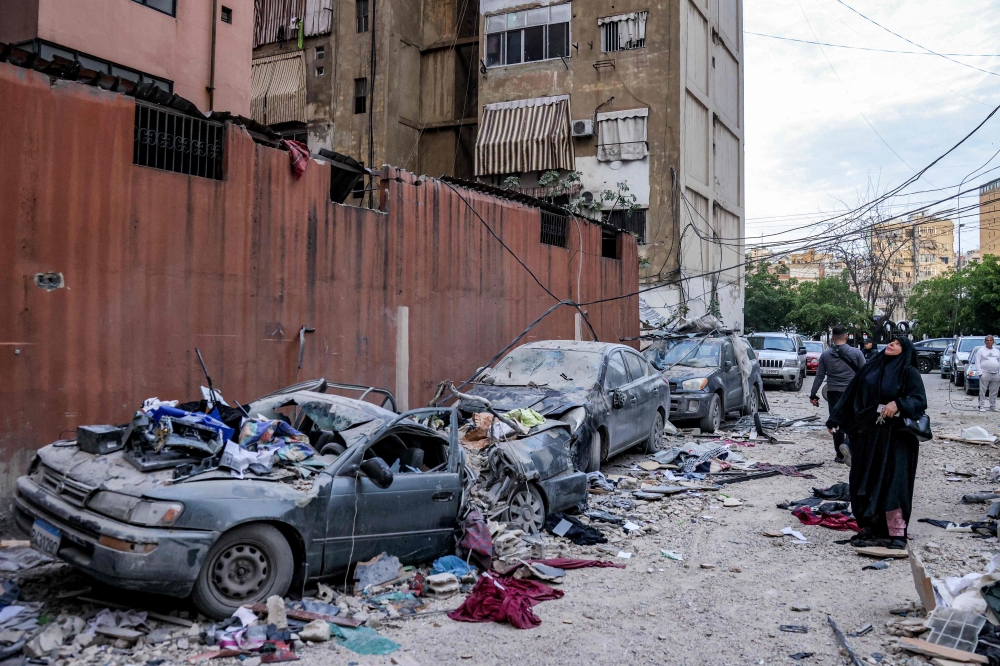
Passersby come to assess the damage after the Israeli nighttime strike that targeted the top floors of a building in the southern suburbs of Beirut, on April 1, 2025. (Credit: Ibrahim Amro/AFP.)






BEIRUT - An Israeli airstrike carried out without warning on a residential building in the southern suburbs of Beirut on the night of Monday to Tuesday has been swiftly condemned by Lebanese officials, including the President Joseph Aoun and the Grand Serail, with further reactions coming from various political figures.
The attack resulted in at least four deaths, including Hassan Bdeir, a Hezbollah official responsible for Palestinian affairs, and seven other injuries.
While Hezbollah has not officially confirmed his death, a source close to the group told AFP under anonymity that the strike "targeted Hassan Bdeir, the head of Palestinian affairs within Hezbollah," who was reportedly at home with his family.
The U.S. State Department justified the strike in a letter cited by Reuters, linking it to rocket fire from Lebanon last Friday. Hezbollah's Secretary-General, Naim Qassem, had warned on Saturday that if Lebanon failed to achieve diplomatic results regarding Israeli violations, "other options" would be considered. Following the attack, Israeli Foreign Minister Gideon Saar called on Lebanon to "take measures to root out terrorist organizations operating from its territory against Israel."
Aoun, Salam and Berry
President Joseph Aoun was the first to condemn the Israeli raid, calling it a "dangerous warning revealing Israeli intentions" against Lebanon. "The Israeli aggression obliges us to double our efforts to engage Lebanon's friends worldwide and mobilize them in favor of our right to full sovereignty over our territory," he said on X.
He stressed the need "to prevent any violation of sovereignty by those who provide additional pretexts for aggression." "We will work with the government and the Prime Minister to thwart any attempt to ruin an exceptional opportunity to save Lebanon," he added.
Prime Minister Nawaf Salam echoed the condemnation, stating in a morning statement that the Israeli airstrike on the southern suburbs of Beirut was a "blatant violation of United Nations Resolution 1701 affirming Lebanon's sovereignty and integrity." He called the attack "a clear violation of the ceasefire agreement reached last November."
Parliament Speaker Nabih Berri, argued that through its attack, Israel was attempting "by fire, blood, and destruction, to assassinate U.N. Resolution 1701 and dismantle its enforcement mechanism." He added that the attack was "a direct assault on the efforts of Lebanese military, security, and judicial forces.
Which had made significant progress in uncovering the circumstances of recent suspicious incidents in the South, bearing Israel’s fingerprints in their timing, objectives, and methods." Berri's remarks referred to recent arrests by the army and General Security as part of investigations into the perpetrators of last Friday's rocket attacks.
International reactions Jeanine Hennis-Plasschaert, the UN Special Coordinator for Lebanon, also reacted, stating: "A new escalation is the last thing anyone needs." She emphasized that "the only viable path" is the implementation of Resolution 1701.
Lebanese Forces, Hezbollah and Amal
Reactions from Hezbollah, Amal, and other political figures such as Richard Kouyoumjian, Lebanon’s new Social Affairs Minister and a member of the Lebanese Forces, a Christian party opposed to Hezbollah, condemned the airstrike and criticized Hezbollah without directly naming the group. He condemned those who claim to have "nothing left to lose" and view the weapons of resistance as "sacred" and more important than "Lebanon and the region," arguing that they prioritize "a militia" over supporting the state.
Several Hezbollah MPs also responded, including Ibrahim Moussaoui, who visited the strike site. "If reports of a resistance fighter being in the targeted apartments are true, international law and the Geneva Convention prohibit killing people outside the front," he said.
"What happened has moved us to a completely different stage, and we hold the international community, the U.S., and the West responsible for this crime," he added, criticizing "irresponsible" statements from some deputies and claiming that some ministers "encourage the enemy to persist in its aggression."
He also recorded 1,500 Israeli violations, resulting in "dozens of deaths and hundreds of injuries since the beginning of the truce."
Hezbollah MP Ali Ammar stated that Israeli airstrikes "harm the reputation of so-called international community institutions." He added, "Hezbollah does not want war, but if it is imposed, we are ready to deter any aggression," assuring that the group was "ready" and had "regained its full strength" on the political, material, security, and field fronts. "Our patience has limits, and it is up to the resistance to choose the right moment" to respond.
Hezbollah MP Hussein Hajj Hassan called the Israeli attack "dangerous and barbaric," alleging that it was "covered by the U.S." during an interview with Russian radio Sputnik. He also criticized the U.S.-led technical committee monitoring the cease-fire, which includes the Lebanese army, the Israeli army, UNIFIL, and France, for "failing to fulfill its mission of stopping Israeli aggression."
Kassem Hachem, a deputy from the Hezbollah-allied Amal movement, commented that the attack confirmed that Lebanon was "in the crosshairs of the Zionist expansionist project" and questioned whether silence was "the best way to confront these challenges."
The Syrian Social Nationalist Party considered the strike "evidence of the failure of the ceasefire to protect Lebanon from the barbarity of the Israeli enemy." The party called for Lebanese unity, asserting that "resistance remains the only way to deter the enemy."
The Palestinian Islamic Jihad also condemned the strike, calling it an "aggression" aimed at exploiting rising security tensions to "reshape the situation" in Israel's favor and "impose its conditions on the Lebanese people."
Ahmad Kabalan, the Jaafari Mufti, close to Hezbollah, labeled Tuesday’s attack as "terrorist" and urged Lebanese unity around sovereignty, asserting that "Tel Aviv treats Lebanon as a fragmented front and a nation without identity, which is the root of the crisis affecting the country deeply."
Siniora, Wakim and Khazen
Former Prime Minister Fouad Siniora condemned the Israeli strike on the southern suburbs of Beirut, urging the international community, including the U.S. and France, to apply pressure on Israel to halt its aggression and withdraw from Lebanese territory. "The most dangerous aspect of this attack is that it is based on supposed and invented intentions, not on facts, which is why we must put an end to this unacceptable arrogance," he stated.
Former Beirut MP Najah Wakim, a Nasserist leader close to Hezbollah, urged the Lebanese state to mobilize its full deterrence force in response to Israeli aggression, rather than trying to weaken Hezbollah. "The policy of weakness and vulnerability will not succeed in discouraging the enemy, nor will it attract U.S. sympathy," he emphasized.
Former Minister and Dean of the Maronite General Council, Wadih al-Khazen, also condemned the attack in the strongest terms, calling it "a brutal aggression that threatens Lebanon's security and stability and endangers the lives of civilians," and urged the international community to adopt a "firm" stance against Israel.
