






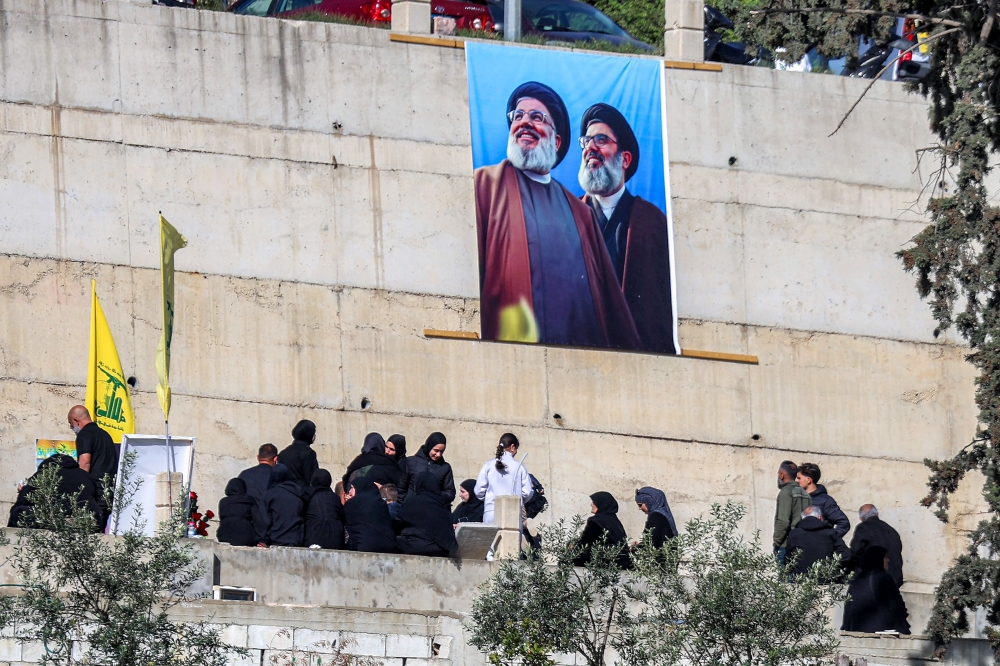
A banner is hanging along a wall displaying the image of former Hezbollah leaders Hassan Nasrallah (left) and his successor Hachem Safieddine, above mourners visiting the graves of those killed in the conflict with Israel in the village of Kfar Kila in southern Lebanon, on March 31, 2025. (Credit: Rabih Daher/AFP)






A fragile calm has prevailed since Israel’s strike on Beirut’s southern suburbs Friday, but the Israeli army has begun strengthening its position at Jabal Blat, near Ramieh in the Bint Jbeil district.
Jabal Blat is one of five positions the Israeli military still occupies, despite an expected full withdrawal by Feb. 18 from all areas it invaded in southern Lebanon during its war against Hezbollah. A cease-fire has been in effect since Nov. 27, 2024.
On Monday, the state-run National News Agency (NNA) reported that the Israeli army had fortified the site with a concrete wall, built earth barricades using bulldozers, and installed posts equipped with cameras and other surveillance systems. The agency also reported that these modifications had cut off a road linking the districts of Sour and Bint Jbeil.
Ali Merhi, the mayor of Ramieh, told L’Orient Today’s southern correspondent that the work took place on Friday and that the road between Ramieh and Marwahin had already been cut off during the war. He clarified that all the fortifications remained within the site’s limits. Merhi said he was in contact with Lebanese Army officials about the Israeli fortifications, which are expected to be discussed with Morgan Ortagus, the U.S. deputy special envoy to the Middle East, who is due in Lebanon soon.
Few incidents reported
No armed group in Lebanon has claimed responsibility for Friday’s strike on Israel, and Hezbollah has denied involvement. The Lebanese Army and General Security said they had arrested suspects in recent days.
Meanwhile, local news site Janoubia reported that Lebanese Army and U.N. peacekeeping forces had entered Hezbollah sites in Zawtar Sharqieh, in the Nabatieh district, along the Litani River. The area is described as one of Hezbollah’s largest weapons storage and manufacturing sites. According to sources cited by Janoubia, the site was targeted by at least 200 Israeli airstrikes during the war.
When contacted Monday by L’Orient Today, U.N. Interim Force in Lebanon (UNIFIL) spokesman Andrea Tenenti said he had no information on the report. The Lebanese Army did not respond to requests for comment.

Apart from Israeli drone overflights in several southern villages and reports of Israeli fighter jets flying over the Bekaa Valley, only a few security incidents have been reported. According to L’Orient Today’s correspondent, Israeli troops fired toward Rmeish, in the Bint Jbeil district, and an Israeli drone dropped a stun grenade near the separation wall between Yarin and Dhaira, in the Sour district. No injuries or damage were reported.
Following Israel’s strike on Beirut’s southern suburbs — the first since the cease-fire began — Hezbollah Secretary-General Naim Qassem warned Saturday that if the Lebanese government fails to achieve political results regarding Israeli violations, "other options" will be considered.
French President Emmanuel Macron urged Israeli Prime Minister Benjamin Netanyahu on Sunday to respect the cease-fire in Lebanon.
Since Sunday, many residents of southern Lebanon have been marking Eid al-Fitr, the holiday that ends the Muslim holy month of Ramadan, by honoring their dead.
