






A Syrian flag and a portrait of Syrian President Bashar al-Assad torn by anti-government militiamen in Aleppo, northern Syria, on Nov. 30, 2024. (Credit: Omar Haj Kadour/AFP)






Close to midnight on March 6, as a wave of sectarian killings swept western Syria, masked gunmen stormed the homes of Alawite families in Damascus and detained more than two dozen unarmed men, witnesses said.
Those taken from the al-Qadam neighborhood included a retired teacher, an engineering student, and a mechanic, all members of the Alawite minority, to which ousted leader Bashar al-Assad belonged.
Earlier that day, Alawite loyalists of Assad had launched an insurgency in coastal areas, about 200 miles (320 kilometers) to the northwest, triggering a wave of retaliatory killings that left hundreds of Alawites dead.
Syria’s interim president, Ahmad al-Sharaa, told Reuters he had sent forces to halt the coastal violence the following day. However, some fighters who flooded the area to suppress the uprising did so without authorization from the Defense Ministry, he said.
Amid fears of broader sectarian conflict, Sharaa’s government downplayed the violence as geographically limited and announced a fact-finding committee to investigate "the events on the coast."
But accounts from 13 witnesses suggest that sectarian violence also spread to the southern outskirts of Damascus, just miles from the presidential palace. The details of the alleged raids, kidnappings, and killings have not previously been reported.
"Any Alawite home, they knocked the door down and took the men inside," said one resident, whose relative, 48-year-old telecom engineer Ihsan Zeidan, was taken in the early hours of March 7.
"They took him solely because he’s Alawite."
All the witnesses who spoke to Reuters requested anonymity, fearing reprisals.
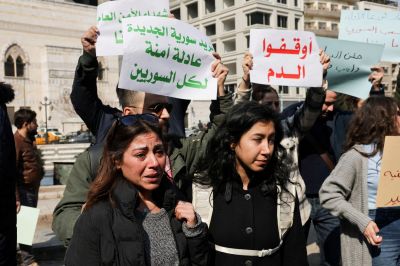
Disappearances and executions
Al-Qadam is known to have a significant Alawite population. Witnesses said at least 25 men were taken in the raids. At least 12 were later confirmed dead, according to relatives and neighbors who either saw photos of their bodies or found them nearby. The rest remain missing.
Four witnesses said some of the armed men identified themselves as members of the General Security Service (GSS), a new Syrian agency composed of former rebels.
A spokesperson for the Interior Ministry, which oversees the GSS, denied targeting Alawites. "Security forces are confiscating weapons from all sects," the spokesperson told Reuters but did not respond to further questions, including why unarmed men were allegedly taken.
Yasser Farhan, spokesperson for the government’s fact-finding committee, said its investigation was focused on coastal areas and had not covered cases in al-Qadam. "There may be deliberations within the committee at a later time to expand our work," he said.
Alawites make up about 10 percent of Syria’s population, primarily concentrated in Latakia and Tartous. However, thousands have lived for decades in Damascus and in provincial cities such as Homs and Hama.
Human Rights Watch researcher Hiba Zayadin called for a thorough investigation into the alleged raids.
"Families deserve answers, and the authorities must ensure that those responsible are held accountable, no matter their affiliation," she said. "Until that happens, the cycle of violence and impunity will continue."
Four of the men confirmed dead were from the same extended family, according to a relative who survived by hiding with young children on an upper floor.
They were identified as Mohsen Mahmoud Badran, 77; Fadi Mohsen Badran, 41; Ayham Hussein Badran, 40, who had a birth defect that disqualified him from military service; and their brother-in-law, Firas Mohammad Maarouf, 45.
Relatives who searched for their bodies at Mujtahid Hospital in central Damascus were denied access to the morgue and referred to the GSS station in al-Qadam, the witness said. There, an official showed them photos of the four men’s bodies but did not provide a cause of death.
The official instructed the family to collect the bodies from Mujtahid Hospital, but staff there denied having them.
"We haven’t been able to find them, and we’re too scared to ask anyone," the relative told Reuters.
Hospital director Mohammad Halbouni told Reuters that any bodies from al-Qadam would have been sent to the forensic medicine department next door. Officials there declined to comment.
The Interior Ministry spokesperson did not respond to questions about whether forces stationed in al-Qadam were linked to the deaths.
'All I want is to leave'
Sharaa has announced the dissolution of all rebel factions and their planned integration into Syria’s restructured Defense Ministry. However, full control over the various, sometimes rival, groups remains elusive.
Four other men taken the same night were later found shot dead in an orchard near al-Qadam, executed "at close range," according to a second resident. The family buried them quickly. Reuters was unable to verify the details of her account independently.
Another set of four men were confirmed dead by relatives who received photos of their bodies via WhatsApp nearly three weeks after they were taken. The images, reviewed by Reuters, showed the men lying on the ground with blood and bruises on their faces. One was identified as Samer Asaad, 45, who had a mental disability and was taken on March 6.
Most of those seized remain missing, including 25-year-old university student Ali Rustom and his father, 65-year-old retired math teacher Tamim Rustom, according to two relatives.
"We have no proof, no bodies, no information," one relative said.
Rabih Aqel, a mechanic, is also missing. His family inquired at local police stations and security agencies but was told they had no information.
A relative compared the disappearances to those under Assad’s rule, when thousands vanished into a vast prison system. Families often learned years later that their relatives had died in detention.
She and other witnesses said they had not been approached by the fact-finding committee.
Farhan, the committee spokesperson, said investigators had interviewed witnesses in several coastal districts and still had two more cities to visit.
Many Alawites in al-Qadam say they now feel pressure to leave. Some already have.
One young resident said armed men visited his home multiple times after Assad’s fall, demanding proof of ownership and that the family had no ties to the former regime. He and his family have since fled, leaving their home in the care of Sunni neighbors.
Others have stopped going to work or only move around during the day to avoid arrest.
A woman in her sixties said she was trying to sell her house to protect her husband and sons.
"After what happened, all I want is to leave."

