






Interim Syrian President Ahmad al-Sharaa speaking in Damascus on March 29, 2025. (Credit: Syrian Presidency / AFP)






Interim Syrian President Ahmad al-Sharaa announced on Saturday evening the formation of a new government without a Prime Minister, in which his loyalists occupy key positions, but which is intended to be inclusive and includes a woman.
In a speech during the ceremony announcing the government, Ahmad al-Sharaa, who assumed power at the head of an Islamist coalition on Dec. 8, expressed his desire to "build a strong and stable state." He emphasized that "this government will strive to open new horizons in education and health," with a focus on preserving and developing human resources and attracting Syrian talents from abroad.
He confirmed the government's efforts to "reform the energy sector, support farmers to ensure food security, and work on rehabilitating the industry while protecting domestic products."
Additionally, he highlighted the goal of building a professional national army, which sacrifices dearly for Syria’s sovereignty and security, and maintaining stable foreign relations to safeguard Syria’s and its friends’ enduring interests.
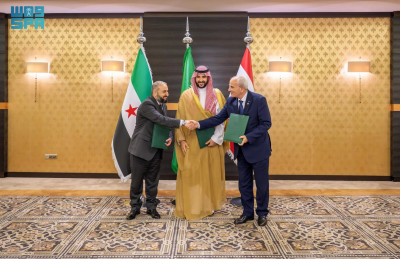
The 23 ministers took an oath in front of Sharaa during a ceremony at the presidential palace, broadcast on television. The Ministers of Foreign Affairs, Assaad al-Shibani, and Defense, Mourhaf Abou Qasra, both loyal to the interim president, retain their positions in the government. The head of General Intelligence, Anas Khattab, also close to Sharaa, is appointed Minister of the Interior.
The government is more inclusive than the interim government that had been managing affairs since the fall of Bashar al-Assad and was led by Mohammad al-Bachir, who becomes Minister of Energy.
Hind Kabawat, a Christian woman, is appointed Minister of Social Affairs and Labor. The government also includes at least one Druze minister, one Kurdish minister, and one Alawite minister.
The new Syrian government also includes the following ministers:
- Mazhar al-Wais – Minister of Justice
- Mohammad Abu Khair Shukri – Minister of Religious Endowments
- Marwan al-Halabi – Minister of Higher Education
- Mohammad Yasser Braniya – Minister of Finance
- Nidal al-Sha’ar – Minister of Economy
- Musab Nazzal al-Ali – Minister of Health
- Mohammad Anjarani – Minister of Local Administration and Environment
- Abdul Salam Heikal – Minister of Communications and Information Technology
- Amjad Badr – Minister of Agriculture
- Mohammad Abdul-Rahman Turko – Minister of Education
- Mustafa Abdul-Razzaq – Minister of Public Works and Housing
- Mohammad Saleh – Minister of Culture
- Mohammad Samih Hamid – Minister of Sports and Youth
- Mazzen al-Salhani – Minister of Tourism
- Mohammad Skaf – Minister of Administrative Development
- Yarab Badr – Minister of Transport
- Hamza Mustafa – Minister of Media
A post for the White Helmets
Raed el-Saleh, head of the White Helmets — the Syrian rescue workers who operated in rebel-held areas — has been appointed Minister of Emergency Situations and Disasters.
This announcement, initially scheduled for March 1, comes as the international community continues to push for an inclusive Syrian transition. It also follows sectarian massacres in early March that targeted Alawites in the western part of the country, where this minority, including the ousted president Bashar al-Assad, is concentrated.
During the ceremony, the president emphasized, "In this difficult phase, we will intensify our efforts to confront any challenges our people may face. To this end, we have established the Ministry of Emergency and Disaster Management to address any crises, whether natural or humanitarian. We are committed to building a rapid and effective response system that ensures the protection of citizens and provides immediate relief."
Turkey has welcomed the formation of a transitional government in Syria, the Turkish Ministry of Foreign Affairs said on Sunday, adding that this decision was a sign that the new leaders of Syria have an inclusive approach to governing the country, according to Reuters.
The ministry stated in a statement that the international community must redouble efforts to support Syria, particularly by fully lifting sanctions so that reconstruction can begin. It added that Turkey, one of the main intermediaries for the Syrian government after the fall of former President Bashar al-Assad by rebels, would continue to support the "comprehensive and inclusive" transitional period.
The new authorities are seeking to reunify and rebuild Syria, which has been devastated by over 13 years of civil war.
Proclaimed interim president in January, Sharaa is tasked with managing the five-year transitional period following nearly 14 years of civil war. Only after this period will elections be held based on a new Constitution.
In the meantime, the constitutional declaration grants him full powers in the formation of the legislative, executive and judicial branches, although it claims to respect the separation of powers.
According to Human Rights Watch, this constitutional declaration "gives the president significant powers, particularly in judicial and legislative appointments, without any oversight or supervision."
