






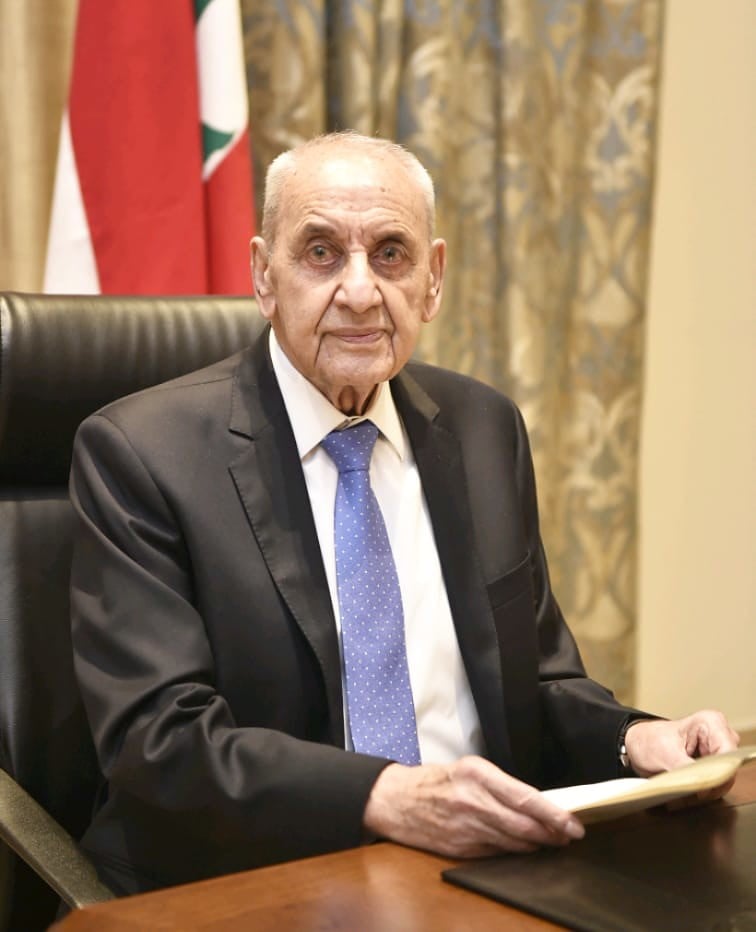
The President of the Lebanese Parliament, Nabih Berri, in Ain al-Tineh, March 16, 2025. (Credit: Hassan Ibrahim/Lebanese Parliament)






Parliament Speaker Nabih Berri called for a meeting of the joint commissions on Monday, March 24, to examine several proposed laws, particularly regarding the upcoming legislative elections scheduled for spring 2026.
The Finance and Budget, Administration and Justice, National Defense, Interior and Municipalities, Public Health, Labor and Social Affairs, National Economy, Trade, Industry and Planning, and Information Technology committees have been called.
The press release from Berri’s office specifies that two laws related to the Lebanese Red Cross, one concerning its protection, will be on the agenda. Another aims to establish a mandatory system of universal primary health care, and a fourth related to technological industries. The last two proposed laws concern the legislative elections and the creation of a Senate. The latter is normally provided for in the Taif Agreement (1989), which ended the Civil War (1975-1990) in Lebanon.
Lebanon as a single constituency
Acoording to local channel MTV, the proposed law concerning the legislative elections was presented by Amal Movement MP Ali Hassan Khalil, close to Berri. The law calls for the addition of six MPs to the current 128 to represent the diaspora. The voting would be conducted according to a proportional voting system, as is currently the case, but in which Lebanon would represent a single constituency. The current electoral law, adopted in 2017, divides Lebanon into 15 electoral districts, where each voter votes for an open list of candidates, with the possibility of using a single preferential vote within the chosen list.
The second law proposes the election of a 46-member Senate, elected for six years, on a confessional basis.
Berri's move is expected to reignite the debate on the electoral law that he had pushed for seven years ago.
After being reviewed by the joint commissions, the proposed laws that are approved are sent to the plenary assembly to be voted on by all MPs. Those that still require amendments can be sent back to the commissions.
