






Israel's cease-fire and hostage release negotiating team is expected to return from talks in Egypt on Friday, according to Haaretz.
Talks are set to continue from Saturday from afar.
Occupied-West Bank
Israeli forces have targeted one of the Palestine Red Crescent Society’s crews with warning shots in the Nur Shams refugee camp just east of Tulkarem city.
“The targeting occurred despite prior coordination as the occupation forces prevented the crew from entering the area to evacuate [a] family,” the charity said.
UNICEF stated that “reports of infants dying of hypothermia in Gaza are devastating and shouldn’t be happening in our modern days.”
In a statement published on X, UNICEF announced that the agency and its partners are distributing winter clothes to children in Gaza to help them protect themselves from the cold, but the needs in the Palestinian enclave are “immense.”
“What children need now is a sustained cease-fire and continued unimpeded access to aid,” it said.
Hussein Sheikh, secretary-general to the Palestinian Liberation Organization's executive committee, met Saudi Foreign Minister Prince Faisal bin Farhan in Riyadh to discuss preparations for the upcoming Arab summit, scheduled to be held in Cairo next week.
In a statement, Sheikh praised Saudi Arabia’s “continued support for Palestinian rights, particularly its efforts to ensure the establishment of an independent Palestinian state with East Jerusalem as its capital.”
Ahead of the holy month of Ramadan, which is set to begin Saturday evening, Hamas called on Palestinians to "come to the al-Aqsa Mosque in large numbers," according to Haaretz.
The Palestinian movement also called on worshipers to "remain at al-Aqsa throughout the month and defy the restrictions" imposed by the Israeli government.
According to several Israeli media outlets, these measures are aimed in particular at preventing Palestinian prisoners recently released as part of the ongoing hostage exchange deal in Gaza from accessing the site, while a large security force, including some 3,000 police officers, will be deployed at checkpoints leading to the al-Aqsa Mosque.
"There will be no release of hostages until Israel agrees to end the war," Hamas sources warned Haaretz.
The six-week extension requested by Tel Aviv for the first phase of the cease-fire agreement "does not benefit" the Palestinian movement, according to these sources, who indicate that the hostages constitute the "major asset" of the organization and that they will not be released in their entirety until Israel has adopted a "clear position on the end of the war."
Separately, two Israeli government officials told Reuters that the delegation in Cairo had proposed the release of three hostages each week in exchange for Palestinian detainees by Israel, similar to the modus operandi adopted during the first phase.
Other forms of compromise are reportedly under discussion, such as exchanging sick or dead hostages for further releases of Palestinian prisoners, or increasing the flow of aid and goods to the Gaza Strip, including heavy equipment to facilitate the reconstruction of the enclave, Haaretz adds.
Germany expressed concern over the Israeli army's operation in three Palestinian refugee camps in the northern occupied West Bank, calling for "better protection of civilians" and "guaranteeing the return as soon as possible" of the residents.
"We call on the Israeli government to better protect civilians and civilian infrastructure during the military operation and to guarantee the return of the 40,000 people to their homes as soon as possible," the Foreign Ministry wrote in a statement, which also deemed "unacceptable" the plan to keep the Israeli army "in the long term" in the Jenin camp.
The large-scale military operation launched in mid-January in the occupied West Bank, dubbed the "Iron Wall," has resulted in the deaths of at least 62 Palestinians and the displacement of around 40,000 people from the Jenin, Tulkarm and Nur Shams camps in the span of a month.
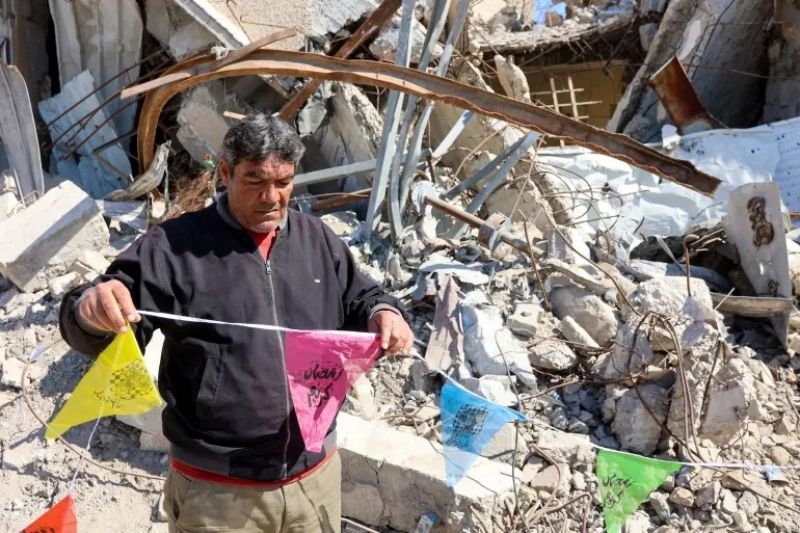
(Credit: Omar al-Qattaa/AFP)
In Gaza City, a man prepares colorful flags in front of rubble as the month of Ramadan approaches.
Hamas official Taher al-Nounou told Qatari news channel Al Araby TV that Israel's policy does not allow for extending the first phase of the cease-fire agreement, following reports of Israeli requests for an extension.
"Israel's disruption of the second phase of the agreement does not allow for the extension of the first phase. We are committed to the cease-fire agreement and it is now up to the mediators to force the occupation to implement it," he said.
Two Egyptian security sources said the Israeli delegation in Cairo was trying to reach an agreement to extend the first phase of the Gaza cease-fire deal by another six weeks, or 42 days, according to Reuters.
Hamas did not agree with the extension plan and instead wants to start the second phase as agreed, the same sources added to Reuters.
Hamas said in a statement "its full commitment to implementing all the provisions of the truce agreement, in all its phases and in all its details, " as the first phase of the cease-fire and prisoner exchange agreement has come to an end and negotiations for the implementation of the second are currently underway in Cairo.
"We call on the international community to put pressure on the Zionist occupation to fully commit to its role in the agreement and to immediately enter the second phase of the agreement, without delay or procrastination," the statement continued.
Israeli drones continue to fly over several regions of south Lebanon, including Saida and the city's Palestinian refugee camps, according to L'Orient Today's correspondent.
Around 50 Palestinian patients were able to leave the Gaza Strip via the Rafah crossing point in the south of the enclave to receive treatment in foreign hospitals, Al Jazeera reports.
"After making all necessary arrangements, the evacuation convoy departed from the European Hospital in Khan Younis. Palestinian Red Crescent ambulances are participating in the evacuation process and will help transport difficult cases, especially amputees injured during Israel's war on Gaza and cancer patients," said local correspondents of the Qatari media outlet, who reported that Israel continues to prevent the entry of "heavy equipment and mobile homes" that have been accumulating on the Egyptian side of the Rafah crossing for about two weeks.
Under the terms of the ceasefire between Israel and Hamas, 150 patients were to be allowed to cross the crossing each day, with three people accompanying each patient. However, Israel has delayed the departure of many patients, according to the Palestinian Health Ministry.
The Israeli army fired machine guns at a border area between Mais al-Jabal and Blida (Marjayoun), according to L'Orient Today's correspondent in the south.
According to Al Jazeera, a young Palestinian man was killed this morning by an Israeli drone strike in the center of the city of Rafah, in the southern Gaza Strip. The Wafa news agency, citing local sources, specifies that the victim is named Raad Nidal al-Amwassi, aged 18.
The Palestinian news agency added that two fishermen were injured after Israeli vessels opened fire on them while they were fishing off the coast of Gaza City.
The Israeli army claimed this morning to have killed a member of Hezbollah, Mohammad Mahdi Ali Shahine, in a strike carried out the day before on Hermel.
Shahine was, according to the Israeli army, "involved in arms smuggling with Syria." He was allegedly "involved in transactions ... for the purchase of arms on the Syrian-Lebanese border since the entry into force of the agreements between Israel and Lebanon," according to a statement on X from the Arabic-language spokesperson for the Israeli army, Avichay Adraee, who said that the Hezbollah member was also "one of the main members of the Hezbollah unit responsible for the Bekaa region in Lebanon."
After flying over the Bekaa Valley at a medium altitude, an Israeli drone fired two missiles on a pick-up truck on a secondary road near the Red Crescent in Hermel on Thursday, then a third missile when people began to gather, according to information from L'Orient Today's correspondent in the region. According to an initial report from the Ministry of Health, the strike left one dead and one injured. According to L'Orient Today's correspondent, the death toll is two.
The Lebanese Civil Defense announced that it had found the bodies of two people on Thursday in Khiam (Marjayoun), in the Jalahiya and Wadi Qais neighborhoods.
The remains were transferred to the Marjayoun government hospital, according to a statement from the organization. They will undergo necessary forensic examinations, including DNA tests, added the Civil Defense, which said that it will continue its search operations in the areas devastated by the Israeli bombardments in coordination with the Lebanese army "until the search for all missing persons is completed."
According to L'Orient Today's correspondents, Israeli warplanes and drones flew over several regions of south Lebanon, including those of Sour and Nabatieh this morning, while Prime Minister Nawaf Salam is currently visiting Lebanese army barracks in south Lebanon.
Israeli jets also flew low over the Bekaa, particularly over Baalbeck and Hermel, the day after a strike that left at least one dead and two injured in the town of Hermel, according to the Health Ministry.
Good morning!
Thank you for joining us for our live coverage.
Be sure to read the Morning Brief so you are caught up with what has been happening.
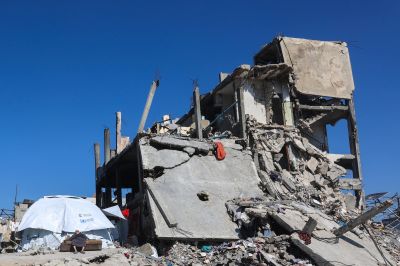
Shots were fired this morning in the vicinity of Aitaroun (Bint Jbeil) where the bodies of dozens of people from the village who were killed or died during the 13-month war between Hezbollah and Israel are to be buried. Aitaroun was among the villages still occupied by the Israeli army even after the cease-fire came into effect on Nov. 27, 2024.
According to L'Orient Today's correspondent in the south, the coffins of the deceased from Aitaroun were transported on four trucks. They were wrapped in Hezbollah or Lebanese flags. The passage of this convoy in some villages was greeted with throwing of rice and flowers.
The bodies of the Aitaroun residents killed during the war had been buried according to the principle of "wadi'a," a temporary burial, due to the inaccessibility of the village. 23 of them were exhumed from North Lebanon, where many people from Aitaroun had been killed in the Israeli strike on Aito, near Zgharta.
Prime Minister Nawaf Salam is on a tour of south Lebanon today, where he is expected at the Lebanese army barracks in Sour and Marjayoun, as well as in Khiam.
Israeli, Qatari and American negotiators are continuing "intensive discussions" in Cairo on the second phase of the cease-fire in the Gaza Strip, which is due to begin on Sunday and provides for a definitive end to the war, but whose entry into force remains uncertain. "The parties concerned have started intensive discussions to examine the next steps of the truce agreement," the Egyptian government said yesterday Thursday.
Israel sent its negotiators to Cairo after Hamas handed over the bodies of four hostages in exchange for the release of 643 Palestinian prisoners, the latest exchange under the first phase of a truce deal between Israel and the Islamist movement Hamas.
Following yesterday's exchange, Hamas said Israel now had "no choice" but to begin negotiations on the continuation of the cease-fire, which had been blocked so far by mutual accusations of violating the truce. On Feb. 22, Israel suspended the release of some 600 prisoners then scheduled in exchange for the return of six hostages, demanding that Hamas renounce holding "humiliating ceremonies" for each release.
Hamas said last week that it was ready to hand over to Israel all the hostages remaining in Gaza "in one go" during the second phase. But this second phase promises to be delicate. Israel demands that Gaza be completely demilitarized and Hamas eliminated, while the Palestinian movement, which has ruled the territory since 2007, insists on remaining there. Israeli Prime Minister Benjamin Netanyahu is also under pressure from his far-right allies within the government coalition, who oppose ending the war. Israeli President Isaac Herzog insisted on Thursday on the government's "moral obligation" to do everything to "bring back all the hostages."
Netanyahu pledged to "work tirelessly" to achieve this, his office said.
The second stage of the truce is supposed to start in the middle of Ramadan, the Muslim month of fasting during which tensions between Palestinians and Israelis tend to be exacerbated, particularly on the al-Aqsa Mosque, the third holiest site in Islam located in East Jerusalem, in an area annexed by Israel. Hundreds of thousands of Palestinians come to pray there during Ramadan, where the slightest incident can quickly degenerate into clashes.
Access to mosques will be subject to "usual" security restrictions, the Israeli government said on Thursday.
For Ramadan 2024, Israel had banned access to men under 55, women under 50 and children over 10 at times usually reserved for Muslims.
Iran's Foreign Ministry yesterday called "scandalous" statements by Israel's foreign minister warning that a "military option" may be necessary to stop Iran's nuclear ambitions.
In an interview with U.S. media outlet Politico, Israeli Foreign Minister Gideon Saar said Iran had enriched enough uranium to make "a few bombs" and that time was running out. "I think in order to prevent Iran from developing a nuclear weapons program, a credible military option has to be considered," he said, according to the Politico article published Wednesday.
Iranian Foreign Ministry spokesman Esmaeil Baqaei condemned the statements. “The Israeli foreign minister and other officials continue to threaten Iran with military action, while the West continues to blame Iran for its ability to defend itself,” he wrote on X. “This is outrageous,” he added.
Israeli far-right lawmaker and former national security minister Itamar Ben-Gvir again called for the "emigration" of Palestinians and the "resettlement" of Jews in Gaza on Thursday evening during a rally in central Jerusalem.
"Today, everyone knows that I was right to encourage emigration. When I said it, I was called 'messianic,' and today, it is the president of the most powerful country in the world who says it," he added, in reference to Donald Trump's plan for the Palestinian enclave.
“The prime minister is encouraging a historic migration out of Gaza with President Trump,” added Environment Minister Idit Silman. “The only solution for Gaza is a complete transfer. There is no other solution to terrorism, there is only sovereignty and inheritance of the land, in Gaza, Jenin and Tulkarm.”
Already have an account? Login here
You have reached your article limit
Stay informed about a Middle East in crisis.
Subscribe now and save 30%: just $8.9/month instead of $12.9.
This article is only available to L’Orient Today subscribers.
Already have an account? Login here

