






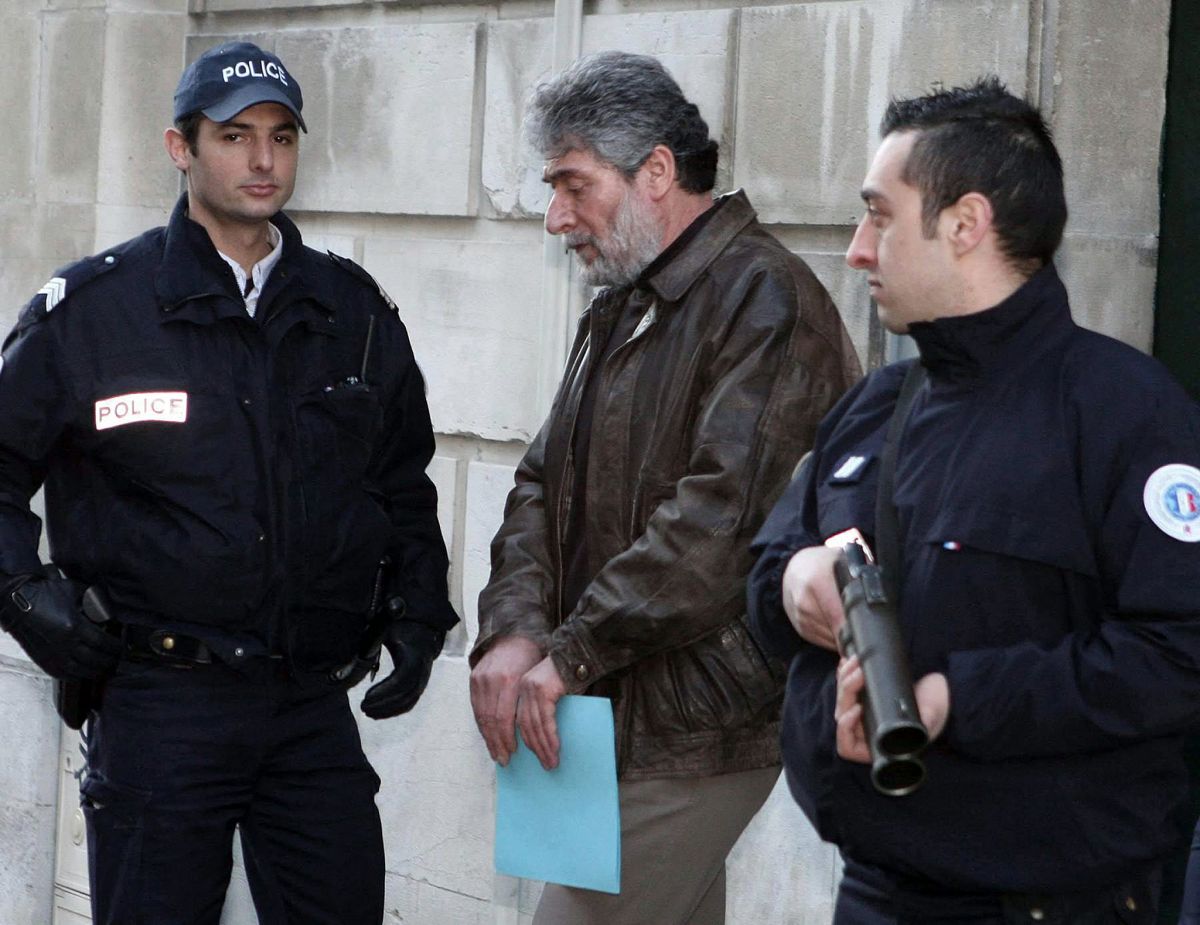
French police escort Georges Ibrahim Abdallah, a Lebanese national sentenced to life in prison, as he leaves the courthouse in Pau, in the southwest of France, on Feb. 18, 2010. (Credit: Jean-Louis Duzert/AFP)






After four decades behind bars, Lebanese militant Georges Ibrahim Abdallah remains in legal limbo as the Paris Court of Appeal postponed its decision Thursday on his potential release to June 19. Abdallah, a pro-Palestinian activist, was convicted of complicity in the assassinations of American and Israeli diplomats in France.
The court delayed its ruling to allow the 73-year-old prisoner to justify compensation for the civil parties, according to a judicial source and his lawyer, Jean-Louis Chalanset, who denounced the move as "legal pettiness." Abdallah has consistently refused to pay compensation. Once one of France’s most high-profile prisoners, he has been eligible for release for 25 years but has had about 10 parole requests denied.
This makes him "an exception," Chalanset said, noting that other political prisoners in France — whether from the far-left armed group Action Directe or Corsican and Basque separatist movements — have been released. "If the court does not grant his request, it would amount to a de facto life sentence, which does not exist in French law," he said before the hearing.
Authorities banned planned demonstrations in support of Abdallah on Wednesday evening in the Paris region, citing concerns over public order amid "a tense social and international context." In Toulouse, about 100 kilometers from Lannemezan prison in southern France, where Abdallah is incarcerated, 300 people protested, calling for his release.
On Nov. 15, the anti-terrorism sentencing court offered a glimmer of hope, ordering Abdallah’s release with immediate deportation to Lebanon, which has agreed to receive him.
Abdallah is the "last remnant of the secular, Marxist, communist-oriented FARL" (Armed Revolutionary Factions), the court wrote in its ruling. He belongs to "the now bygone history of the violent activism of the Lebanese and Palestinian ultra-left," which has "not been responsible for any attacks in France or elsewhere since 1984." However, the anti-terrorism prosecutor’s office (PNAT) appealed the decision, immediately suspending it.
A "Symbol"
The case was re-examined by the Paris Court of Appeal on Dec. 19 in a closed hearing. PNAT justified its opposition by arguing that Abdallah had "not evolved" and that his convictions "remained intact."
Abdallah has always denied involvement in the 1982 assassinations of the two diplomats in Paris and has refused to compensate the civil parties. However, he has also never condemned "acts of resistance" against "Israeli and American oppression" during the Lebanese Civil War. PNAT argued that he "represents a symbol or even a guiding figure of the Palestinian cause."
The court, in its ruling, countered that Abdallah "now represents the symbol of a man who has been detained for over 40 years — an excessive period given the nature of his acts and his current level of danger."
His defense claims U.S. pressure is behind his prolonged imprisonment. The U.S. government, which was a civil party in his 1987 trial, has systematically opposed his release. Before the December hearing, it sent a letter to the court urging judges to "vigorously oppose" his release.
At his 1987 trial, Abdallah was labeled France’s public enemy No. 1 and was suspected — wrongly, as it later emerged — of being linked to a wave of deadly attacks in Paris carried out by pro-Iranian militants. Today, he is largely forgotten except by a small group of supporters, a handful of left-wing lawmakers, and figures such as French Nobel laureate Annie Ernaux.
On Friday, he received visits in prison from radical left-wing lawmakers Eric Coquerel and Sylvie Ferrer, who called for an end to what they described as a "state scandal."
"It is a disgrace for the French state," Coquerel told reporters.
