






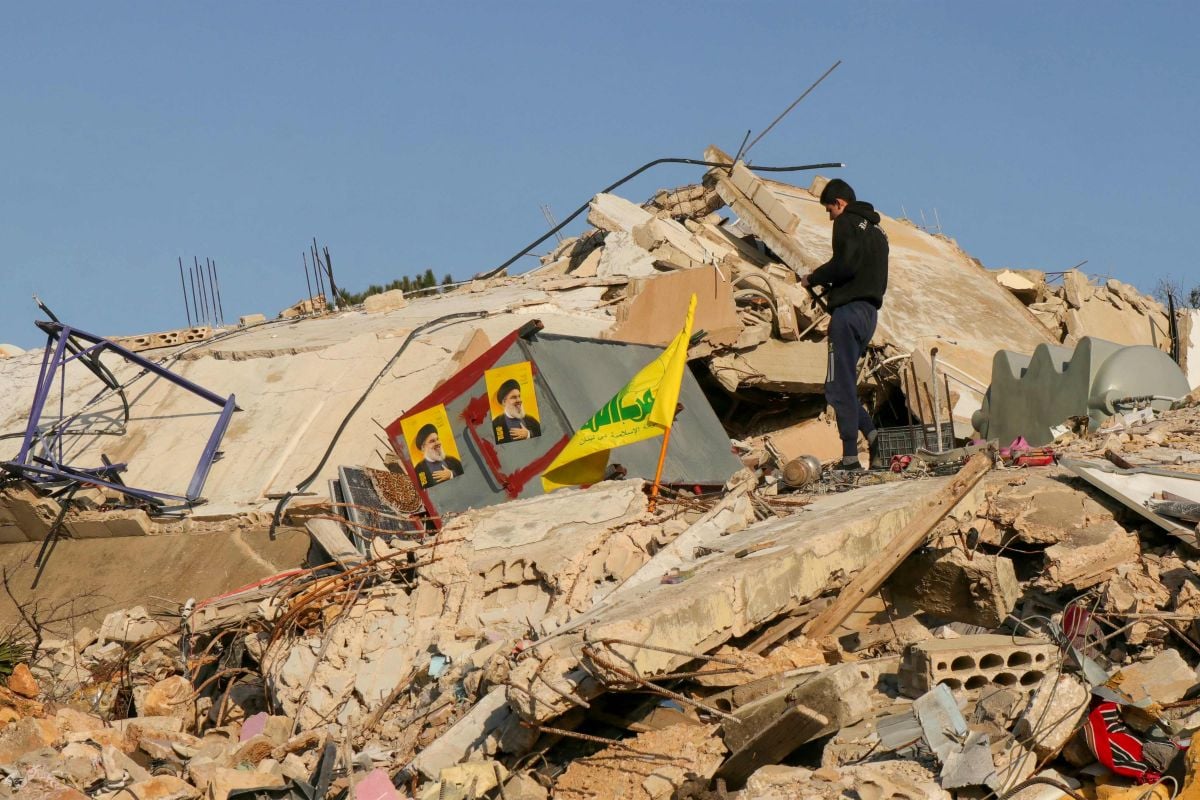
A Hezbollah supporter in front of a house destroyed by Israeli army bombings in Southern Lebanon, in Khiam, on Jan. 28, 2025. (Credit: Rabih Daher/AFP)






For the first time since the truce agreement between Israel and Hezbollah on Nov. 27, two Israeli drone strikes targeted north of the Litani River, in Nabatieh al-Fawqa, in southern Lebanon. According to our correspondent, the first strike targeted the road between Nabatieh al-Fawqa and Zawtar, and the other struck the junction leading to Zawtar.
According to the Ministry of Health, the strikes injured at least 24 people.
"The air force conducted strikes against a truck and another vehicle belonging to Hezbollah transporting military equipment in the areas of Shaqif and Nabatieh, southern Lebanon, to eliminate a threat,'" claimed Avichay Adraee, the Arabic spokesperson for the Israeli army.
Caretaker Prime Minister Najib Mikati condemned "an aggression which constitutes a new violation of Lebanese sovereignty and a flagrant transgression of the cease-fire agreements as well as the provisions of U.N. Resolution 1701." According to a statement from his press office, Mikati also contacted U.S. General Jasper Jeffers, head of the cease-fire monitoring committee, asking him to take a "firm stance to ensure that Israel honors its obligations under international law."
This strike seems to send a message to Hezbollah, which insists that the cease-fire agreement outlines a disarmament only south of the Litani.
On Sunday residents tried to reach their border villages, while Israel announced its intention to continue occupying these localities beyond the Jan. 26 deadline. Since then, the Israeli state has withdrawn from several towns where the Lebanese Army has subsequently deployed, but shootings against residents have killed over 24 people in two days. The deadline given to Israel has been extended to Feb. 18.
In exchange for this extension, Israel committed to opening negotiations on the fate of the Lebanese detained by its army after Oct. 7, 2023. In this context, Mikati announced on Tuesday that Israel had released nine Lebanese prisoners, calling for the release of nine others still detained.
In a statement, he "thanked the International Committee of the Red Cross for its efforts to release nine Lebanese detained in Israeli prisons," without providing details on the individuals released or the circumstances of their detention. An ICRC spokesperson, in turn, "welcomed the announcement of the release of Lebanese nationals" and said it "remains ready to play its role as a neutral intermediary."
The anger of residents in southern Lebanon
Meanwhile, the Lebanese Army began its deployment on Tuesday in Yaroun, in the district of Bint Jbeil, while being unable to reach the village square where an Israeli tank is still positioned. Ali Touhfa, president of the municipal council, stated that residents had reached the town's western outskirts without getting to the center.
"The residents will not back down until they have reached all the village neighborhoods," he assured. The Lebanese Army announced on its X account that the Israeli army fired at soldiers and civilians on the road connecting Yaroun to Maroun al-Ras, injuring a soldier and three civilians.
So far, the Lebanese Army has entered the villages of Aita al-Shaab, Boustan (Sour), Deir Mimas, Bani Hayyan, Tallouseh and Taybeh (Marjayoun). They are also partially present in Marwahine (Sour) and Yaroun (Bint Jbeil). In light of these incidents, the anger of residents has intensified. Those from the border village of Kfar Kila (Marjayoun) briefly blocked the Khardali road, at the level of Deir Mimas, which connects Nabatieh to Marjayoun, to protest the delay in returning to their lands.
In the same context, the Israeli army used bulldozers to demolish and set fire to several buildings in the Mfaylha area, west of the village of Mais al-Jabal. In the district of Hasbaya, it triggered at least two heavy explosions in Wazzani. A similar operation had already been carried out the previous day in the same area.