






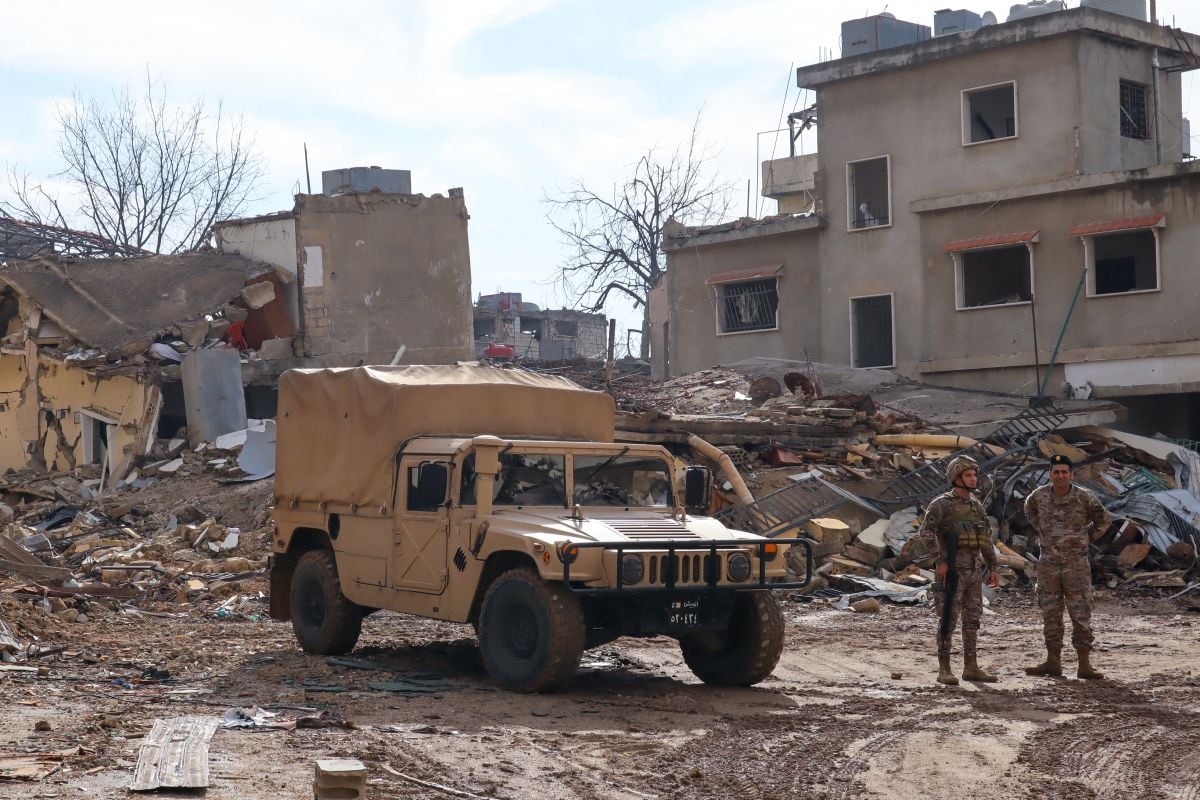
Lebanese soldiers stand next to damaged buildings in the village of Khiam, in southern Lebanon, on December 23, 2024, following the withdrawal of Israeli forces from the area under a cease-fire agreement with Hezbollah. (Credit: AFP)






Several explosions have rocked the Marjayoun district, where many residences have been demolished by the Israeli army in Tallousseh, Bani Hayan, Taybeh, and Rabb al-Thalathine. On the outskirts of Mais al-Jabal, several Israeli vehicles have been mobilized to search the area, according to our correspondent in the South. During the night, the Israeli army destroyed buildings in the center of the locality.
Meanwhile, in the same district, two shells were fired by the Israeli army at the outskirts of Burj al-Moulouk, while Israeli forces used explosives to destroy infrastructure in Markaba.
The municipality of Rmeish, in the Bint Jbeil district, announced it had requested the evacuation of the village's Civil Defense center after several Israeli bombardments near the building. The strikes damaged several houses. During the 14 months of the war, the Israeli army regularly targeted rescue teams and ambulances belonging to the Civil Defense and relief organizations tied to the Amal movement and Hezbollah.
In Bint Jbeil, the Israeli army fired from a Merkava tank, destroying three buildings, including the mayor’s house. Machine gun fire and explosions were heard Wednesday morning in Aita al-Shaab, in the same district.
Overnight from Tuesday to Wednesday, three Syrian shepherds from the Hamad family went missing near Mais al-Jabal, according to security sources cited by our correspondent. The missing include a father and his two sons. Further east, in the Hasbaya district, Israeli soldiers opened fire with automatic weapons at shepherds on the outskirts of Halta, near Kfar Shuba, forcing them to flee.
Additionally, four people, including a Lebanese soldier, who were abducted by the Israeli army on Monday in the plains of Majidieh (Hasbaya district), were released, according to Wazzani Mayor Ahmad al-Mohammad.
Despite the cease-fire, which has been in effect since Nov. 27, 2024, between Hezbollah and Israel, the Israeli army regularly strikes southern Lebanon with missiles, mainly launched by drones. These bombings have killed at least 34 people, according to our count. The Israeli army, which prohibits Lebanese from entering an area about 10 kilometers wide along the border and remains present in some Lebanese villages, has also detained several people since the truce began.
‘Uninhabitable’
Following the redeployment of the Lebanese army to Alma al-Shaab and other villages in the western sector of the border on Tuesday after the withdrawal of Israeli forces, the president of the Alma al-Shaab municipality, Jean Ghafari, said there is “no sign of life in the village.”
“Infrastructure — including water and electricity networks, solar panels, and electric generators — has been severely damaged by recent Israeli attacks,” Ghafari said in a statement relayed by our correspondent. He also mentioned “attacks” on the village church, which was hit by a shell and vandalized with Hebrew phrases and a Star of David painted on a wall. He announced that the municipal headquarters, numerous houses, and a water tank were destroyed, estimating that it would take “at least a year” to rebuild and restore the village.
“In recent days, UNIFIL has supported the redeployment of the Lebanese Armed Forces in their positions in the southwest of Lebanon following the withdrawal of Israeli forces,” the United Nations Interim Force in Lebanon (UNIFIL) said in a statement Wednesday. “Peacekeepers will continue to support the cessation of hostilities and the full implementation of Resolution 1701 as a path toward peace,” the statement added.
On Monday, the Lebanese army announced its entry into the border village of Naqoura (Sour district), which is “almost entirely destroyed,” according to municipal council president Abbas Awada.
Diplomatic Efforts
On the diplomatic front, Blinken said he sees a “lasting peace” in Lebanon as Israeli troops begin to withdraw from the south of the country. Speaking during a press conference in Paris alongside French Foreign Minister Jean-Noël Barrot, Blinken said: “We have recently seen (...) the withdrawal of more than a third of Israeli forces from Lebanon. I believe the cease-fire can be a bridge to lasting peace.”
The U.N. and the Lebanese government launched a $371.4 million appeal Tuesday to address urgent humanitarian needs. In October 2024, a similar appeal for $426 million was launched to aid those displaced by Israeli strikes in Lebanon, which helped mobilize about $250 million, according to the U.N.