


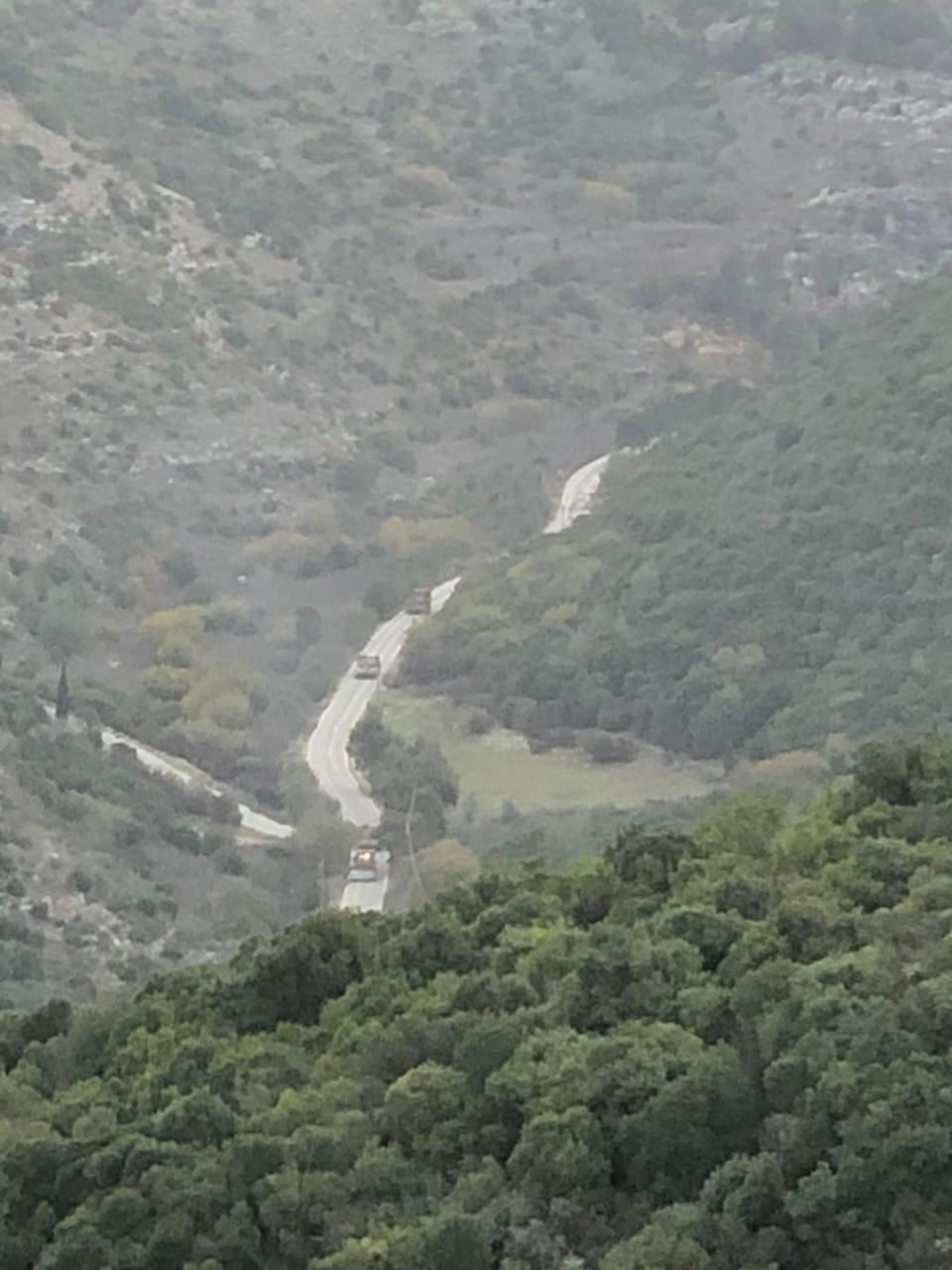
Israeli army vehicles in Wadi Hojeir, a strategic valley in South Lebanon, on Dec. 26, 2024. (Photo sent by L'Orient Today's correspondent Mountasser Abdallah)






While the Israeli army deployed for most of Thursday, with dozens of soldiers and vehicles including armored vehicles, in the strategic Wadi Hujeir, the Lebanese Army denounced an "infiltration at several points" and affirmed having "reinforced its deployment" in the area.
Meanwhile, sources within the Israeli army told Haaretz that its troops are "preparing for the possibility of remaining in south Lebanon beyond the 60 days stipulated in the cease-fire agreement," which mandates a full withdrawal by that time.
"This delay will take occur the Lebanese Army does not fulfill the obligations stipulated in the agreement and fails to regain full control of south Lebanon," they said. In such a scenario, the Israeli army "would remain in place until the Lebanese army fulfills its commitments."
Nearly a month after the cease-fire took effect, granting the Israeli army 60 days to withdraw from southern Lebanon, Israeli forces deployed along Wadi Hujeir road. They set-up an earthen barrier to block a key route and shot a man, injuring him, before briefly detaining him. The injured man was later identified as a contractor for the United Nations Interim Force in Lebanon (UNIFIL).
Raking and mounding earth
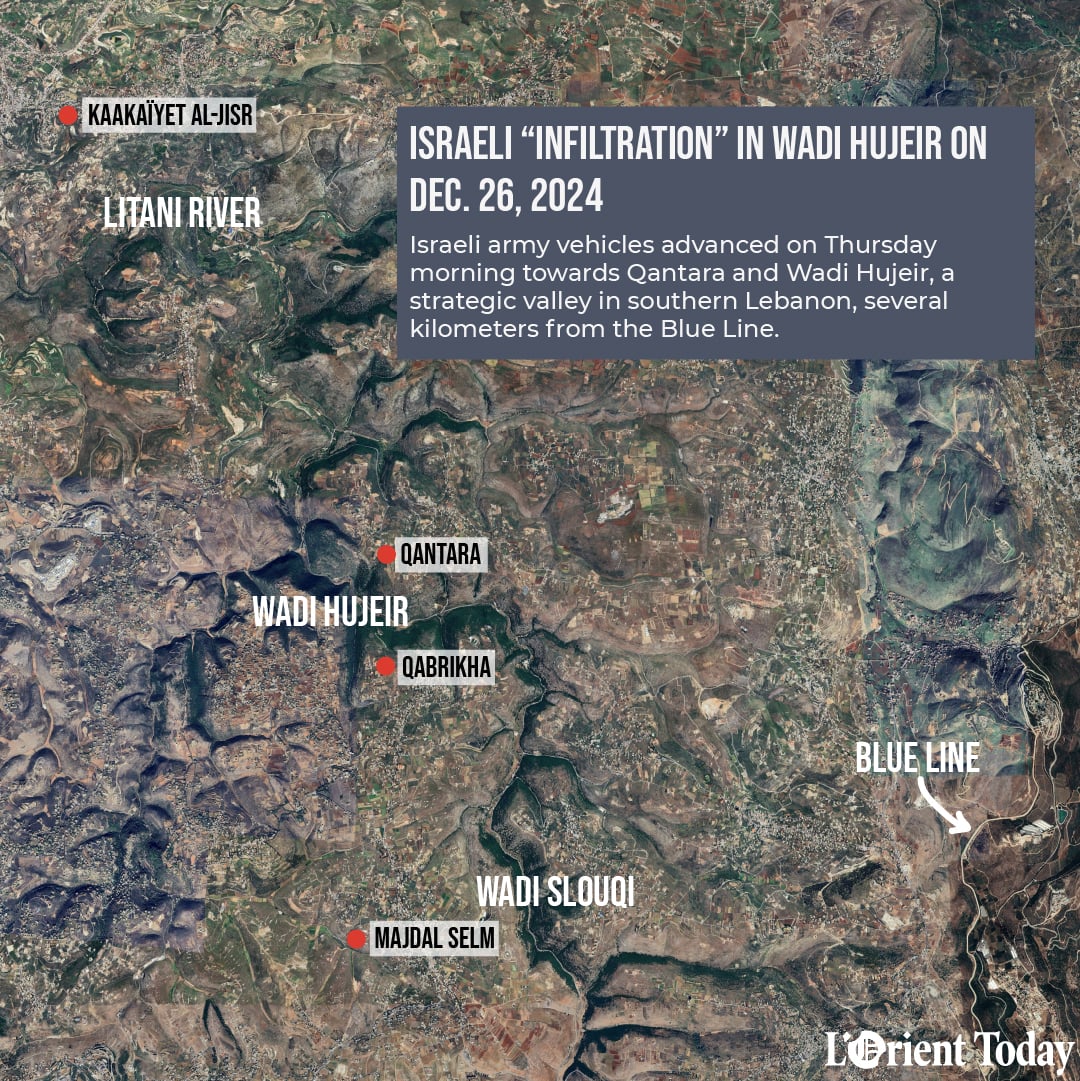
The deployment of the Israeli army towards Qantara and Wadi Hujeir, at least seven kilometers west of the Blue Line, began around 7 a.m. and the Israeli military quickly began combing the area, reported our regional correspondent citing local and security sources.
Wadi Hujeir connects several regions, including the districts of Marjayoun and Nabatieh. The Israeli army was unable to enter it before the cease-fire, as part of its ground offensive launched on Sept. 30. However, invading troops have now deployed vehicles there without opposition. Images obtained by L'Orient Today's correspondent show Israeli soldiers deployed in the Wadi Hujeir reserve, monitoring the area. In another video, tanks can be seen at the side of a road, erecting a mound of earth and closing off an axis linking Wadi Hujeir to another key valley in the south, Wadi Slouqi.
Reinforced deployment of the Lebanese Army
In a statement, the Lebanese Army condemned early this afternoon an Israeli "infiltration" "in several points" in south Lebanon, notably in Qantara, Odaisset al-Qusayr and Wadi Hujeir. The troops accused the Israeli army of "continuing to violate the cease-fire agreement and undermining the sovereignty of Lebanon."
In response, the Lebanese Army "reinforced its deployment in these areas," following L'Orient Today's reporting on its advance on the outskirts of Qaaqaaiet al-Jisr. The Lebanese military command "is monitoring the situation with UNIFIL and the international monitoring committee" of the terms of the truce agreement.
This Israeli advance forced residents of surrounding villages, including Qantara, to flee the area in the morning. Several municipalities, including Majdal Selm and Touline, urged residents to avoid using the road linking the valleys of Wadi Hujeir and Wadi Slouqi, as well as the secondary roads leading to Qabrikha.
Civilian shot and kidnapped
A man from Tebnine, who had been reported missing, was briefly abducted by the Israeli army while he was traveling in the valley. The civilian, identified as a contractor working with a UNIFIL contingent, had left Tebnine in the morning and was shot in the head and detained while passing through Wadi Hujeir. He was released shortly afterward and handed over to UNIFIL and the Red Cross, then hospitalized, reported our regional correspondent, citing security sources.
Military expert Riad Kahwaji told L’Orient Today that this latest Israeli maneuver demonstrates its intent to operate in areas “up to 10 kilometers inside Lebanon,” which aligns with the “initial objective of its ground offensive.” Israel, according to Kahwaji, is “taking advantage of the cease-fire” to position its forces strategically.
He emphasized the “strategic importance” of Wadi Hujeir, located north of Bint Jbeil — a site of significant battles during the 2006 war.
Kahwaji added that the Israeli army likely entered the valley because “it believes Hezbollah has tunnels and weapons there.”
For Imad Salameh, political analyst and professor at the Lebanese American University in Beirut, Israel’s actions in the area reflect “its growing confidence in its position, particularly after the collapse of the Syrian regime,” which disrupted Hezbollah’s supply lines.
“Israel is leveraging this dynamic to secure more favorable conditions in any future arrangement concerning Lebanon,” Salameh explained.
Hezbollah urges Lebanese State to ‘reassess the situation’
In response to developments on the ground, Hezbollah MP Ali Fayad condemned the situation as a “serious escalation and a grave threat” to the implementation of United Nations Security Council Resolution 1701, which underpins the cease-fire agreement. Fayad stated that the Israeli deployment “also undermines the already fragile credibility of the committee tasked with overseeing” the agreement’s compliance.
He urged the Lebanese State to “immediately reassess the situation” in light of what he described as a “blatant failure to curb” Israeli violations.
The same day, The Israeli army blew up houses in Kfar Kila (Marjayoun) and fired a missile at the outskirts of Khiam. However, the missile did not explode.
On Wednesday, Christmas Day, an Israeli strike targeted the Baalbeck region in Lebanon in the first bombardment carried out by the Israeli air force on the Bekaa Valley since the cease-fire between Hezbollah and Israel came into force on Nov. 27.
In southern Lebanon, the Israeli army continued shelling and demolishing homes in border villages, according to our local correspondent.
Lebanese authorities renewed their calls on Tuesday evening for an end to Israeli violations, further highlighting the fragile state of the truce.

