






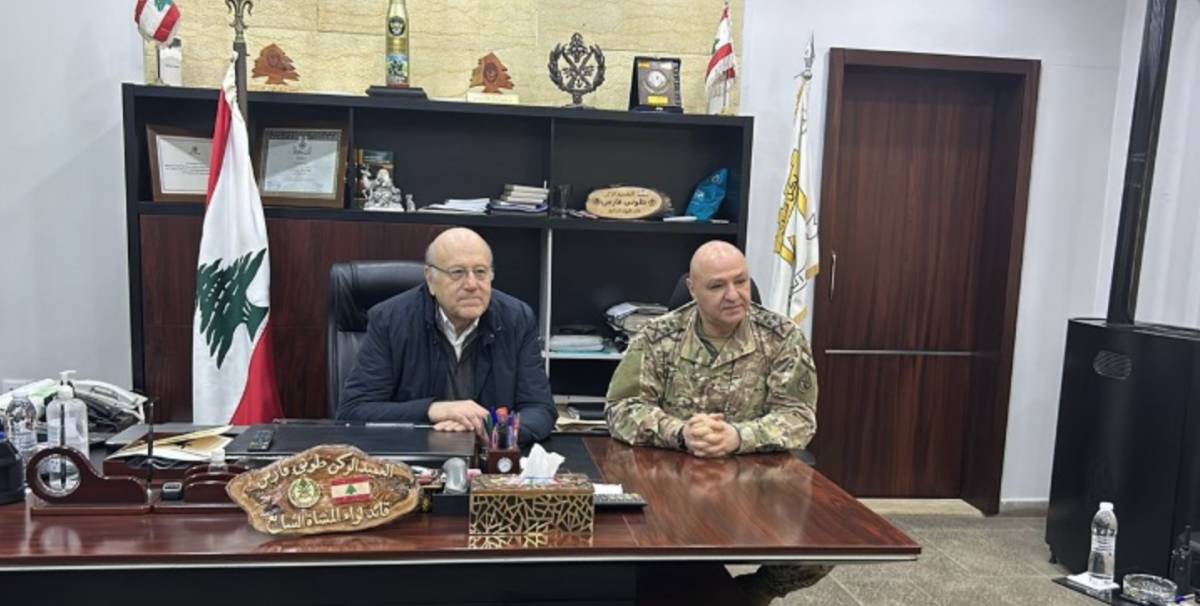
Outgoing Lebanese Prime Minister Najib Mikati, and General Joseph Aoun, in the François al-Hajj barracks in Marjayoun, South Lebanon, on Dec. 23, 2024. (Credit: National News Agency)






Outgoing Lebanese Prime Minister Nagib Mikati, on an inspection tour Monday to Marjeyoun in southern Lebanon, said the government's priority was “full implementation” of U.N. Security Council Resolution 1701, and an end to Israeli violations of the ceasefire agreement in Lebanon.
Mikati and Commander-in-Chief of the Army, General Joseph Aoun, are on an inspection tour on Monday in Marjayoun, southern Lebanon. The visit comes just under a month after the cease-fire between Hezbollah and the Israeli army came into effect, following several months of war that devastated the south of the country, and while the Israeli army remains deployed on Lebanese territory.
“The Prime Minister has arrived in the South to tour front-line army units,” announced the press office of the Council Presidency. He will also discuss with General Aoun the situation in the eastern sector of the border, where Marjayoun is located.
For its part, the army announced on the X platform the arrival of its Commander-in-Chief at the François al-Hajj barracks in Marjayoun “to meet officers and soldiers and enquire about their missions.”
An end to 'systematic destruction'
From the headquarters of the U.N. Interim Force in Lebanon (UNIFIL) in Ibl al-Saqi, the second stop on Mikati's tour of the South after the François el-Hajj barracks in Marjayoun, the Council President declared that “the government's priority is the full implementation of international resolution 1701, the withdrawal of Israel from territories where its army has infiltrated, an end to the systematic destruction of villages in the South, as well as an end to its violations” of the cease-fire agreement.
The cease-fire agreement, which came into force on Nov. 27, gives the Israeli army 60 days, until the end of January, to withdraw from southern Lebanon, where it launched a ground offensive on Sept. 30. At the same time, the Lebanese Army is to deploy in the region, and Hezbollah is to withdraw completely from south of the Litani River. A monitoring committee, made up of representatives of the U.S., France, the U.N. Interim Force in Lebanon (UNIFIL) and the Lebanese and Israeli armies, is to ensure that no party violates the terms of the agreement. Since Nov. 27, however, the Israeli army has continued to blow up houses in border villages. It has arrested several Lebanese, seven of whom were released on Sunday, and killed at least 34 people in strikes, mainly carried out by drones.
The role of the Supervisory Committee
“We aspire to lasting stability in the South through the full accomplishment of the army's missions in cooperation with UNIFIL”, added Najib Mikati, who was received in Ibl al-Saqi by the Commander of this U.N. force, General Aroldo Lázaro, and the Commander of Sector East, General Fernando Ruiz.
For his part, the UNIFIL Commander stressed the importance of the Monitoring Committee, which has met several times in Naqoura since the beginning of the truce, “continuing its meetings to carry out its mission.” A view shared by General Aoun, who considered it “imperative” that Israel respect the agreement. The Lebanese army “is fulfilling its missions and will continue to do so, in order to implement resolution 1701 in cooperation with UNIFIL,” added the Lebanese commander-in-chief.

