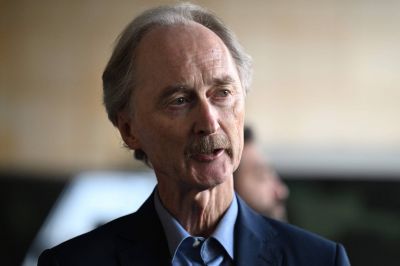
U.N. Special Envoy Geir Pedersen addresses the media outside a hotel in Damascus, Dec. 18, 2024. (Credit: Louai Beshara/AFP)






American, European, Arab, and Turkish ministers and officials who held a meeting on Syria in Aqaba, Jordan, on Dec. 14 will convene again in Paris in January to continue “aligning their messages,” the caretaker French foreign minister announced Wednesday.
Since the fall of Bashar Assad on Dec. 8, Western powers have emphasized the need for an inclusive political transition in Syria.
The Dec. 14 meeting reaffirmed the principle of a "credible and inclusive transition... led by Syrians and based on the principles of U.N. Security Council Resolution 2254," according to the U.N. envoy for Syria, Geir Pedersen.
“Together with our Arab partners, Turkey, the United States, the United Kingdom, Germany, and the European Union, we gathered on Saturday, Dec. 14, in Aqaba, Jordan, to coordinate our collective and conditional support for a transition in Syria,” Jean-Noël Barrot said Wednesday.
“In a declaration, we outlined the guiding principles of our engagement in Syria,” he added. “This group will be formalized, and we will host its second meeting in January in Paris,” he noted, without specifying an exact date.
When contacted by AFP, Barrot's team said they were unable to provide additional details at this time.
Meanwhile, as a team of four French diplomats visited Damascus on Tuesday, the caretaker foreign minister emphasized that France was not ruling out “any future contact.”
“What matters is not which interlocutors each party meets but the consistency of the messages conveyed to the de facto authorities,” Barrot said. “This is why it was so important for France to be represented in Aqaba last Saturday, to ensure that the messages of the international community are aligned,” he stressed.
Resolution 2254, adopted in 2015, reaffirms the “strong commitment to the sovereignty, independence, unity, and territorial integrity of the Syrian Arab Republic” and outlines a roadmap for a political solution in Syria.
HTS, the former Syrian branch of al-Qaida that led the operations resulting in Bashar Assad's fall, claims to have broken ties with jihadism but remains classified as a “terrorist” group by several Western capitals, including Washington.