






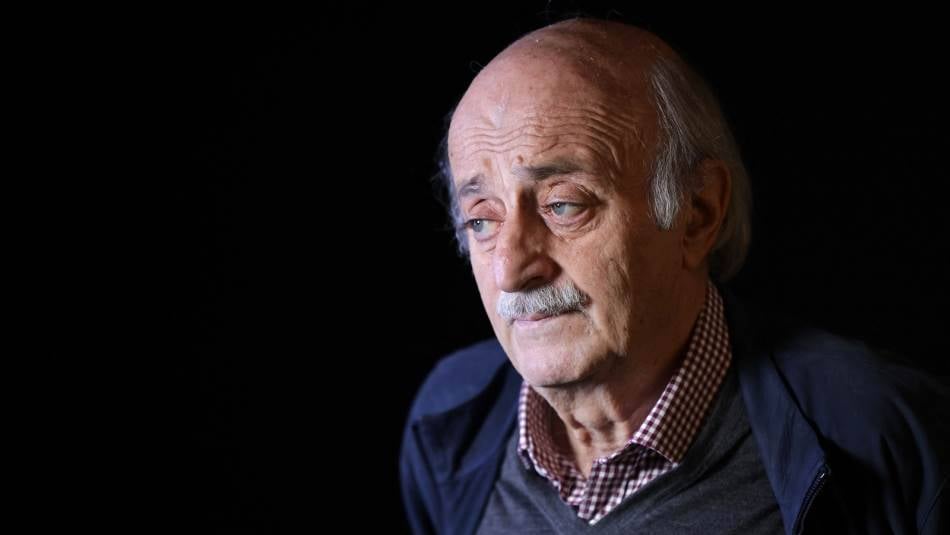
Druze leader and former head of the Progressive Socialist Party (PSP), Walid Joumblatt. Photo from the PSP X account






The Druze leader and former head of the Progressive Socialist Party (PSP), Walid Joumblatt, called Abu Mohammad al-Jolani—whose real name is Ahmad al-Sharaa—the leader of Hay'at Tahrir al-Sham (HTS) and the rebel coalition now in power in Syria, over the weekend, according to the PSP’s newspaper Al Anbaa. This marks the first contact by a Lebanese official with the leader of Syrian rebels. Citing PSP sources, Al Anbaa reported that Joumblatt plans to visit Damascus soon. The Druze leader had long boycotted the Assad regime, which he accuses of assassinating his father, Kamal Joumblatt, in 1977.
Joumblatt’s last visit to Damascus was in January 2011, just weeks before anti-regime protests broke out, leading to a brutal crackdown by Bashar Assad. In 2013, he declared that neither he nor his son would set foot in Syria until it was “liberated from the clique currently in power.”
During his phone call with the HTS leader, Joumblatt congratulated him on “the great victory against the repressive regime and the regained freedom after 54 years of tyranny.” The two leaders stressed the importance of Syria’s territorial unity in the face of “projects that could harm both Syria and Lebanon.” They also warned against the “suspicious actions” of supporters of the fallen regime who might “collaborate with Syria’s enemies.”
Al-Sharaa reportedly acknowledged that “Joumblatt has paid a heavy price for the Syrian regime’s injustice, starting with the death of Kamal Joumblatt. He supported the Syrian people’s revolution from the very beginning.” According to Al Anbaa, the HTS leader emphasized his group’s cooperation with military factions in Sweida, a predominantly Druze region, during the regime's downfall.
Hikmat Hajri, the head of the Druze community in Syria, expressed hope that efforts would be made to ensure the political and ministerial representation of the Druze minority in the short term. “We want to build a modern Syria where everyone is represented in a secular and democratic state,” he said, extending an olive branch to HTS.
These statements came after online videos surfaced showing Druze dignitaries, including some from the village of Hader in the Syrian Golan, calling for the annexation of villages in the area by Israel.
In response, the spiritual leadership in Hader declared, “The village of Hader, in the heights of Jabal al-Sheikh, is part of Syria, and all other claims are illegal and do not represent the majority of residents,” according to a statement published by Al Modon.
In Lebanon, former Prime Minister Saad Hariri welcomed the fall of the Assad regime, describing it as one that “intimidated individuals and groups and wielded power arbitrarily.” Hariri stated that he had long awaited this moment. “Assad has fallen… This is the day I have been waiting for since that dark hour,” he wrote on X, in reference to the 2005 assassination of his father, former Prime Minister Rafik Hariri, in Beirut—a murder widely attributed to the Syrian regime and Hezbollah.
On Saturday, in his first televised appearance since the fall of Bashar Assad, Hezbollah leader Naim Qassem expressed hope that the new Syrian regime would not “normalize” ties with Israel. “We supported Syria because it helped enhance the resistance’s capabilities through its territory to Lebanon and Palestine. Today, the regime has fallen. We can only judge the new forces when they take clear positions and when the situation in Syria stabilizes,” he said.
Qassem admitted that “Hezbollah has lost its military supply route via Syria,” though he dismissed this as “a small detail that could change with time.” He expressed optimism that “this route could be restored with the new regime, or that new methods could be found.” Qassem concluded by asserting that “what is happening in Syria will not affect Lebanon.”

