






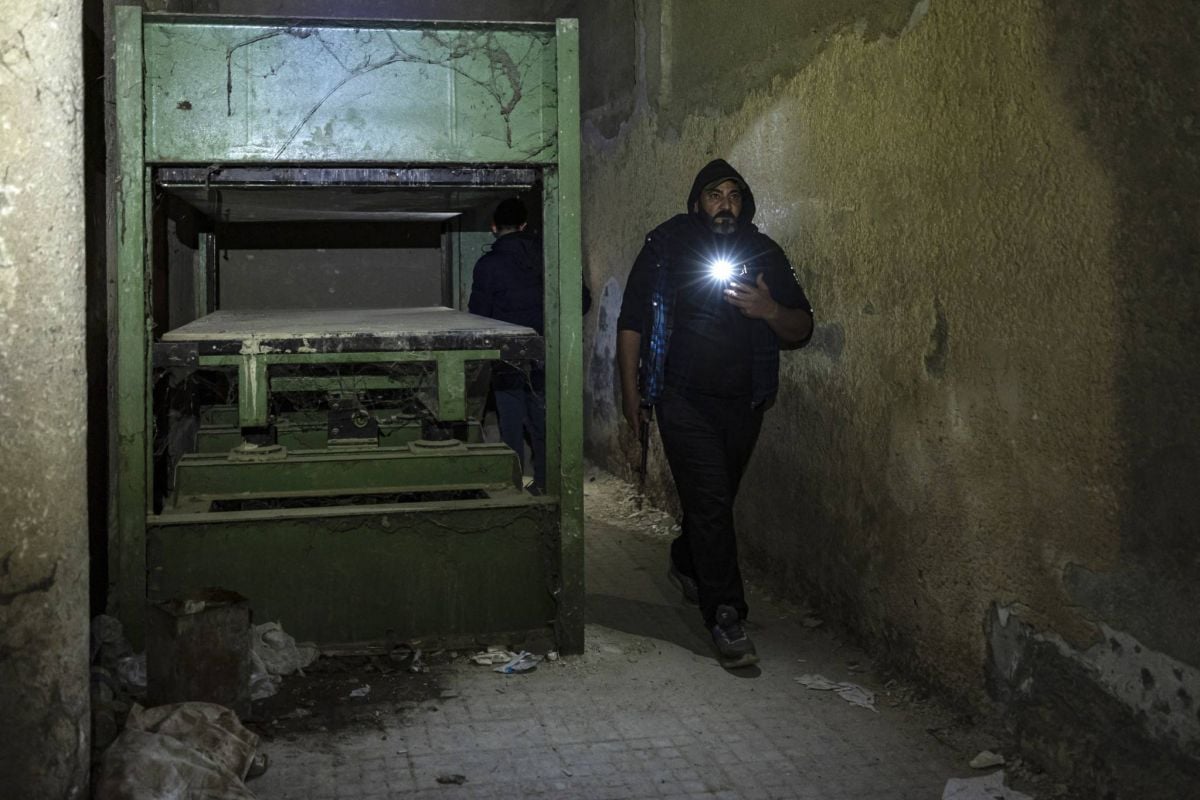
A man walks past a mechanical press at Saydnaya Prison in Damascus, Dec. 11, 2024. (Credit: Sameer Al-Doumy/AFP Photo)






Saydnaya Prison, located north of Damascus, is infamous for its inhumane conditions and its central role in the violent repression carried out by the Assad regime, particularly since the start of the civil war in 2011.
This detention center, notorious for extrajudicial executions, torture, and enforced disappearances, epitomizes the atrocities committed by ousted President Bashar al-Assad against his opponents.
Upon entering Damascus on Sunday, Syrian rebels announced that they had taken control of Saydnaya Prison and freed numerous detainees, some of whom had been held since the 1980s.
According to the Association of Saydnaya Prison Detainees and Missing Persons (ADMSP), more than 4,000 prisoners were liberated by the rebels.
Images of emaciated, dazed prisoners — some too weak to leave their cells without help — have circulated globally, exposing the grim reality of the facility Amnesty International once labeled a "human slaughterhouse."
Here’s what you need to know about the notorious prison:
Torture and 'crematorium'
Saydnaya Prison was built in the 1980s during the rule of Hafez al-Assad, Bashar’s father. Initially intended to house political prisoners, including members of Islamist groups and Kurdish activists, it became a symbol of the Syrian state's ruthless control over its citizens.
In 2016, UN investigators accused the Syrian government of "acts of extermination amounting to crimes against humanity," particularly at Saydnaya.
In 2017, Amnesty International documented thousands of executions at the prison, describing a systematic "policy of extermination."
Shortly thereafter, the United States reported the presence of a "crematorium" used to dispose of the bodies of countless prisoners.
By 2022, the Syrian Observatory for Human Rights (SOHR) estimated that approximately 30,000 people had been detained at Saydnaya, with only 6,000 released. Many detainees were subjected to horrific torture.
Executions and 'salt rooms'
The ADMSP estimates that more than 30,000 detainees were executed or died at Saydnaya between 2011 and 2018, succumbing to torture, neglect, or starvation.
The organization accused authorities of creating "salt rooms" to serve as makeshift morgues, preserving corpses in the absence of refrigeration facilities.
Many other detainees remain officially "disappeared," with death certificates rarely issued unless families paid exorbitant bribes in a widespread extortion scheme.
In 2022, the ADMSP released a report detailing the use of these "salt rooms" at Saydnaya, with the first reportedly created in 2013, one of the bloodiest years of the Syrian conflict.
Foreign detainees
Saydnaya Prison, where thousands of families of the disappeared rushed on Sunday hoping to find their loved ones, is now empty.
The White Helmets, a Syrian rescue group, announced Tuesday that search operations had concluded without any detainees being found.
Many foreign nationals had been held in Syrian prisons, including Jordanian national Osama Besheer Hassan al-Bataynah, who was repatriated on Tuesday after spending 38 years in Syrian detention. He was reportedly found "unconscious and amnesiac" in Syria, according to Amman.
The Arab Organization for Human Rights in Jordan reports that 236 Jordanians remain imprisoned in Syria, most of them at Saydnaya near Damascus.
A Lebanese man, Souheil Hamawi, 61, returned to Lebanon on Monday after spending 33 years in Syrian prisons, including Saydnaya.

