






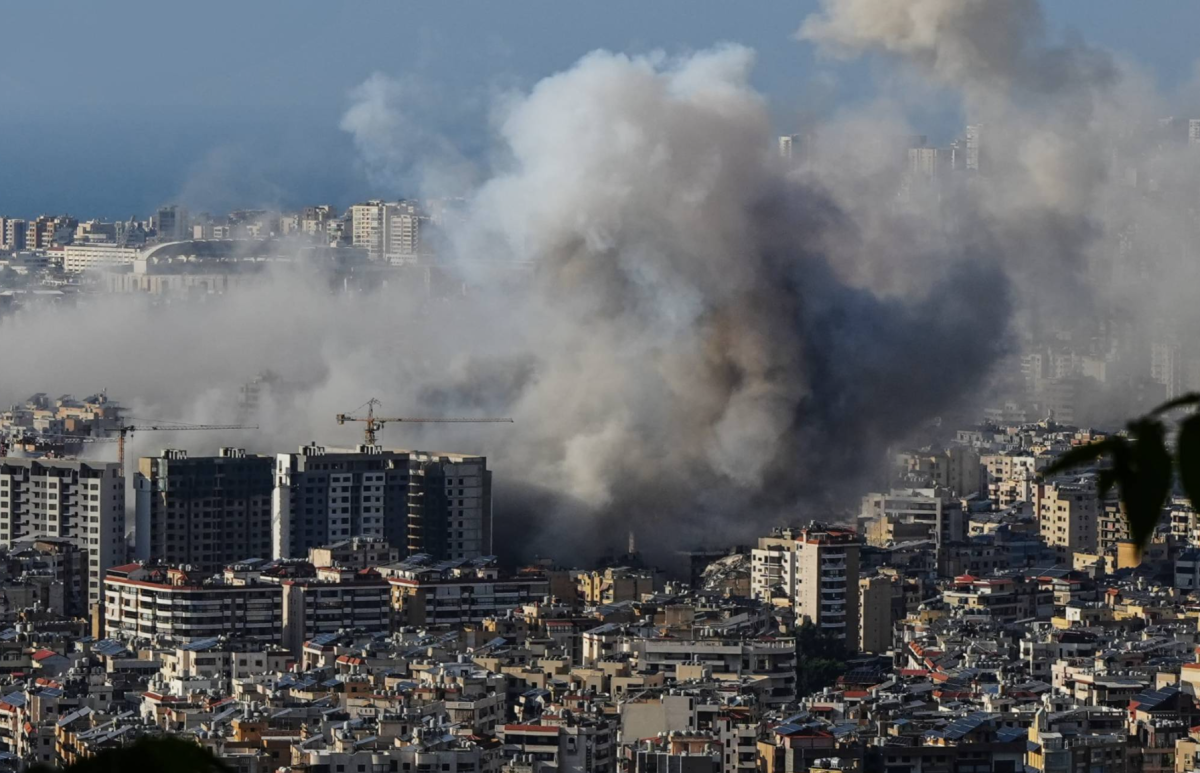
Explosion caused by one of the strikes on Beirut's southern suburbs on Thursday, Nov. 21, 2024. (Credit: Mohammad Yassine/L'Orient-Le Jour)






After a three-day lull, coinciding with the visit of U.S. envoy Amos Hochstein to Beirut, Israel resumed its bombardment of Beirut's southern suburbs on Thursday, while continuing its violent shelling of southern Lebanon and the Bekaa.
The day after the speech by its Secretary General, Naim Qassem, Hezbollah claimed its farthest strike since Oct. 8, 2023, the date on which it began its clashes with the Israeli army, which have degenerated into a near-total war over the last two months.
Shortly before 3 p.m., the party claimed to have fired missiles at the Hatsor air base, located east of Ashdod, 150 km from the Lebanese-Israeli border and, more importantly, halfway between Tel Aviv and the Gaza Strip. He described the base as “an important air wing containing qualified reconnaissance training and squadrons of warplanes.” This attack is part of “the Khaybar operations” and responds to “the call of the assassinated former leader of Hezbollah, Hassan Nasrallah,” he added.
The Israeli media did not relay any information confirming or denying this strike, as was the case when Hezbollah claimed responsibility for an attack on the Israeli Defense Ministry in Tel Aviv on Nov. 13.
Published at the end of the day, the new death toll from this war is now 3,583, according to the Lebanese Health Ministry.
The process of negotiating a cease-fire has made no headway since the previous day, despite a meeting lasting around four hours between U.S. envoy Amos Hochstein, who arrived in Tel Aviv on Monday evening, and Israeli Prime Minister Benjamin Netanyahu. It was during this meeting that Netanyahu learned that he and his former Defense Minister, Yoav Gallant, whom he dismissed in early November, were now the target of arrest warrants from the International Criminal Court.
Several attacks on Beirut's southern suburbs
While its last attack on Beirut and the surrounding area was on Sunday (an unannounced strike on the Mar Elias neighborhood in the west of the capital) the Israeli army sent the first of three warnings published on X by its Arabic-speaking spokesperson Avichay Adraee, targeting several buildings in Haret Hreik, in the southern suburbs.
The second and third waves of warnings were issued between late morning and mid-afternoon, for several targets around Hadath and Haret Hreik. The fourth was issued mid-afternoon, targeting a building in Ghobeiri, but the Chiyah district was also hit.
In its claims, the Israeli army referred to firing on Hezbollah infrastructures, providing only vague details in line with its usual style of communication.
South Lebanon and the Bekaa were not spared either, while residents of several localities in the South and Beirut received calls during the night urging them to evacuate their homes in anticipation of a forthcoming bombardment.
In southern Lebanon, after a violent night, the Israeli army, through the voice of Avichay Adraee, asked the inhabitants of three localities to leave early in anticipation of bombardments. These were Burj al-Shemali, al-Hosh and Maashouq. The call concerned hundreds of buildings in areas regularly hit by Israeli aircraft, without prior warning. These three villages, which were heavily bombed, are also close to al-Bass, which was hit overnight by Israeli aircraft. Israeli air raids also targeted numerous other localities in the region, with the death toll still unspecified at the end of the day.
The Bekaa also experienced a particularly violent day. At the end of the day, 40 people had been killed in various strikes on localities in the Baalbeck-Hermel districts. This figure was confirmed by the Health Ministry in the early evening. In a message on X, the region's governor, Bashir Khodr, described “a particularly violent day for Baalbeck-Hermel,” before adding that clearing-up operations were continuing.
The battle of Khiam
Hezbollah, for its part, had carried out at least 20 operations by early evening, according to its statements. In particular, the party claimed responsibility for seven attacks on Israeli soldiers in and around Khiam, while the official National News Agency (NNA) reported that the Israeli army was dynamiting houses and buildings in this southern Lebanese locality close to the Israeli border.
The party also returned to Wednesday's ambush that claimed the lives of several soldiers and Zeev Erlich, an Israeli archaeologist equipped as a soldier and armed, an operation that took place in Tayr Harfa (Sour) and about which it had briefly communicated the same day. The press release also stated that “among the dead were an officer and a soldier from the 13th Battalion [Golani, attached to the 36th Division of the Israeli army], as well as a soldier from the Maglan unit [98th Division], in addition to the archaeologist concerned.”

