






Zeev Erlich, in military uniform, while present in southern Lebanon with the Israeli army. (Credit: Photo posted on social networks)






For the past 24 hours, Zeev Erlich’s photos have circulated widely on social media.The 71-year-old Israeli was killed Nov. 20 in southern Lebanon during a clash between the Israeli army and Hezbollah fighters.
Described as a “researcher” by certain Israeli media outlets, Erlich was a public figure and appears to be a controversial one. While some Israeli reports indicated that he was neither an active-duty soldier nor a reservist, Erlich was in military uniform and armed when he last entered southern Lebanon. He was reportedly accompanied by members of the Golani Brigade.
His death has prompted the Israeli military to launch an investigation, as his presence in southern Lebanon was unauthorized and may constitute a violation of military regulations.
In a statement released on Nov. 21, Hezbollah provided some details surrounding the archeologist’s death in fights, adding that "the archeologist was accompanying the army under the responsibility of the [Golani] brigade commander ‘to familiarize himself with the area,’” the statement read citing the Israeli army.
Erlich’s Presence in Shamaa Fortress
Originally from the Ofra settlement, which he co-founded in Binyamin in the occupied West Bank, Erlich was described by the Israeli daily Haaretz as a “researcher” who authored several works on Jewish history in Israel and the region.
Erlich’s presence alongside Israeli soldiers in southern Lebanon was reportedly justified by the military as part of an invitation to “assess a fortress the forces planned to convert into an observation post,” according to Haaretz. One of the videos featuring Erlich shows him in the fortress, identified as the Shamaa Castle, a historical landmark, located in the small village of Shamaa in southern Lebanon's Sour district, about 25 kilometers from the border.
On Nov. 17, the Israeli army stationed an artillery battery in this area, and heavy fighting between Hezbollah and the Israeli army reportedly took place in the village.
In uniform and armed
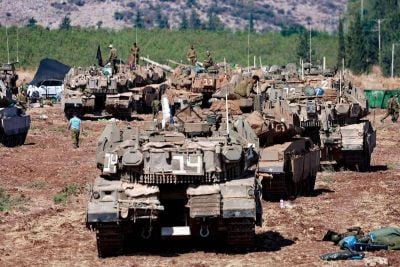
Erlich, wearing military uniform and carrying a weapon, was accompanied in the zone by a senior officer of the Golani Brigade, one of five divisions involved in the Israeli ground offensive launched in southern Lebanon on Sept. 30.
It was in this historic structure that Erlich and an Israeli soldier were killed, while another soldier sustained severe injuries, according to Israeli media. Although Erlich was neither an active-duty soldier nor a reservist, Haaretz reported that an army official posthumously declared him a “fallen soldier,” retroactively listing him as a reservist at the time of his death.
This was reportedly not Erlich’s first entry into Lebanese territory since the outbreak of the war between Israel and Hezbollah on Oct. 8, 2023, according to Haaretz, though no further details were provided.
Beyond the uproar over a potential security breach within Israel’s chain of command, Erlich’s profile has also sparked significant debate. The UK-based online outlet Middle East Eye described Erlich as part of a group of extremist settlers. The outlet highlighted his 2012 military-guarded “archaeological tours” in Palestinian villages.
The regional council of Binyamin referred to him as a “renowned researcher” in the field of “exploring and colonizing the land of Israel.”
On social media, pro-Lebanese accounts criticized Erlich as a man known for “falsifying history,” accusing him of attempting to prove that the Lebanese territory he was on belonged to Israel.
Conversely, pro-Israeli accounts praised him as a historian celebrated for his knowledge of Hebrew scriptures, which Israel’s most extreme factions cite as justification for their occupation of territories, including southern Lebanon.
Erlich is not the first Israeli citizen to enter Lebanese territory. On Oct. 14, the Israeli military organized a media tour in several villages in southern Lebanon, inviting Israeli journalists and Western media professionals to observe what it claimed were tunnels belonging to Hezbollah. Additionally, an Israeli Channel 12 presenter filmed his active participation in an Israeli army attack, involving booby-trapping and razing houses in southern Lebanon.
This article originally appeared in French in L'Orient Le-Jour.
