






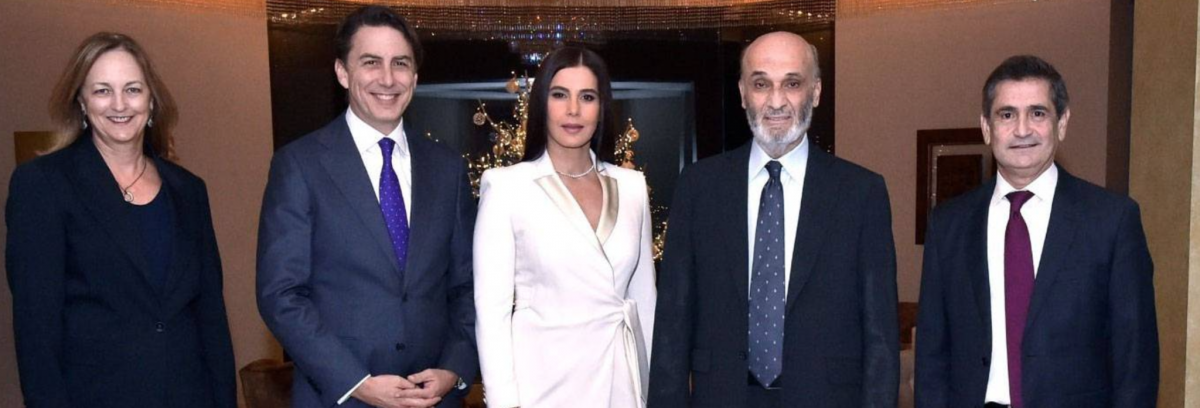
Lebanese Forces leader Samir Geagea receives U.S. envoy Amos Hochstein, in the presence of U.S. ambassador Lisa Johnson, Sethrida Geagea and former minister Richard Kouyoumjian, in Maarab, Nov. 19, 2024. (Credit: National News Agency)






“Any solution that is not based on the application of international resolutions 1559, 1680, 1701 and the relevant clauses of the Taif Agreement will be of no use to Lebanon.” These words were spoken on Tuesday evening by the leader of the Lebanese Forces (LF), Samir Geagea, to the American envoy Amos Hochstein, whom he was receiving for dinner in Maarab.
Hochstein has been in Beirut since Tuesday morning in an attempt to advance negotiations on a possible cease-fire between Hezbollah and Israel, at war since Oct. 8, 2023.
Resolutions 1680 and 1701 were both approved in 2006. The former concerns the delineation of the land border between Lebanon and Syria, while the latter, which put an end to the July war, calls for the withdrawal of the party from areas south of the Litani River. The 1559 agreement dates from 2004 and calls for the disarmament of “Lebanese and non-Lebanese militias.”
Hochstein briefed Geagea on the progress of his cease-fire negotiations and the mechanisms for implementing Resolution 1701. He added that he was awaiting replies from the Lebanese side, which he would pass on to Israel if there were any serious positive elements to build on.
The meeting was attended by U.S. ambassador Lisa Johnson, MP Sethrida Geagea, wife of the LF leader, and former minister Richard Kouyoumjian, responsible for external relations within the LF, reports the official National News Agency (NNA).
Hochstein, the Biden administration's American envoy, is still in Lebanon, according to local media reports. Sources confirmed to LBCI that he is “continuing his discussions” on a possible cease-fire, before heading to Tel Aviv.
He held talks with former Lebanese President Michel Aoun at his home in Rabieh, according to a message on X from the former head of state. During the meeting, the American diplomat “updated Aoun on the status of cease-fire negotiation.s” The two men exchanged “ideas and suggestions” on how to “strengthen Lebanon's rights and the role of the Lebanese Army.”
One year after Hezbollah opened a Gaza-supporting front in southern Lebanon, on Oct. 8, 2023, the day after the Palestinian Hamas movement attacked Israeli territory and the two belligerents exchanged fire across the border, the Israeli army stepped up a gear, increasing the intensity of its bombardments in southern Lebanon, the Bekaa and Beirut's southern suburbs. Recent strikes have even hit parts of Beirut previously spared. The war has already killed 3,544 people and wounded 15,036 in Lebanon, according to the latest figures from the Lebanese Health Ministry published on Tuesday.

