





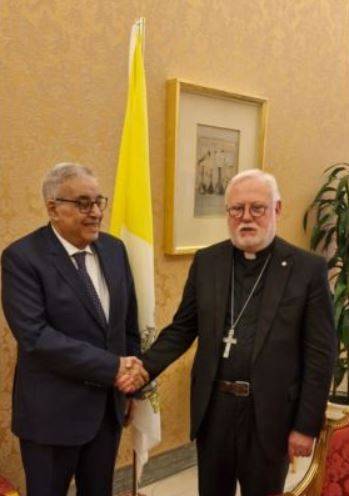
Lebanon's caretaker Minister of Foreign Affairs and Expatriates, Abdallah Bou Habib (l.), and the Holy See's Minister of Foreign Affairs, Cardinal Richard Paul Gallagher. (Credit: NNA)






As part of his week-long European tour that began on Sunday, aimed at advocating for a cease-fire in Lebanon, caretaker Foreign Minister Abdallah Bou Habib first visited the Vatican, where he met with the Holy See’s Foreign Minister, Cardinal Richard Paul Gallagher. "I sensed the Vatican’s deep concern over the deteriorating situation in Lebanon, particularly the fate of 16 Christian villages in southern Lebanon, as well as the political deadlock and the failure to elect a president. I also sensed the Vatican’s desire to help Lebanon overcome this crisis, and we agreed on the need to stop the suffering and killing," the Lebanese diplomat said after the meeting. "Cardinal Gallagher told me that he admired the Lebanese people’s ability to shine and succeed despite everything," he added.
The European tour aims to garner broader diplomatic support for a cease-fire in Lebanon, culminating in the Paris conference set for Thursday, Oct. 24, initiated by France to provide aid to Lebanon. On Sept. 23, after nearly a year of attritional conflict between Hezbollah and Israel at the southern border, Israel launched a large-scale offensive in southern Lebanon and the Bekaa, displacing more than a million people and raising the war’s death toll to over 2,400 with 11,200 wounded. In Italy, Bou Habib will attend a meeting of G7 foreign ministers (Germany, Canada, the U.S., France, Italy, Japan, and the U.K.) in Pescara, at the official invitation of his Italian counterpart, Antonio Tajani.
According to a statement from the ministry published by the National News Agency (NNA), Bou Habib will advocate for the "full and balanced" implementation of U.N. Security Council Resolution 1701 and for strengthening the deployment of the Lebanese Army south of the Litani River, in line with the resolution's provisions. He will also request urgent humanitarian aid to address the displacement of about a quarter of Lebanon's population—1.4 million people—since the beginning of Israel’s expanded military offensive on Sept. 23.

 7 p.m. recap: Iran warns Egypt, Israeli soldiers vote in south Lebanon, Haret Hreik responds to Kataeb