



Pro-Palestinian demonstrators march with signs and banners through the streets of New York as part of a city-wide protest against Israeli Prime Minister Benjamin Netanyahu, on Sept. 26, 2024. (Credit: AFP)






Israeli teams had meetings on Thursday to discuss the U.S. cease-fire proposals with Lebanon and will continue discussions in the coming days, Israeli Prime Minister Benjamin Netanyahu said on Friday, adding that he "appreciated the U.S. efforts to mediate."
“Our teams met on Thursday to discuss the American initiative and how we can advance the common goal of bringing people safely back home. We will continue these discussions in the coming days,” Netanyahu said in a statement, released to “clarify” his position, as he is due to deliver a speech at the United Nations General Assembly in New York on Friday evening.
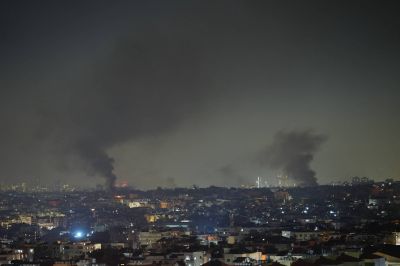
These statements followed after Israeli Foreign Minister Israel Katz declared on Thursday that there would be no cease-fire with Lebanon, after an intensive Israeli military offensive ignited on Monday in southern Lebanon and the Bekaa regions, killing over 600 people, injuring thousands and displacing tens of thousands.
Netanyahu himself declared on Thursday that Israel's policy was clear: “We continue to hit Hezbollah with all our might. We will not stop until we have achieved all our goals, primarily the safe return of northern residents to their homes. That is the policy, and no one should be mistaken about it.” The United States, the European Union and other allies, as well as several Arab states, have issued a joint call for a halt to the fighting in Lebanon for 21 days.
The call for a three-week cease-fire came hours after Israeli army chief, Lieutenant General Herzi Halevi, on Wednesday asked soldiers to prepare for a possible ground offensive against Hezbollah. On Friday, an Israeli security official told journalists, on condition of anonymity, that a possible ground operation against Hezbollah in Lebanon would be “as short” as possible, reported AFP.
“A mistake”
On Thursday, President Emmanuel Macron said it would be “a mistake” on the part of the Israeli Prime Minister to reject the proposed cease-fire in Lebanon and that he would then take the “responsibility” for a regional escalation. “The proposal made is a solid one. It was not made frivolously,” he said at a press conference in Montreal with Canadian Prime Minister Justin Trudeau.
It was “prepared, negotiated with Prime Minister Netanyahu and his teams, both by the Americans and by ourselves,” Macron said. “I think it would be a mistake for the (Israeli) Prime Minister to reject it because he would take responsibility for a regional escalation, obviously new civilian casualties in Lebanon, but an escalation far beyond, which no one would control,” he added.
“We must absolutely achieve a cease-fire immediately,” echoed the Canadian Prime Minister, speaking of “horrible images.”
The French president estimated that Israel's initial reactions, indicating a rejection of the proposal, were not “definitive” and mentioned the possibility of convening a new Security Council on the subject to “increase the pressure.”
For or against a cease-fire?
On the same day, U.S. Secretary of State Antony Blinken met with Israeli Strategic Affairs Minister Ron Dermer in New York and warned that further escalation of the war would only create difficulties in reaching a prisoner exchange agreement with Hamas and bringing home northern Israeli residents, reported the site al-Modon on Friday.
“The message that President Joe Biden’s advisers received from Dermer is that Netanyahu believes that a temporary cease-fire is the right thing because he does not want to be drawn into a ground invasion that could lead to entanglement and erode the achievements that the Israeli army has accomplished so far,” said a source with direct knowledge of the talks, revealed the American site Axios.
This official also said that the White House would not have advanced the cease-fire initiative if it had not received the assurance from Netanyahu and the Lebanese side that both parties agreed in principle.

 7 p.m. recap: Netanyahu seeks mastermind behind Flydubai incident; Washington sanctions 2 French nationals; Ben Gvir's 'I want to kill you' threat