






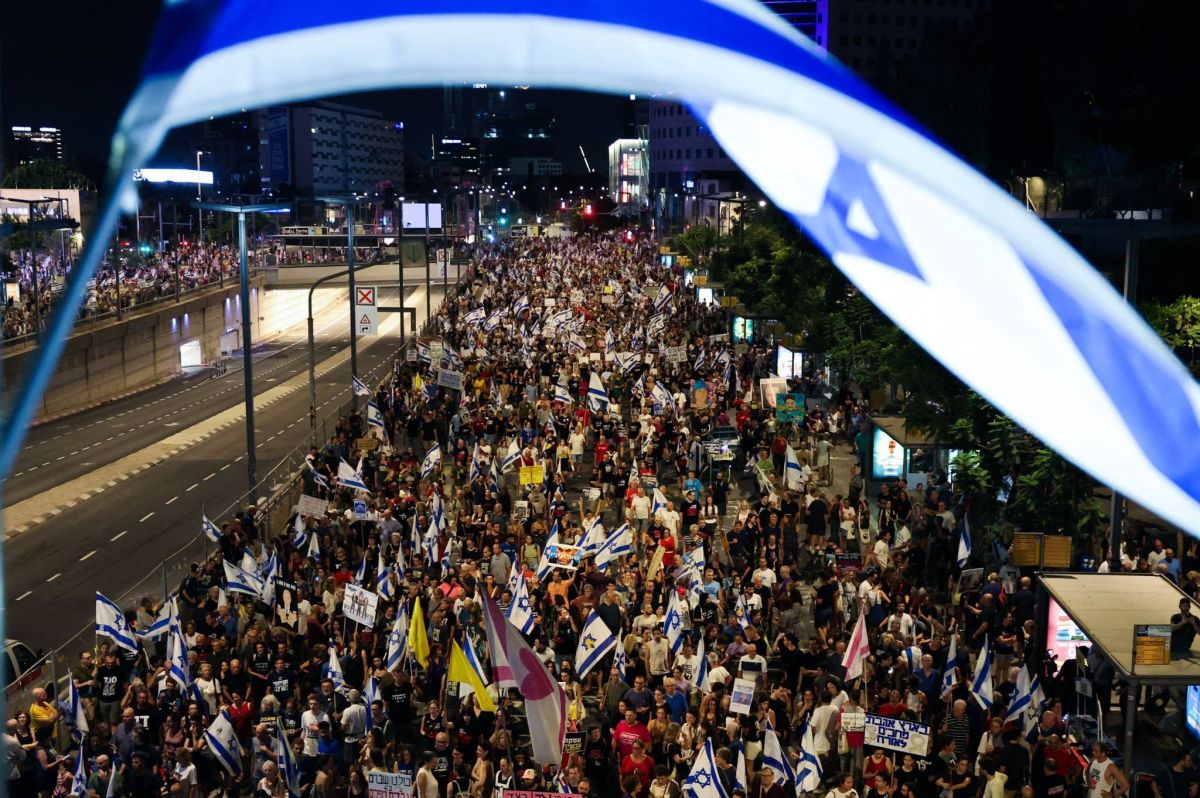
Demonstrators lift placards and flags during a protest calling for the release of Israelis held hostage by Palestinian militants in Gaza since October, in Tel Aviv on Aug. 31, 2024. (Credit: Jack Guez/AFP)






While six hostages were found dead on Saturday, Aug. 31, in a tunnel in Gaza, videos were released shortly afterward showing two of these captives, who were reportedly executed by Hamas, still alive. This has fueled anger among the families and relatives of the hostages still held in the strip, as Benjamin Netanyahu's government continues to refuse to finalize a cease-fire agreement that would include the release of some of the nearly 100 captives still in Gaza. For nearly a week, protests seeking a deal to bring the hostages back have continued, with a general strike even being observed on Monday, Sept. 2, before being canceled by the judiciary.
A Strategy from the Early Days of the War
The videos released by Hamas are said to be part of a communication strategy used by the Islamist movement to pressure Israel amid the ongoing war that has been raging since Oct. 7, 2023. In interviews with the Wall Street Journal (WSJ), released hostages have described how they were forced to record multiple propaganda videos under duress during their detention in Gaza, in response to the movement's staged productions.
Aviva Siegel, kidnapped from Kfar Aza kibbutz and held for 51 days in tunnels and elsewhere, stated that her captors filmed her repeatedly, dictating what she had to say. 'I always forgot something,' she told the WSJ, explaining how they instructed her to include specific details such as her age and a plea to Israeli Prime Minister Benjamin Netanyahu. 'So I had to repeat it over and over,' she added, quoted by the WSJ. At other times, she was filmed near her guards while eating, forced to smile and say that everything was fine in front of the camera, she further recounted.

A Form of 'Psychological Torture'
Arab mediators and officials in contact with Hamas told the American newspaper that the Palestinian group's activists, listed as a terrorist organization by Israel, the United States, and the European Union, were instructed to frequently take photos and videos of the roughly 250 hostages captured during the Oct. 7 attack and that these recordings were stored in vast archives. Chen Almog-Goldstein, a former hostage taken with her three children, claimed that 'on the second day in Gaza, they filmed us inside the tunnels,' adding that her captors placed Israeli snacks in their hands for the video. However, like others, this recording was never released. According to the Hostage Families Forum, which represents most of the captives' relatives, many detainees were forced to record videos during their captivity in Gaza, the American newspaper further reported.
Some videos, edited by professional teams, were nevertheless shared by Hamas outside the Gaza Strip to pressure the Israeli government, according to the aforementioned sources. 'I think they have a huge impact on Israeli society, and that’s their aim,' said Gershon Baskin, a former Israeli negotiator involved in the 2011 prisoner exchange with Hamas, referring to the videos produced by the group. Israeli officials and relatives of the hostages have, for their part, denounced this as a form of 'psychological torture.' This tactic underscores the centrality of the hostages in Hamas’ strategy to survive the war, as Benjamin Netanyahu has vowed to 'eliminate' the movement.
While Israeli media previously avoided showing the videos to the public, over time, the hostages' families pushed for them to be aired to make the situation a priority. Of the 251 hostages captured on Oct. 7 in Israel, 97 are still being held in Gaza, with more than half potentially already dead. Pressing for an agreement, the hostages' families and Israeli security services warn that time is running out for the remaining captives due to the harsh conditions. While the videos released by Hamas provide proof of life to the families, the Palestinian group, along with its ally Islamic Jihad, is said to have staged scenes of hostages being provided with meals or getting haircuts, to give the impression that the captives were being well-treated, according to the WSJ. The production of hostage videos under duress may also constitute a war crime, according to the newspaper.
