






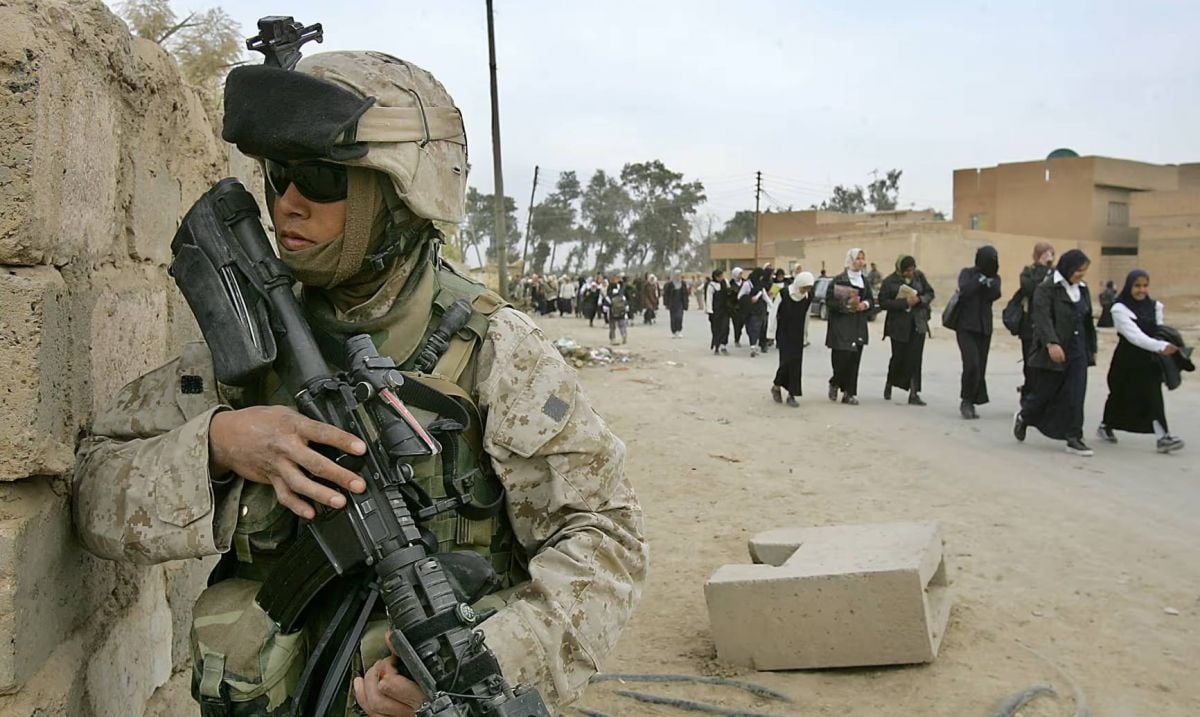
A U.S. Marine patrols the Iraqi town of Yusufiyah, south of Baghdad, in December 2004, as a group of schoolgirls walk home. (Credit: Odd Andersen/AFP)






"What happened during this massacre will be revealed," an Iraqi lawyer, who lost several family members in what became known as the Haditha massacre in Iraq, told a fellow Iraqi who also lost relatives in the November 2005 killings by U.S. Marines, according to the New Yorker magazine.
The lawyer was trying to convince the other man to sign a petition – initiated by the New Yorker – to have the U.S. military release years later the photos taken after the massacre by two Marines, in which 24 civilians were killed. The images were finally obtained after a long legal battle by the media outlet, which first published them on Aug. 27.
What happened on Nov. 19, 2005 in Haditha? What do the photos obtained on this event provide? L'Orient-Le Jour returns to this event of the American invasion of Iraq in 2003.
The facts
Haditha is a rural town in Anbar province, located 240 kilometers north of Baghdad, on the Euphrates. The events of Nov. 19, 2005, in the midst of the Iraq War (2003-2011), began at 7:15 a.m. when a vehicle from a patrol of the 3rd Battalion of the 1st Marine Regiment traveling in Haditha exploded while driving over an improvised explosive device, placed by "insurgents," according to testimonies cited, notably in an article in the Washington Post dating from April 2007 and citing documents from the US Army investigation.
The explosion killed Corporal Miguel Terrazas, who was driving the vehicle, and wounded two other soldiers. In retaliation, two Marines immediately pulled five civilians out of a car and shot them. After reinforcements arrived, the Marines were reportedly fired upon by "small arms fire from a nearby house." Their lieutenant then ordered the house from which the gunfire came to be "stormed," as well as others nearby. One of the soldiers present, Staff Sergeant Frank D. Wuterich, said he followed "the rules of engagement" and first threw fragmentation grenades before firing.
The victims
In total, the massacre left 24 victims, men, women and children, some "still in bed in their pajamas," according to the Washington Post article.
The New Yorker points out that the youngest victim was three years old and the oldest 76. Among them, the magazine published the photos of Zeina Salim, a five-year-old girl, killed in a bed next to her mother, Aida Ahmad, forty years old, her sisters Sabaa, ten years old, Aisha, three years old, the youngest of the victims, and her brother Mohammad, eight years old. Another sister of the Salim siblings, Nour, aged fifteen, was also killed in the same room, while Safa, who was eleven years old, was able to survive by hiding. Asma Rassif, thirty-two years old, and her four-year-old son, Abdallah, were killed in another room. Abdallah was hit by a bullet in the head, fired according to investigators from less than two meters away. In this living room was found the mortal remains of Jahid Hassan, 43 years old. In another house attacked was Khoumeissa Ali, 66 years old.
Another photo shows the five passengers of the vehicle killed by the Marines just after the explosion on the road in front of the stormed houses. They are Wajdi Abdelhussein, 19, Akram Fleh, 19, Khalid Abdel Hussein, 26, and Mohammad Ahmad, 21.
After the incident, two soldiers went to the scene and took photos of the bodies, which they numbered with a red marker.
No conviction
While the case was initially swept under the carpet after the Marines claimed the victims were armed insurgents and that some of the deaths were caused by the roadside bomb, it was a 2006 Time Magazine investigation that shed light on the deliberate killing of civilians.
A dual investigation into the killings by the U.S. military was launched, one into the events of Nov. 19, 2005, and the other into why the military was not informed sooner of what had happened, a military official told CNN in May 2006.
As part of the first investigation, eight Marines faced criminal charges or administrative sanctions, including Staff Sergeant Frank Wuterich. Between April 2007 and June 2008, charges against seven of them were dropped, either in exchange for testimony or because the evidence against them was deemed too weak. The officer who was at the scene, Wuterich, was finally court-martialed in 2012 on charges of voluntary manslaughter, aggravated assault, reckless endangerment, dereliction of duty and obstruction of justice. The officer pleaded guilty to negligent dereliction of duty and was sentenced a few days later to 90 days in custody, which he did not serve for procedural reasons. He was demoted to private.
The importance of photographs in documenting the massacre
According to Madeleine Baran, the journalist who wrote the New Yorker article, one of the reasons for the light sentences against the military is the lack of damning images, unlike other scandals involving the army such as that of the Abu Ghraib prison, when the army and CIA agents were accused of violations of prisoners' rights between 2003 and 2004, after having physically and sexually abused detainees. This is what prompted the journalist to request photos of the massacre from the U.S. Army in 2020, citing the Freedom of Information Act. In the absence of a response, she filed a complaint against the troops. It was after having obtained the agreement of the victims' families, in coordination with some of them on the ground, to strengthen her legal request, that she finally accessed the images.
This article originally appeared in French in L'Orient-Le Jour.
