


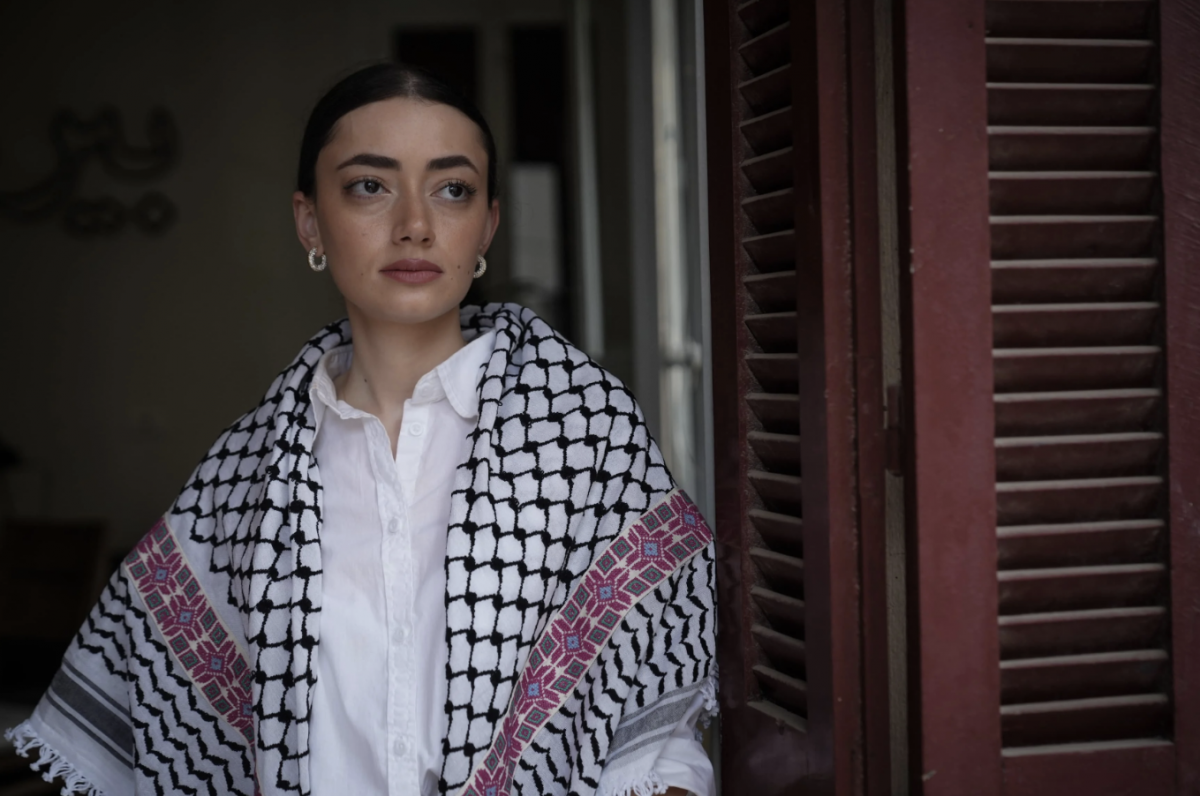
Plestia Alaqad: Feelings as if anaesthetized. (Credit: Mohammad Yassine)






She could have been gone. She could have been among the more than 40,000 deaths officially recorded by Gaza's Health Ministry. Plestia Alaqad, heroic journalist, is a survivor of the Gaza massacre: A miracle.
To her, being a journalist and a Palestinian means "knowing deep down that you'll end up covering the destruction of your own city." After covering the first two months of the Palestinian enclave's nightmare, she was lucky enough to leave, but “not voluntarily,” she said.
Today, even if she is no longer physically in the Palestine of her origins, she still lives in Gaza in her mind, with all the trauma she carries with her. So much so that she says she no longer knows what it means to live.
For her first interview with the Lebanese press, Alaqad answered our questions from Beirut, where she has just moved to pursue a master's degree at the American University of Beirut. With something akin to emotional anesthesia, she told us about her childhood memories in Gaza — with its “unassailable sea, which remains despite all that Israel has been able to destroy” —, her first contact with the Israeli occupation and her life before and after Oct. 7.
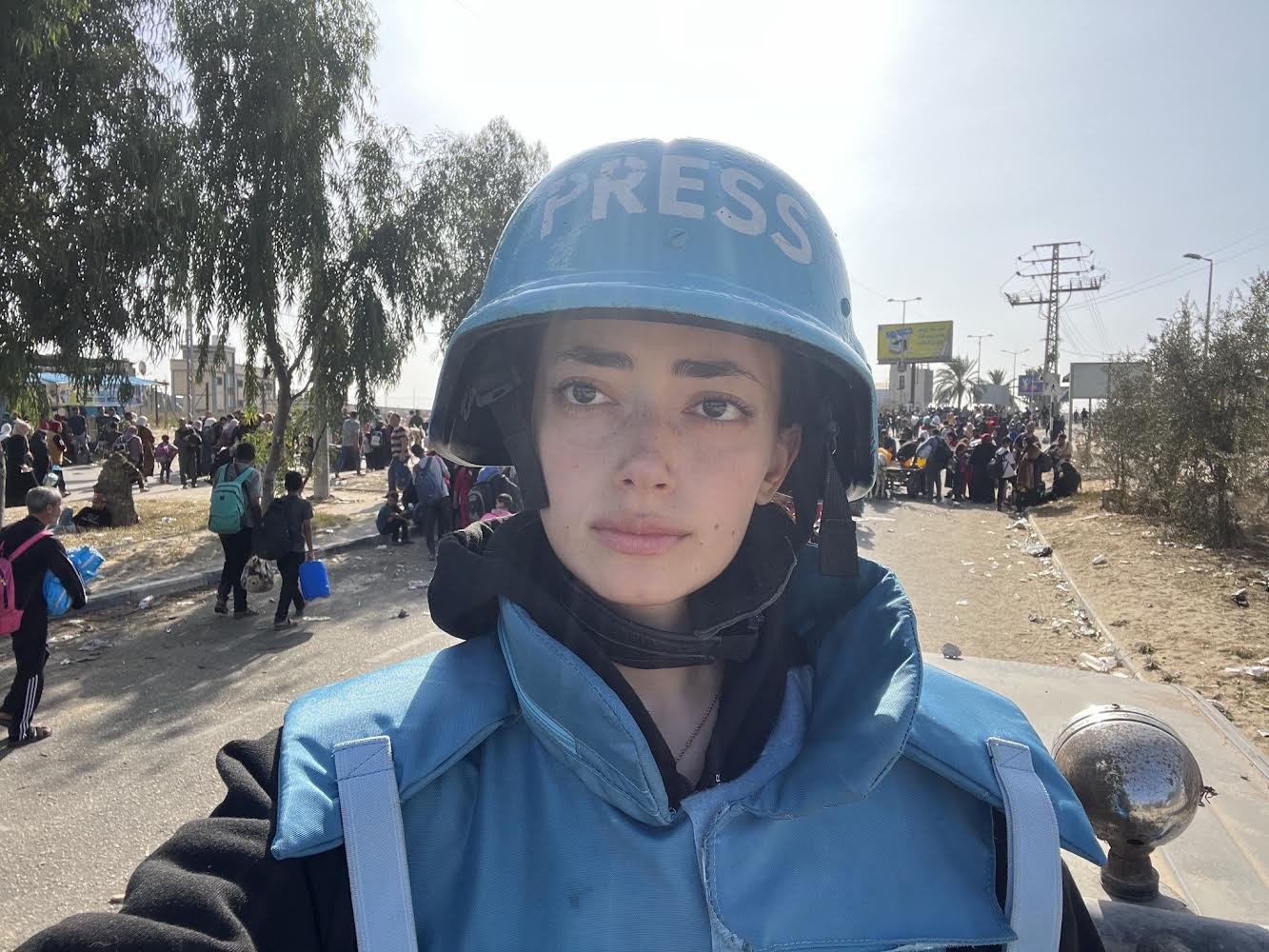 Plestia Alaqad covered the Gaza war for two months. (Credit: Plestia Alaqad)
What brings you to Lebanon at the moment? Are you worried about being in a country where an all-out war could break out at any moment?
I've just moved to Lebanon for the next two years to study for a master's degree in media at the American University of Beirut, after getting the Shireen Abu Akleh [the Palestinian journalist murdered by Israel in 2021] scholarship. I chose to pursue my studies because the more the Israeli occupation forces target schools and universities, the more education seems to me to be a precious and crucial tool. As toxic as it sounds, being in an unstable country where war could break out at any moment doesn't scare me. It reminds me of home. Even if I think and hope that nothing as extreme as what I experienced in Gaza will happen here.
Let's start with your childhood in Gaza. What are your most vivid memories of this period?
My first memory is always of the sea. We lived a 10 minutes' walk from the sea. I remember going there almost every day, especially on Fridays. The beach was always crowded. And today, with all that's going on, at least there's still the sea.
The sea is unassailable. Israel can bomb anything — hospitals, schools, churches — but when it comes to the sea, nothing can touch it. Even though I spent my whole life there [in Gaza], today, looking at the photos, I no longer recognize most of the places or the streets, which are now nothing but sand. But when I see the sea, I say to myself, “Ah, I recognize that.” The sea is the only thing that will always remain. It's my landmark.
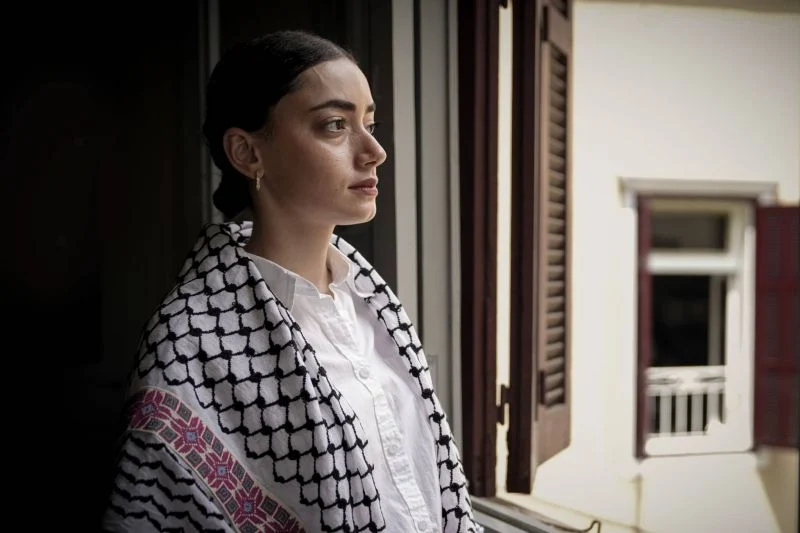 The 22-year-old Palestinian journalist, Plestia Alaqad. (Credit: Mohammad Yassine)
When did you first become aware of the reality of occupation, either as a concept or through concrete experience?
In 2014, I was 13 years old. It was my uncle's wedding, an opportunity for the whole family to get together. But unfortunately, in Gaza, the Israeli attack had started at the same time. The borders were closed, and we couldn't travel. That's when I understood what the occupation means, how it limits and controls our lives.
Another memory comes back to me: My family and I were in Egypt, in a hotel room. Barely 10 years old, I was anxious, repeating to my mother, “We need to find electricity to charge our phone.” She replied, “It's okay, there's always electricity here in Egypt.” I was surprised, because for us, it was normal to have a limited number of hours of electricity per day. My mother then explained to me that it was because of the occupation that our lives resembled a prison.
There are many misconceptions and distortions about life in Gaza before the war. Could you share with us what life was really like there?
There were always limitations, as we lived under blockade and occupation, but it was the only normalcy we knew. Limited imports, scarce job opportunities, restricted electricity hours, the inability to travel freely: It was all part of our life, a life marked by uncertainty. Travel outside Gaza was difficult, and even with a permit, the restrictions were humiliating. We weren't allowed, for example, to take liquids with us, or travel with wheeled suitcases. Daily life was unpredictable, making planning impossible.
On Oct. 6, I remember spending the day with my friend Yara in a café, applying for jobs and scholarships. We were dreaming about the future, but the next day, on Oct. 7, everything changed. No matter what our plans were, Israel always had another plan for us. But we knew we deserved a normal life, not one “normalized” by the occupation. The resistance that runs through our veins drives us to live, and despite everything, places like cafés, restaurants and the sea are always crowded, because people want to live.
Many people wonder about the situation of women in Gaza, especially under the influence of Hamas...
I blame the media for this. Honestly, the media have been dehumanizing us for decades, and they've always seen Palestinian women as a uniform block. They don't show the diversity that we are. Most people don't even know that there are Christians in Gaza. They often ask me what it's like to live in Gaza under Hamas. But the real problem isn't the government or Hamas, it's the occupation.
How can we move forward when, every few years, we're bombed for a different reason every time? Every time we build, or try to learn more, just move forward as a city, Israel bombs us and takes us back. One of the hardest things I experienced in October and November was spending my days looking for eggs or bread. I thought to myself, 'We're living in 2024, and instead of queuing for a job interview, I'm queuing to buy eggs.' It's so humiliating and sad to see how much power Israel has.
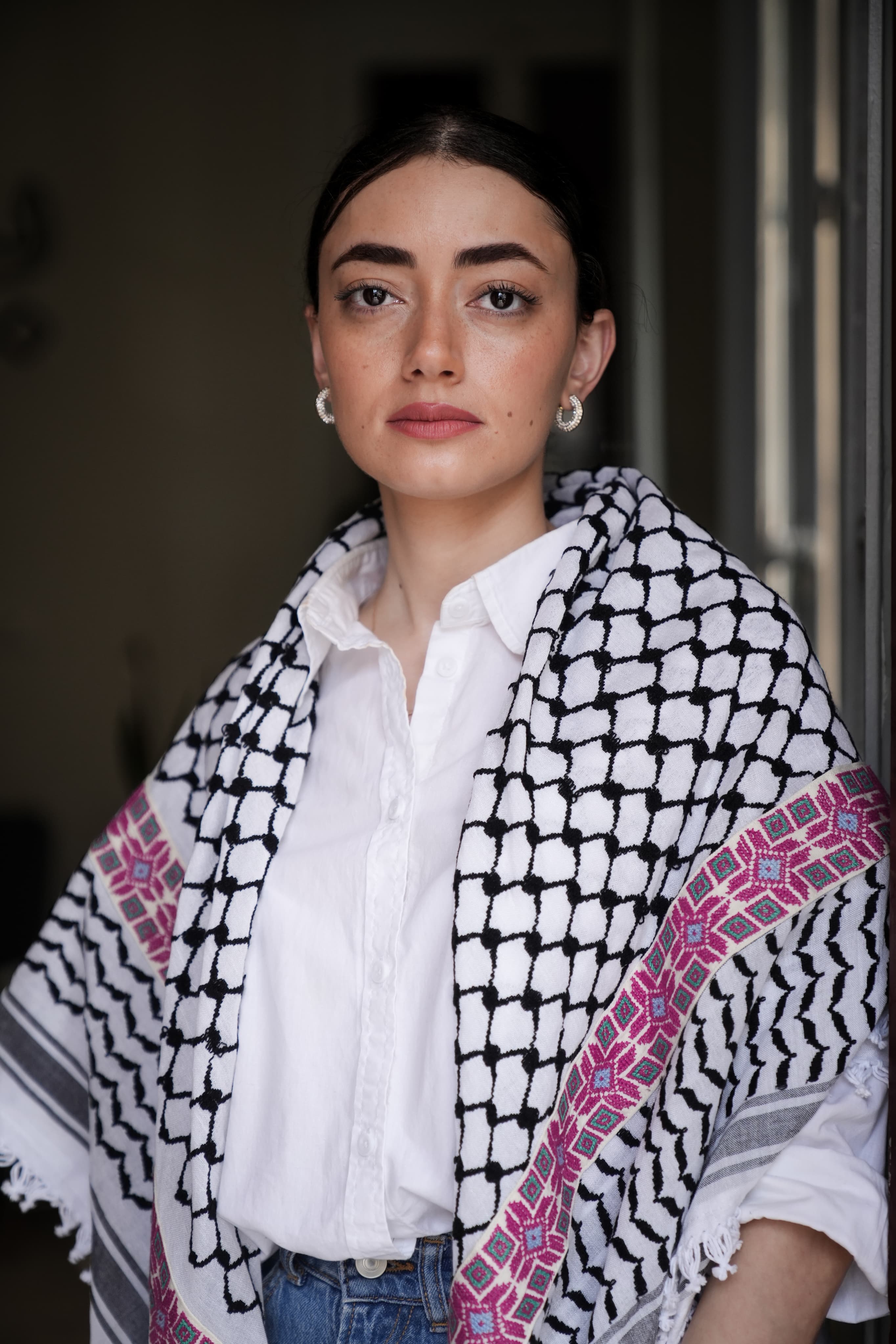 Plestia Alaqad: “We were dreaming about the future, but the next day, on Oct. 7, everything turned upside down.” (Credit: Mohammad Yassine)
On Oct. 7, your life changed in an instant. When the Hamas attack took place, did you expect what would happen to you in the days that followed?
I don't think any normal human mind could have imagined that it would last for this long or be this extreme. The attack by the Palestinian fighters lasted four hours, and now, for 10 months, we've been suffering from genocide as punishment. How could this make sense?
Tell us about your first experience of forced displacement.
Displacement in Gaza has been endless since the genocide. I only spent two months in Gaza and was displaced maybe six or seven times. But that's nothing compared to now. In two weeks, people move six or seven times. You're literally carrying your house, all your memories, your whole life in a bag, walking from one place to another in total uncertainty. I once heard a mother say, “I protected my son the whole way we moved, only to arrive in a place that was supposed to be safe, and get bombed.”
You know that at some point you'll be killed, you'll be targeted; you just don't know when. The first time I was displaced, I didn't have much time to take anything with me. I didn't even have my birth certificate or important papers. All I had was a small prayer book, the kind you use to pray for someone who has died. My grandfather had died before the war, and that was the only thing I took with me, along with my telephone.
Later, most of the house was demolished, but the building was still standing. So I went back to get my passport, but also lipstick. Don't ask me why. In this kind of situation, you don't have time to think or sort things out. You literally have no time, and you can be bombarded at any moment. So you just grab anything and go.
What made you decide to start covering events in the field?
I'm a journalist. That's my training. Studying journalism as a Palestinian, and more specifically from Gaza, means knowing, deep down, even if you don't want to, that you'll end up covering the destruction of your own city.
What's the one thing you saw in Gaza that you'll never forget?
I'd like to make it clear that what we see on social networks or in the media only represents 10-20 percent of what's really happening on the ground. Journalists work with many limitations and few resources, often with just a phone or a camera, and sometimes we have to choose which stories to document. It's heartbreaking, especially when so many people refuse to be filmed, having lost faith in humanity, wondering what the point is.
One image that will stay with me is that of a little girl in the hospital, aged five or six. She had lost her hand, and every night she would wake up looking around the hospital for it, wondering why she was the only one who had lost it. Her father told us her story, and it left a deep impression on me.
What the children are going through right now is an accumulation of traumas. I often wonder how these children will ever be able to overcome what they've seen, especially those who witnessed the death of their parents before their eyes.
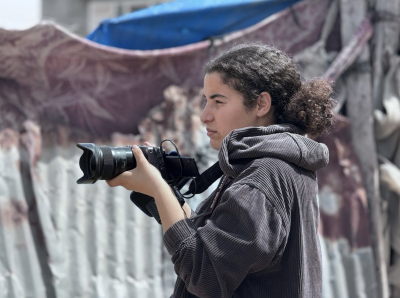
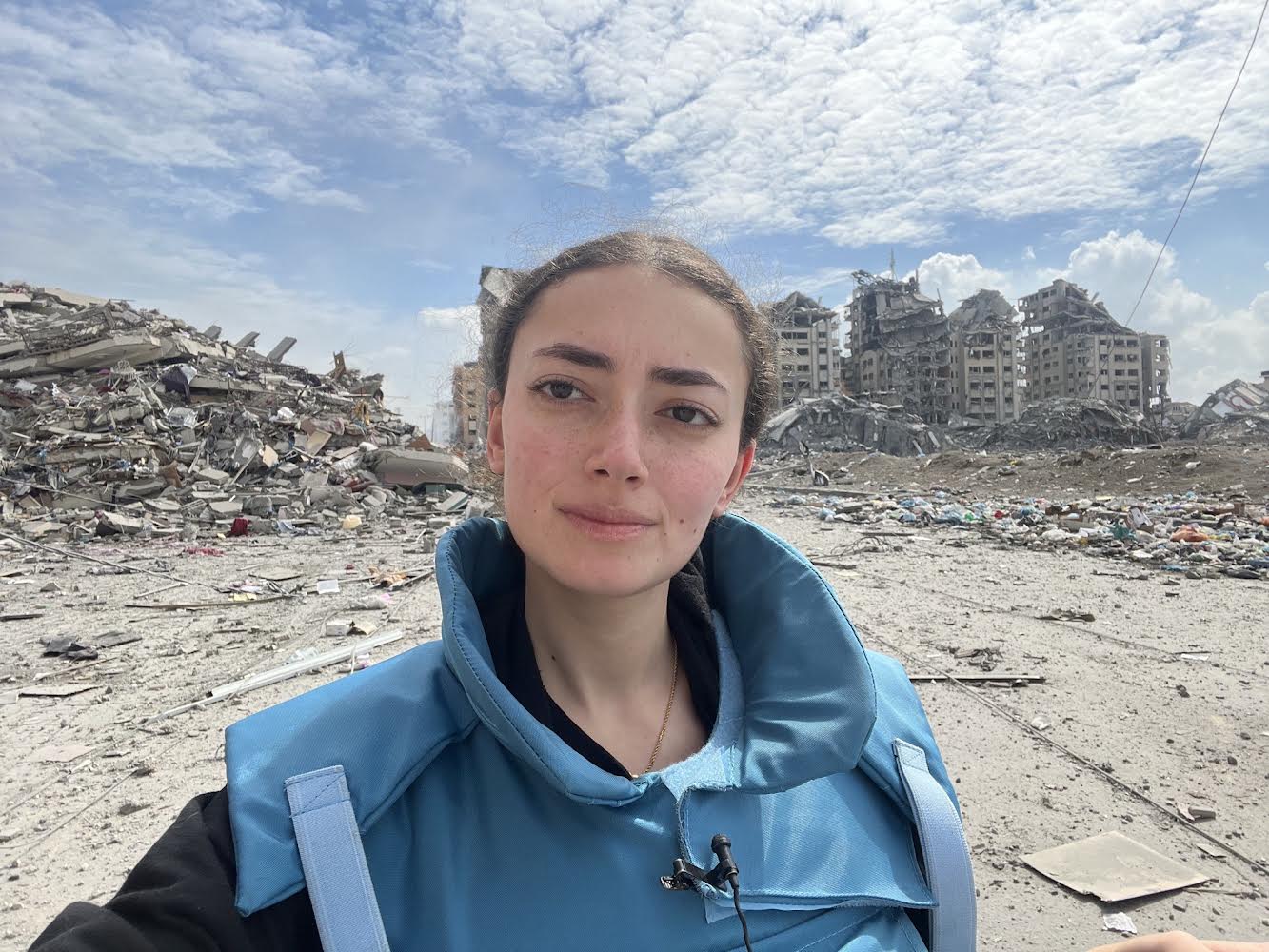 The young journalist in the field. (Credit: Plestia Alaqad)
What do you think is the biggest misconception about Gaza and the ongoing war?
What really makes me angry is that, ten months after the genocide began, some people are still saying that this is a war against Hamas. If it's a war against Hamas, then why are children, women, men, civilians being targeted and killed? How can it be called a war against Hamas when a study published in The Lancet puts the death toll at over 186,000?
Part of public opinion accuses Hamas of throwing its population into the lion's den...
Living in the Gaza Strip means that an Israeli war or aggression can happen at any time. This is also the case in the West Bank, where Hamas is non-existent. We're living with a noose around our necks, and the Palestinian fighters are confronting the Israeli occupation forces, supported by many countries with arms and money. This is not a war between two equal forces. So I don't blame any Palestinians for what's happening, because even if we stayed at home, Israel could bomb us without anyone reacting. After the first hospital bombing, I thought the world would finally react, but it hasn't changed a thing. If the world doesn't have the power to stop Israel, what can the Palestinian fighters do alone to liberate Palestine?
What motivated your decision to leave Gaza?
Leaving was never a decision. I see leaving Gaza as a forced move. I didn't have to make a decision. It just happened. Perhaps I was lucky enough to have a family member abroad with a dual nationality, which enabled us to leave. The sad thing is that the borders have now been closed for two months. Even the wounded can't get out for treatment.
What has your life been like since you left Gaza?
Even though I don't physically live there anymore, mentally I'm still there. It's really hard to watch the news, because I'm constantly terrified of hearing about the death of one of my cousins. At this point, it's not that I don't know what death is anymore, but rather that I don't know what it means to be alive.
Today, Gaza is in ruins, but the Palestinian cause has never enjoyed such worldwide support. How do you live with this paradox?
It's so ironic that Israel has been targeting us Palestinians for decades, ruining our beautiful homeland. And Gaza, for just as long. And it's only now that the world is beginning to learn about Palestine.
Gaza is almost destroyed, but it's only now that the whole world is standing by us. I'm grateful that at least, thanks to the work of Palestinian journalists, we're no longer allowing the media to dehumanize us. The world finally has a chance to hear the direct experiences of Palestinians. So yes, I'm grateful that the world is finally aware of our struggles, but I'm not grateful that over 186,000 Palestinians had to die for the world to become aware of our existence. I would have preferred that no one knew about us and that we could lead a normal life.
What do you expect from the world, and more specifically from Western and Arab nations, at this time?
Why do we always talk about the Western world and forget about the Arab world? Palestine is an Arab country, and the Arabs aren't doing enough to help us. I expect much more from them than is currently being done.
If you had the choice to return to your pre-war life or continuing in the current situation, which may or may not lead to liberation, what would you choose?
You can never really choose. Living in Gaza means that genocide can happen at any moment, even without the Palestinian fighters doing anything. Life has always been uncertain, and living with uncertainty isn't really living.
We were starving for life, starving for a normal existence, so we pretended to be happy, to go to the sea, and so on. But deep down, the situation was already very bad. Today, because of the extreme violence we're experiencing, people have begun to romanticize life before Oct. 7, but that life wasn't a life at all.
What do you miss most about Gaza?
The sea, and the sense of community.
Do you still hold out hope of returning one day?
Of course I do. I feel like I've left before I've done everything I was supposed to do there. I need to go back and finish my story when I decide to. What terrifies me most is the idea of returning to Gaza and not recognizing it anymore.
This article was originally published in L'Orient-Le Jour; English version edited by Yara Malka.

 7 p.m. recap: 1 person killed near border with Lebanon; 200 kilos of explosives carried by mules; Riyadh shuts its airspace