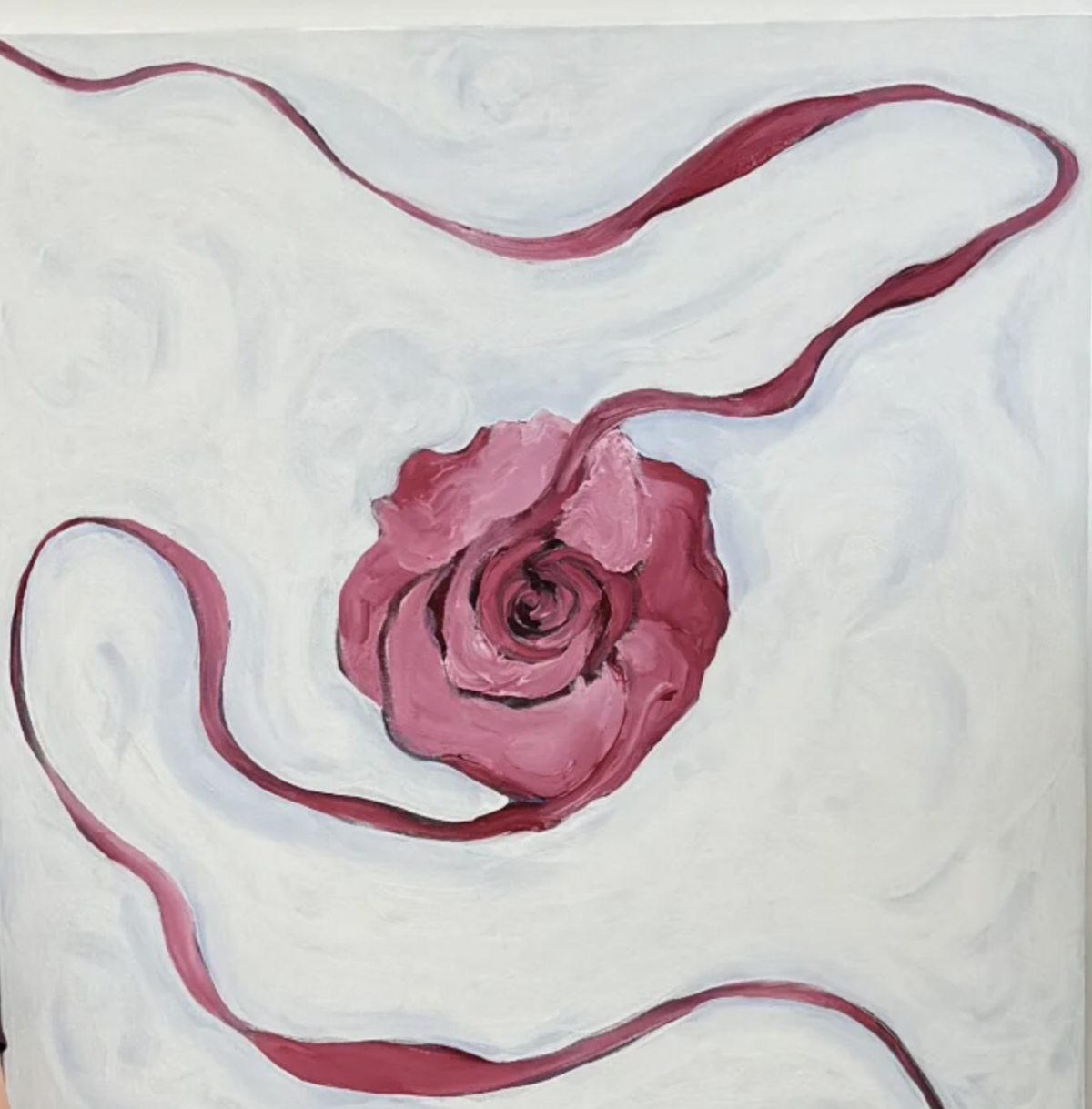
The rose with its spiraling petals, a recurring symbol of Seta Manoukian's new period. (Credit: The artist)






The Buddhist nun calmly strolled, dressed in saffron and dark red, among the happy few invited to the opening of her Dew Drops painting exhibition at Marfa’ Art Gallery in Beirut.
Seta Manoukian, 79, has a simplicity and modesty that we’d like to see contagious. Yet after mentioning her name to exhibition curators, curatorial specialists and major collectors, a chorus of admiration followed; She was one of the emblematic figures of the Lebanese art scene in the 1970s.
She is an artist whose paintings, imbued with a certain De Chirico metaphysics, marked the depiction of a twilight Beirut during the first years of the Civil War. These include eloquent paintings, inspired by newspaper photos, of people trapped in daily turmoil and an urban environment that had become a frontline.
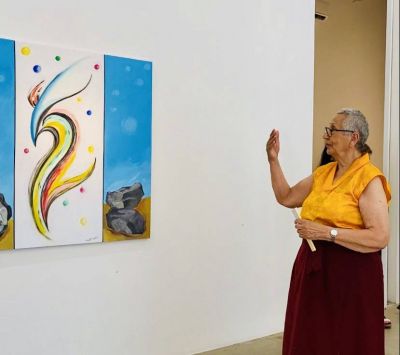
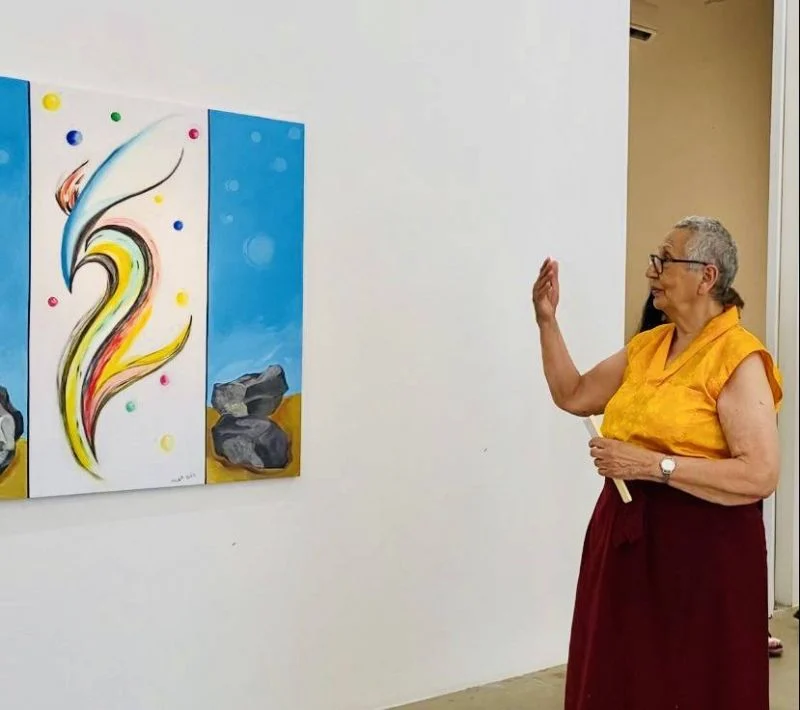 Seta Manoukian in front of one of her paintings at the Marfa' Gallery. (Credit: Yolla Edde)
She is a committed artist, pro-Palestinian activist and professor at the Lebanese University’s Faculty of Fine Arts. She is a member of the circle of artists and intellectuals who reworked the world at Horseshoe café in Hamra: Paul Guiragossian (one of her first teachers), Yvette Achkar, Hussein Madi, Rafik Sharaf and art critic Nazih Khater, all of whom left their mark on modern and contemporary Lebanese painting.
“Their company had a major impact on my career,” Seta Manoukian told L’Orient-Le Jour.
“Because it was their debates and exchanges on art and politics that opened the eyes of the naive, sheltered young woman I was at the time. I had just returned from four years of pure happiness and beauty spent in Italy, where I had studied at the Academy of Fine Arts in Rome, and I knew nothing of the state of the world and its cruelty. They nurtured in me the doubt, questioning and anxiety that later led me to seek out paths of peace and serenity,” she said.
Manoukian took a spiritual path in Los Angeles, in the States, where she settled in 1985 with her family and parents, “fed up with the empty words of politicians and the endless violence in which Lebanon was immersed.”
‘Beyond life and death’
In this capital of the film industry, glitter and expressways, she pursued her artistic work, increasingly marked by horizontal and vertical lines turned upside down by obtuse angles.
At the same time, however, she felt a profound lack of nature and authenticity, which she compensated for by practicing meditation.
“I needed to reconnect with myself, to go inside myself. I started meditating more and more until I was meditating eight hours a day. I then joined the Theravada Buddhist temple in Los Angeles, where I met my lama [master] who, by initiating me into Buddhist symbols, brought back memories of transcendental experiences I’d had in my youth in Lebanon,” she said.
From 1995 onwards, the artist intensified her spiritual commitment, rising through the ranks to become an ordained Buddhist nun. She put away her brushes for good, devoting herself exclusively to meditative prayer for ten years, before being caught up by her passion for painting.
“When people talked to me about art, I felt guilty, because I felt a state of withdrawal like that experienced by a former smoker. It took me a long time to realize that painting could also be another form of meditation” she said, once she returned to her painting in 2005.
But she never really came out of her retreat.
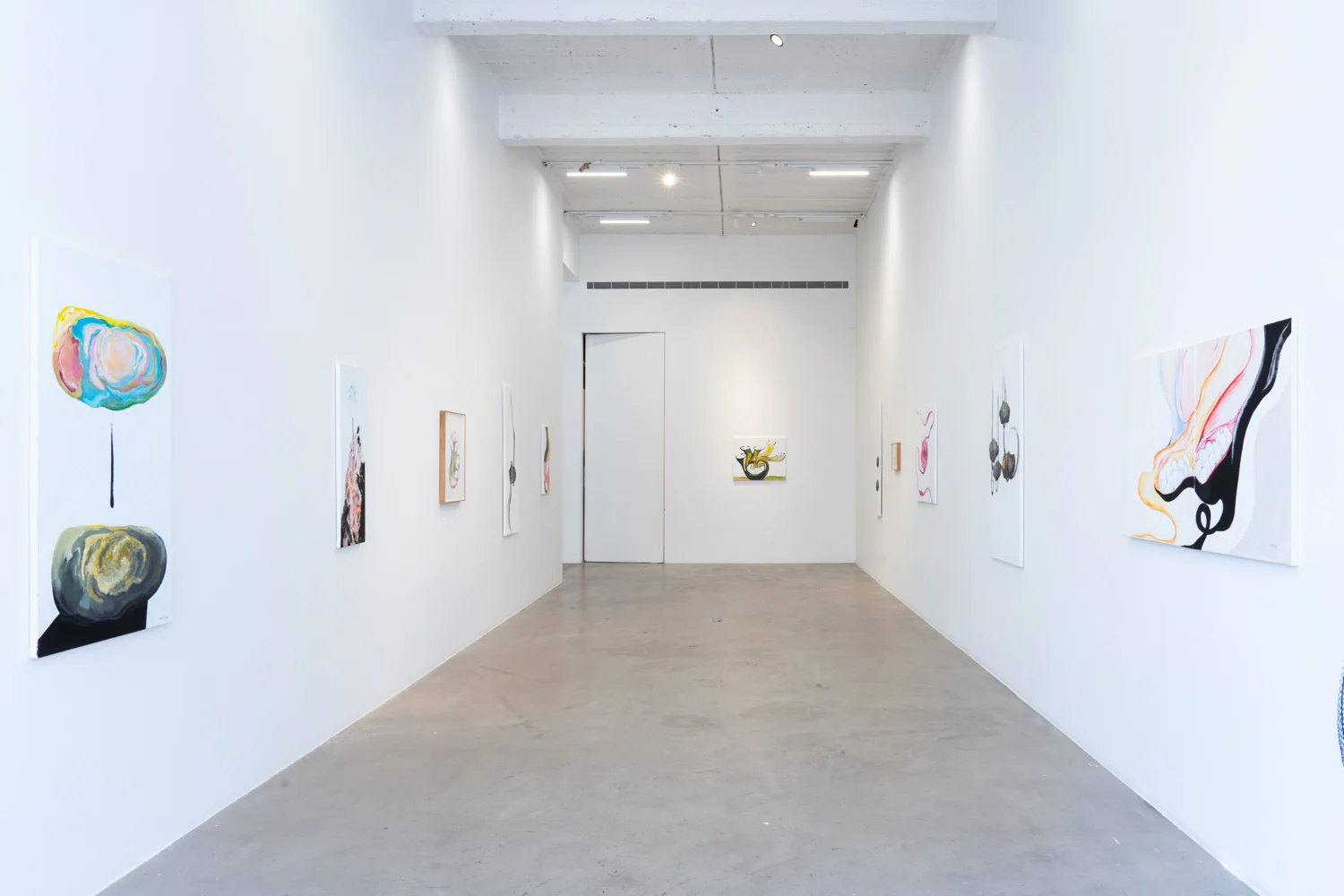 A view of Seta Manoukian's "Dew Drops" exhibition at Marfa' Gallery. (Credit: Galerie Marfa')
Blood, roses and stones
This is where Joumana Asseily, head of Marfa’ Art Gallery, looked for her. “I went to see her in Los Angeles to convince her to come back and show the new phase of her work in Lebanon. Her works from the last two decades are very different from her earlier work,” Asseili said.
This was a new period for the artist, with subjects and patterns clearly infused with Tibetan spirituality. For example, the Body Fluids, the playful representation of blood that Seta Manoukian now favors in her paintings, stems from her “inner journeys.”
This and the patterns evoking the duality of life and death represented in her eyes by delicate eggs, spiraling roses, loaves of bread, stones swaying on hair or the lyrebirds that recur in her work.
These vibrantly colored compositions on luminous white backgrounds will likely confound fans of Seta Manoukian’s earlier paintings. The artist, who is well aware of this, invites visitors to contemplate them, accompanying herself with Rumi’s quotation, “You’re not a drop in the ocean, you are the entire ocean in a drop.”
Seta Manoukian’s Dew Drops at Marfa’ until Sept. 7.
This article was originally published in L'Orient-Le Jour and translated by Joelle El Khoury.