






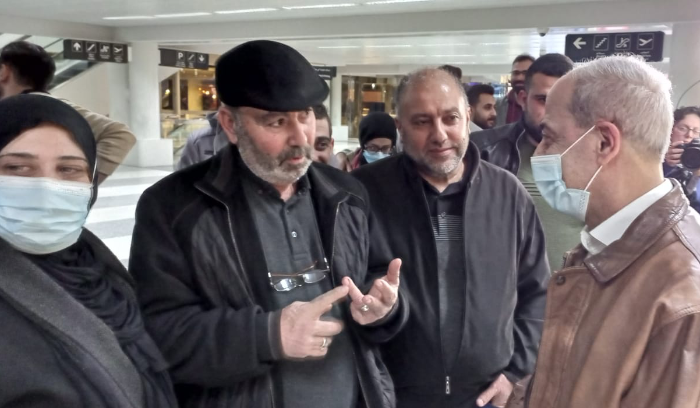
The first batch of Lebanese evacuees from Ukraine arrive in Beirut at 4 a.m. on March 2, 2022. (Credit: NNA)






Want to get the Morning Brief by email? Click here to sign up.
Joint parliamentary committees will convene this morning to study the student dollar law, the creation of a mandatory syndicate for licensed chemists, and a law to exempt some building permits from fees. The student dollar law requires banks to allow families with a student overseas to transfer up to $10,000 per year for tuition payments at the official lira exchange rate of LL1,507.5. Parliament passed a version of the legislation last December, but President Michel Aoun returned it to the chamber in January with proposed amendments. The proposed building permit law has come under criticism from some experts and observers who warn that it amounts to an electoral bribe by basically allowing people to build haphazardly. Authorizations granted to illegally built structures were historically given out ahead of elections as a bribe. Proponents of the law, however, say it will make it easier for people to build in the countryside.
Yet another lawsuit to remove Judge Tarek Bitar from the head of the Beirut port explosion investigation was filed yesterday. The new lawsuit, lodged at the Court of Cassation, was brought by the “committee of the martyrs of the explosion at the port of Beirut,” a breakaway group from the “families of the victims of the explosion” group. The breakaway group, led by Ibrahim Hoteit, was formed after Hoteit released a video late last year reversing his vocal support for Bitar and instead calling for him to be removed. Many speculated that political pressure was behind the abrupt change in position. The lawsuit will seemingly not impact the investigation for now, since it is already on hold since last December due to a similar suit by MPs and former Amal ministers Ghazi Zeaiter and Ali Hassan Khalil. The judge in charge of hearing that challenge by Zeaiter and Hassan Khalil is, of course, also subject to a request for removal by the two former ministers.
The British High Court of Justice ruled in favor of a Lebanese-British businessman and against two Lebanese banks for refusing to transfer funds abroad. The complainant, Vatche Manoukian, had requested a transfer of his funds and to close his accounts in Lebanon in 2019, however the banks refused due to the de-facto capital control measures they imposed at the start of the financial crisis. At issue is approximately $4 million in British pounds, US dollars and Euros that SGBL and Bank Audi refused to transfer. The British court ruled in Manoukian’s favor and ordered the banks to make the transfers, but the banks will have 21 days to appeal from the publication of the decision. At the end of 2021, the British High Court of Justice ruled in favor of BLOM Bank in a lawsuit initiated by one of its clients. In another late 2021 case, in France, Saradar Bank lost an initial trial but announced its intention to appeal.
The first wave of Lebanese citizens evacuated from Ukraine arrived at Beirut airport this morning, according to the state-run National News Agency. The group of 40 evacuees had been temporarily hosted by a Lebanese businessman Mohamad Murad in a hotel in Bucharest, Romania. Murad said via social media that “over 150” Lebanese students had arrived in Bucharest and “200” other individuals were en route from the border. Another wave will arrive “within 48 hours” coming from Warsaw, the NNA quoted the head of the Higher Relief Committee Mohamad Khair as saying. While the Ukrainian Embassy in Lebanon says there are approximately 1,800 Lebanese citizens in Ukraine, the Lebanese Embassy in Kyiv, the capital of the country Russia invaded last week, puts the number at 3,700.
Visits by delegations from the International Monetary Fund and the US Treasury Department are continuing, with both delegations meeting with President Michel Aoun yesterday. Aoun told the IMF delegation that Lebanon has no interest in delaying the implementation of financial and economic rescue plans. Lebanon has been suffering through a crisis for more than two years while the government has adopted a de facto policy of stalling in order to allow hyperinflation to shift financial losses onto the working and middle classes. The contents of the Treasury delegation’s discussion with Aoun was not immediately known but in December US Treasury Under-Secretary for Terrorism and Financial Intelligence Brian Nelson expressed his “disappointment” at the lack of initiative of the Lebanese banks in the fight against corruption.
In case you missed it, here’s our must-read story from yesterday: “Lebanese stuck in Ukraine left to their own devices”