



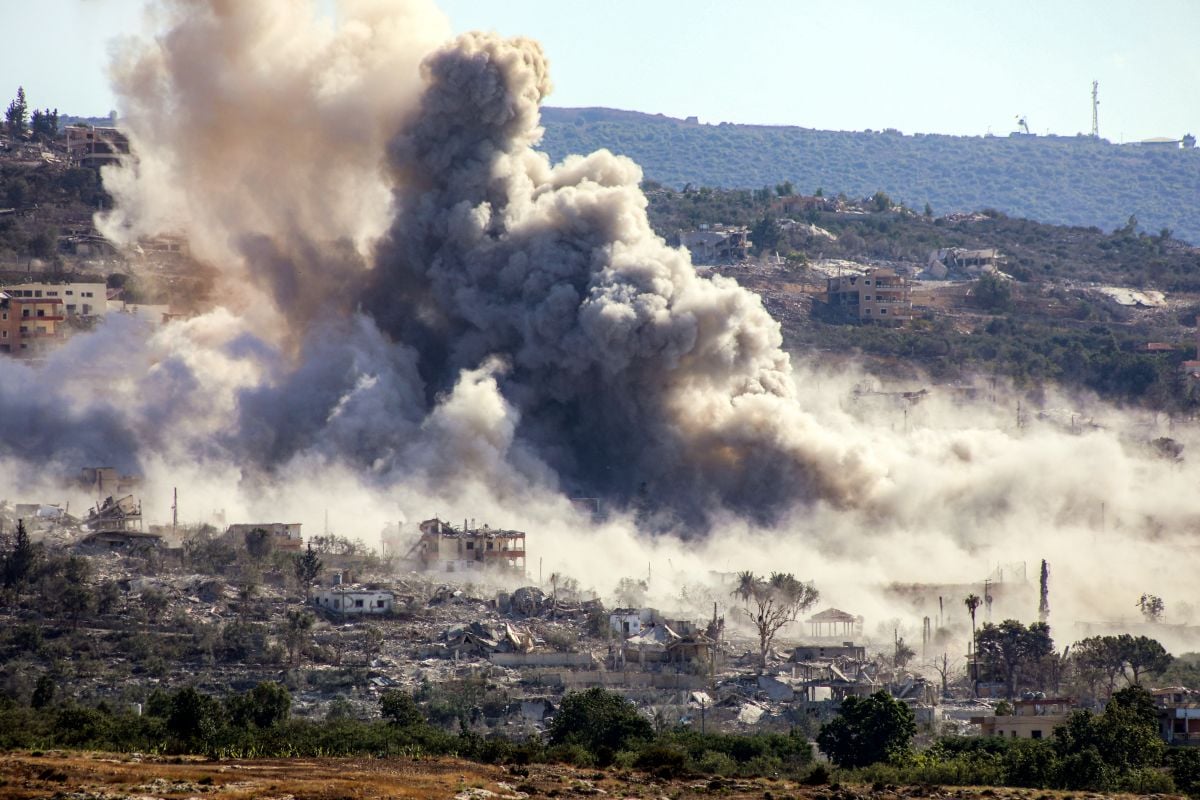
Smoke rises from Mansouri, targeted by demolitions carried out by the Israeli army in Israeli-occupied southern Lebanon, on Sept. 17, 2026. (Credit: Kawant Haju/AFP)






SOUTH LEBANON — Israel continued its methodical destruction of the coastal village of Mansouri (Sour) overnight, carrying out at least 17 demolitions of various buildings and homes, according to our correspondent in the South.
The first Israeli demolitions were reported Monday after 9 p.m., with three powerful blasts in quick succession causing tremors felt in nearby areas. The demolitions continued until 2 a.m., when Israel fired a stun grenade from a drone on the village, bringing the total number of demolitions to 17.
Mansouri, the northernmost point of the Israeli-occupied zone in southern Lebanon along the coast, has faced methodical Israeli destruction for several months, including daily demolitions, artillery fire, and airstrikes.
Drone strike south of Nabatieh
Israel has also been targeting Zibqine and its valley, located a few kilometers east of Mansouri, with daily bombardments in recent days. The area came under Israeli artillery fire overnight, as did Haddatha and Kounin (Bint Jbeil), Kfar Tibnit on the eastern slope of the Ali Taher hill in the Nabatieh district, Qantara, and Wadi Slouqi (Marjayoun), within the Israeli-occupied zone, which covers more than 600 square kilometers.
An Israeli drone strike also targeted the Deir neighborhood in Nabatieh Fawqa, while Israeli forces fired flares over Wadi Slouqi and Houla (Marjayoun), which also came under machine-gun fire.
At around 6:30 a.m. Tuesday, Israel fired machine guns and grenades at the Bastara farm on the outskirts of Kfar Shuba (Hasbaya) from the Israeli base in Ramtha in the eastern sector.
The previous day, Israeli airstrikes targeted six villages in southern Lebanon, while artillery fire targeted 15 others. Israel also carried out demolitions on homes, buildings, and infrastructure in five localities.
Despite the “cease-fire” announced between Israel and Hezbollah in late June, Israel has continued daily attacks, shootings and demolitions in Lebanon over the past three months. According to the latest Health Ministry figures, Israel has killed at least 4,386 people and injured 12,407 others since March 2.
Minister of Justice in Nabatieh
Justice Minister Adel Nassar visited the city of Nabatieh Tuesday to tour its Palace of Justice, which has been out of service since the resumption of the war on March 2, and inspect the extensive structural damage caused by ongoing Israeli attacks in the South. He held a meeting to discuss the possibility of reopening the courthouse and resuming services for citizens and lawyers, and engaged with local residents and public employees to address their concerns.
"The Ministry attaches great importance to restoring judicial operations in Nabatieh," Nassar said, adding that the visit aimed to assess the situation and determine the most appropriate decision on whether to resume work from the courthouse or expand operations at the newly established center in Beirut. He also reaffirmed the "state's commitment to rehabilitating the damage to the Palace of Justice and providing judicial services to residents despite the existing challenges."
Meanwhile, the city's mayor, Abbas Fakhr al-Din said the "return of the Palace of Justice, alongside the return of several security and administrative state institutions to the city, would help strengthen stability and ease the burden of travel on residents."
Furthermore, the First President of the Nabatieh Courts of Appeal, Judge Mounif Barakat, who accompanied Nassar, highlighted the "difficulties judges and employees had faced over the past months while working from Beirut, particularly limited space," adding that "efforts were underway to reach an appropriate decision on returning to Nabatieh."
The outskirts of the city of Nabatieh continues to be subjected to regular Israeli bombardment. Two weeks ago, following Israel's announcement of having gained "operational control" of the Ali Taher hill and amid concerns expressed by residents over a possible Israeli offensive on the city, the authorities increased the Lebanese Army's deployment and pledged to restore public administration services there.
Last week, U.S. Ambassador to Lebanon Michel Issa visited Zawtar Gharbieh (Nabatieh), accompanied by a delegation from the Council for Development and Reconstruction. A few days earlier, President Joseph Aoun made a surprise visit to Nabatieh alongside Army Commander Rodolph Haykal in a show of “solidarity” with residents after deadly Israeli attacks targeted the district just a few days earlier.
Additional reporting by Mountasser Abdallah.