


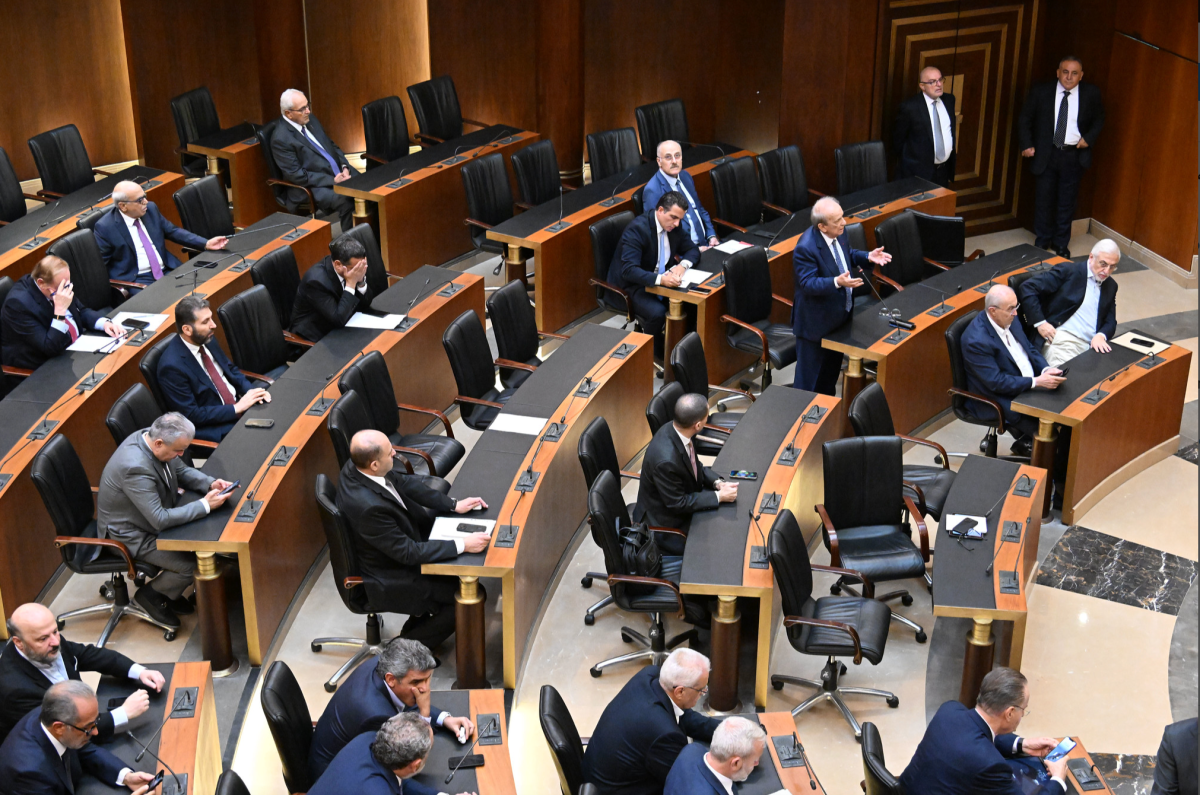
The members of parliament during the general policy debate at the Parliament, on Wednesday, Sept. 16, 2026. (Credit: Hussein Ibrahim / website of the Lebanese Parliament)






BEIRUT — After two days of general policy debate marked by heated exchanges, Parliament on Wednesday overwhelmingly renewed its confidence in the government of Nawaf Salam, with 68 MPs voting in favor, 12 against and two abstaining. Hezbollah MPs, however, left the session without taking part in the confidence vote, signaling their disapproval of the government’s policies without going as far as voting against it. In an apparent division of roles within the Shiite political alliance, the Amal Movement voted to renew its confidence in the government. One of its lawmakers, Kabalan Kabalan, cast his vote saying, “With regret, confidence.”
Salam, who opened the sessions Tuesday at the request of MP Gebran Bassil, closed the debate by reiterating the government’s priorities: financial and economic reform, establishing a state monopoly on weapons, securing an Israeli withdrawal from southern Lebanon and reconstruction. He also acknowledged that his government “had raised many expectations,” but said these “had collided with a difficult reality, made even more difficult by the war.”
Despite the renewed vote of confidence, the prospect of street protests was raised over socioeconomic concerns, as Parliament is expected to begin discussing the 2027 budget soon. MPs from across the political spectrum voiced concern over the prospect of new taxes, with Lebanese Forces (LF) MP Melhem Riashi warning of “another thawra,” referring to the 2019 popular uprising. Addressing Salam, MP Simon Abi Ramia denounced the “status quo” in southern Lebanon and warned of “a social explosion” if the war continues.
Heated exchanges over Hezbollah
Hezbollah was a recurring focus of MPs’ speeches throughout the session, with remarks by Michel Moawad sparking a heated exchange between the Lebanese Forces and Hezbollah. The independent MP for Zgharta said that “Hezbollah’s losing wars bring Israeli occupation” and criticized the fact that “even Ali Taher, which had been presented as Stalingrad, was handed over to the Israelis by Hezbollah instead of the Lebanese army.”
Hezbollah MP Ihab Hamadeh called for some of Moawad’s remarks to be struck from the record. “It is not permissible to say such things in Parliament. Go and ask who brought the Israelis back into the country. You lied to the people,” LF MP Ziad Hawat angrily retorted.
“Some of our colleagues think Israel is not an enemy,” Hezbollah MP Hussein Jachi then said, interrupting Hawat.
Apparently reacting to the exchange, Druze leader Walid Joumblatt wrote on X that “this stream of accusations and invective exchanged in Parliament leads nowhere.” “The roadmap for the future must therefore be based on the remarks of President Joseph Aoun and Prime Minister Nawaf Salam, both in their assessment of the current situation and in how to address it,” he wrote.
Later in the evening, another heated exchange broke out between Sunni Tripoli MP Achraf Rifi and Hezbollah MPs after Ihab Hamadeh spoke about Syrian refugees in Lebanon. “Ask yourself why they came,” Rifi responded. “What were you doing in Syria [during the Syrian civil war, from 2011 to 2024]? You bear responsibility for this,” he added, before a heated exchange followed.
In his closing remarks, Salam welcomed the “return of nearly 700,000 Syrians to their country,” saying the government had “facilitated and organized” their return.
The political divide between Hezbollah and its opponents was also evident throughout the session. Independent Beirut MP Paula Yacoubian asked: “Why isn’t the non-occupied part of southern Lebanon handed over to the government and the Lebanese army?” She added: “Why doesn’t Hezbollah hand over a map of its weapons to Lebanese negotiators so that they can secure an Israeli withdrawal and the return of displaced people?”
“We hear criticism of Hezbollah, but after everything that has happened, they must acknowledge their responsibility,” independent Beirut MP Ibrahim Mneimné said.
Metn MP Elias Hankache of the Kataeb Party called for “the implementation of the disarmament decision in Metn, as in Beirut and other Lebanese regions.” “How can we tolerate the presence in our mountains of training camps belonging to remnants of the Assad regime and other groups?” he asked.
LF MP Melhem Riachi questioned “when and how the government’s decision on the state’s monopoly over weapons can be implemented,” while fellow LF MP Antoine Habshi accused “certain officials of covering for Hezbollah’s weapons.”
Hezbollah MP Ibrahim Mussawi responded sarcastically, telling Habshi to “go buy weapons and arm the Lebanese Army.”
Another Hezbollah MP, Raed Berro, paid tribute to the party’s “resistance fighters” on the Ali Taher hill, saying they had “prevented the enemy from achieving a feat,” despite the Israeli army taking the ridge earlier this month and destroying Hezbollah tunnels beneath it.
Berro also criticized the government for planning to allocate “zero” to the army in the 2027 budget.

Electricity sector under scrutiny
Socioeconomic issues were the other main theme of the MPs’ speeches. At the start of the session, Akkar MP Sajih Attieh criticized the management of the electricity sector, saying that “there are electricity bills worth $2.5 million a month in Palestinian camps, but the government has taken no measures to collect them.” “If we cannot get electricity, the government will have accomplished nothing,” he said, as state-run Électricité du Liban (EDL) provides an average of just six hours of electricity per day.
On the same issue, independent MP Adib Abdel Massih called on the authorities to “put in place a short-term plan so that citizens can feel the difference in electricity supply.” Imad Hout, an MP from the al-Jamaa al-Islamiya, said the Lebanese people “need electricity” and that imposing new taxes on a stagnant economy was “unacceptable.”
The efficiency and cost of Électricité du Liban’s service providers have been the subject of regular debate since their arrival in 2012. The providers cite the succession of crises that have hit the country since 2019, as well as their excessive dependence on EDL decisions, which they say have hindered their work.
Beirut MP Waddah Sadek criticized the “nerve” of some politicians who have been in office for years “and are now asking where we stand on electricity and water.” “Some people should be ashamed to ask what the government has done. Of course I have criticisms to make, but this government has known nothing but war since it came to office,” he argued.
Pierre Bou Assi (LF) said he “doubted that foreign investment will come to Lebanon,” while Raed Berro criticized the fact that the government was reportedly planning to allocate “zero” to the army. He added that he was “worried about the government,” which has faced the resumption of war between Israel and Hezbollah in its very first year, arguing that “under these circumstances, no other government will be able to work.”
Meanwhile, a heated exchange took place between Sunni MP Bilal Hosheimi and MPs from the Free Patriotic Movement (FPM) bloc over the electricity sector, with Hosheimi criticizing how the issue was handled in the late 2010s. Cesar Abi Khalil (FPM), who served as energy and water minister from December 2016 to January 2019, interrupted Hosheimi, leading to a tense exchange between the two, as well as with fellow FPM MP Selim Aoun.
“Listening to some people, one would almost think that the electricity crisis began with this government,” Nawaf Salam said sarcastically in his closing remarks, responding to the criticism. He added: “In reality, what Lebanese citizens are paying today is, to a large extent, the cost of more than two decades of neglect in developing the electricity sector.” On negotiations with Israel, the prime minister said he was “not claiming that the results we seek have been achieved,” while stressing that the talks were “not yet over.”
In July 2025, the Cabinet had already secured a renewal of Parliament’s confidence by 69 votes to nine, with four abstentions. It was the first general policy debate held in Parliament since 2017.
