


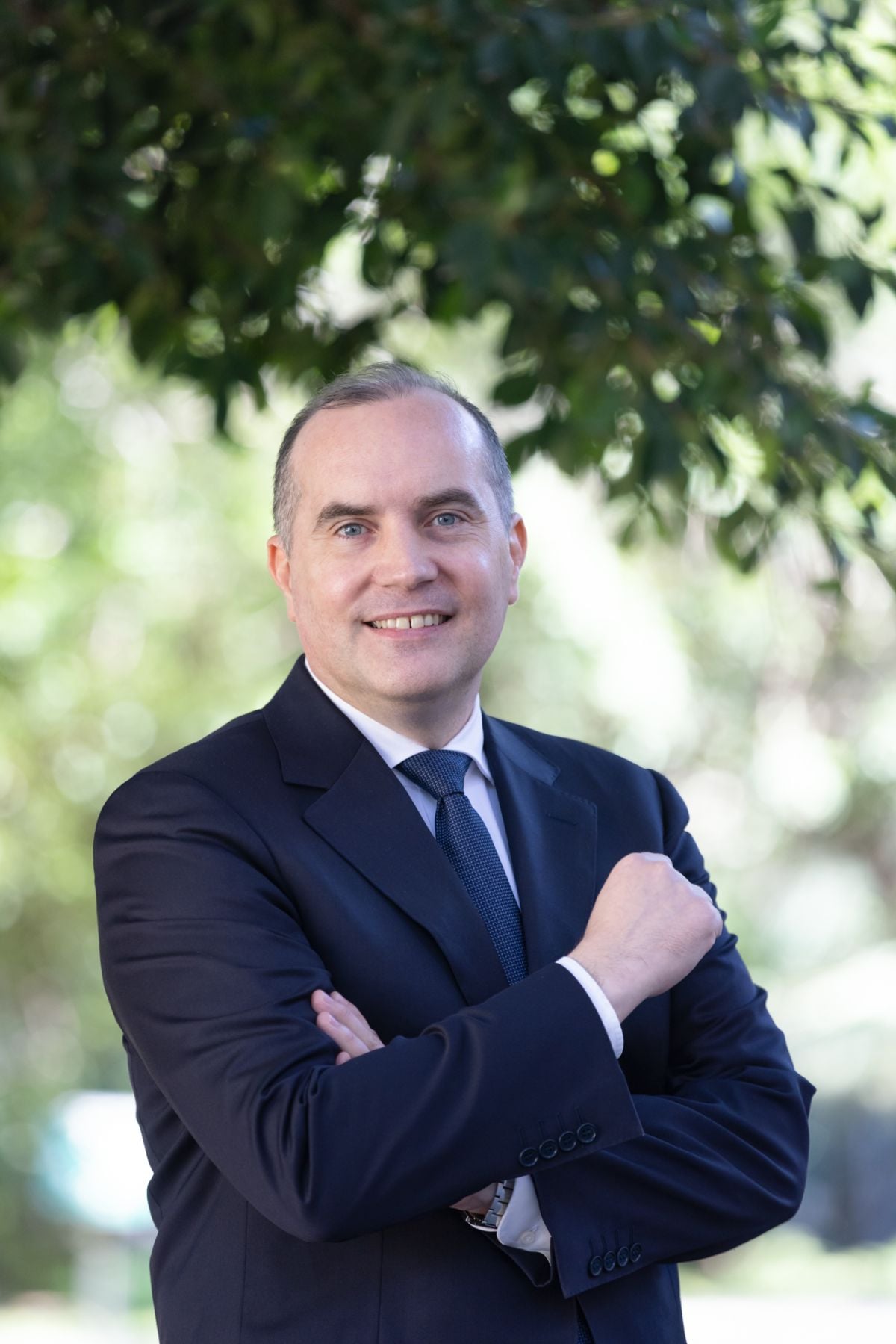
Maxence Duault, Director General of ESA. Photo provided by ESA.






To mark its 30th anniversary, l'École supérieure des affaires (ESA) is dedicating a week to meetings, exchanges and projects shaping its future, with conferences, conversations, exhibitions and inaugurations in the program.
The anniversary week also provides an opportunity to look back on three decades of the school’s development and the challenges ahead. On this occasion, Maxence Duault, ESA’s director general, spoke to us about his vision for the institution, its mission and its future.
L'OLJ: Is 30 years more of a time to take stock or to celebrate for you?
Maxence Duault: An anniversary is, of course, an opportunity to look back at the road we have traveled and assess what we have accomplished. But the term “taking stock” can give the impression that we have reached some kind of endpoint, or even conclusion, and that is what concerns me somewhat. At ESA, particularly given the complex environment in Lebanon, I believe an anniversary should above all allow us to look to the future.
We gave a lot of thought to how we wanted to celebrate these 30 years. We planned different events, with a range of formats and themes, to highlight the diversity of ESA’s activities. The security situation led us to postpone some of these events, but we were determined to maintain our commitment to celebrating these 30 years together.
These events can, of course, only represent a small sample of everything we do on a daily basis. But they bring together people from very different sectors and help foster the ecosystem that is so important to us. ESA is a business school, of course, but it is also a place where companies, institutions, entrepreneurs, students and graduates come together. We also want to highlight this diversity through the anniversary celebrations.
It is therefore an opportunity to build on what we have accomplished, but above all to think about what we want to do and what we want to build in the years ahead.
L'OLJ: What do you see as ESA’s weaknesses?
M.D.: We have reached a point where the school is functioning well, after several years that were far from easy. But I firmly believe that an organization that stops progressing will eventually fall behind. We therefore need to continue developing and do more to showcase everything we are accomplishing.
We still have several projects that are important to us, including new classrooms, the development of our sports center, and new teaching tools, particularly those involving artificial intelligence.
We also aim to continue expanding beyond Beirut and Lebanon. In recent years, we have provided numerous customized training programs in the United Arab Emirates, Qatar, Iraq, Turkey, Spain, Egypt, and Jordan. We are also expanding our presence in Saudi Arabia. We now need to continue and strengthen our regional reach, particularly because a significant number of our graduates now work in the region.
L'OLJ: How has the way you prepare students for today’s business world changed compared with 30 years ago?
M.D.: Thirty years ago, our academic partners, who were already highly prestigious, designed the programs. At the time, ESA largely operated as an offshore program. We were missing an essential dimension: contextualizing what we taught and developing a detailed understanding of the needs of Lebanon and, more broadly, the region.
When I arrived in 2011, this was one of the first issues we worked on. We created departments and academic councils to encourage greater dialogue among the different stakeholders and adapt our programs to better meet the needs of companies and executives in the Lebanese and regional context. We also sought to strengthen our Executive Education offering and develop training programs that were increasingly grounded in the realities of the business world.
I would also like to take this opportunity to pay tribute to Stéphane Attali, who was ESA’s director general at the time and strongly championed the vision of an education system closely connected to companies and able to respond to their needs.
The second major change was preparing our students more effectively for a much more complex world. Our mission is to give them the tools they need to become tomorrow’s leaders. We have therefore evolved the fundamentals, from marketing and finance to human resources, while placing increasing emphasis on interpersonal skills, which are essential for professional development and, ultimately, for taking responsibility for teams.
L'OLJ: Has the arrival of AI disrupted the curriculum?
M.D.: In reality, yes and no. We had already begun integrating artificial intelligence across our courses. We obviously still need to teach finance, marketing, and the fundamentals of each discipline, while ensuring our students learn how to use these new tools effectively.
AI will undoubtedly play a major role in the years ahead, even though we do not yet know exactly how far it will go or what its limits will be. It will probably fundamentally change the way we work and learn. Our role is therefore to prepare our students for this evolution without losing sight of what matters most: organizations remain, above all, human organizations. Judgment, the ability to collaborate, understand others, exercise leadership, and make decisions will remain fundamental.
The issue, then, is not whether AI will replace certain skills, but rather how we can use it to strengthen our capabilities while preserving the central role of people.

L'OLJ: What are you most proud of since you took over as director of ESA in 2019?
M.D.: I took over as director of ESA in 2019, in an especially difficult environment. The years that followed brought profound changes, particularly within our teams, as many employees left the country. We had to adapt and reorganize in an environment that was constantly changing.
I am most proud of how we collectively managed to preserve ESA and continue developing it. I would like to warmly thank the school’s leadership and all our academic partners, whose support and commitment were essential in helping us navigate these years.
This resilience never came at the expense of our academic mission. We maintained the quality of our programs, supported our students, and continued developing our educational project with the same high standards. It is the result of a collective commitment and a shared conviction: whatever the circumstances, academic excellence must remain at the heart of our mission.
In partnership with


 1 p.m. recap: 3 injured in Houthi attacks on Saudi airports; Katz threatens Gaza ahead of Oct. 7 anniversary