





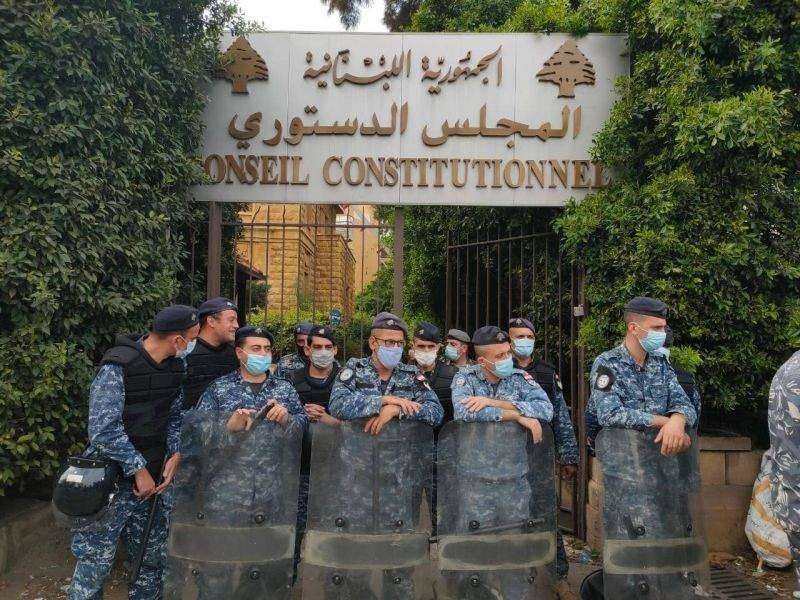
Security forces officers in front of the Constitutional Council. Archive photo by Claude Assaf






Passed on Aug. 12 by Parliament and enacted on Sept. 4 by President Joseph Aoun, the general amnesty law was suspended Thursday by the Constitutional Council (CC). Proposed for several years, this law was finally adopted as part of a compromise among the various religious and political components. It is sharply contested by many criminal law judges, who see it simply as a way to foster impunity.
In a session attended by nine of the ten members of the Constitutional Council, which had been seized Wednesday by an appeal for invalidity of the law filed by ten deputies from the Free Patriotic Movement (FPM), the suspension of the law, pending a decision on its constitutionality, was voted by a majority of seven members: Tannous Meshleb (President of the CC), Mireille Checrallah, Elias Mechreqani, Riad Abu Ghida, Fawzat Farhat, Akram Baassiri, and Albert Serhan. The two other members present, Michel Tarazi and Aouni Ramadan, voted against. The tenth member, Omar Hamze, was absent for health reasons.
According to the law organizing the CC, it must meet as soon as an appeal is lodged against a challenged law to decide whether to suspend its application. The CC president must then appoint a rapporteur chosen from among the members of the body, a role he may fulfill himself. The rapporteur has a deadline of ten days from appointment to present a report to the CC president. The president then sends the document to the other members and sets a hearing within five days. From this hearing date, the CC has fifteen days to debate and deliberate, either declaring the law in conformity with the Constitution or wholly or partially unconstitutional.
If no decision is made within fifteen days following the first meeting, the challenged law is deemed valid and enforceable. In this case, the final fate of the general amnesty law should be determined by next October at the latest.
Reasons for the appeal
The FPM appeal, a synthesis of which L’Orient-Le Jour has consulted, targets both the voting procedure and the substance of the law. The first grievance concerns “the violation of Article 36 of the Constitution,” which requires voting by “roll call.” The FPM deputies also argue that “the text was amended after being submitted to a vote, so parliamentarians could not vote on the final version adopted.” Such an amendment, in their view, “tainted the regularity of the legislative process and infringed on popular sovereignty and legislative intent.”
The appeal also points to the “imprecision” of some provisions, whose vague or ambiguous wording could lead to multiple interpretations. The appellants cite, in this regard, French Constitutional Council case law indicating that the use of imprecise expressions in a law is sufficient grounds for its annulment.

Another reason for the appeal concerns the lack of consultation with the Higher Judicial Council (HJC). The plaintiffs see this as ignoring the HJC’s prerogatives and, consequently, infringing on judicial authority and the principle of “cooperation between the branches of power.”
The law is also challenged in terms of the separation of executive and legislative powers. According to the appellants, it has the effect of canceling administrative decisions and sanctions imposed on public officials. Such neutralization would, in their view, amount to the legislature substituting itself for the executive.
The appeal also alleges a violation of the principle of proportionality between the exception established by the amnesty and the intended public interest. This principle aims to prevent victims from being required, in the name of public interest, to bear burdens that go beyond what is constitutionally permissible to require of them, according to the appeal’s terms.
Before and after March 1
Among other grievances cited is the law’s failure to comply with constitutional objective criteria that must frame an amnesty, including the principle of equality. Contacted by L'Orient-Le Jour, Adel Yammine, a constitutional law expert and university lecturer, asks: “Why would the perpetrators of crimes covered by the law benefit from amnesty if the acts were committed before March 1, 2026, while those who committed the same crimes after that date would be excluded?” He generally considers the contested law “not justifiable,” arguing that a defendant “can only be declared innocent by a judicial decision.” According to the legal expert, prison overcrowding and slow justice, cited by proponents of the law, cannot justify such a measure, which “undermines accountability, to the detriment of victims’ rights or those of their relatives.”

 7 p.m. recap: Iran warns Egypt, Israeli soldiers vote in south Lebanon, Haret Hreik responds to Kataeb