


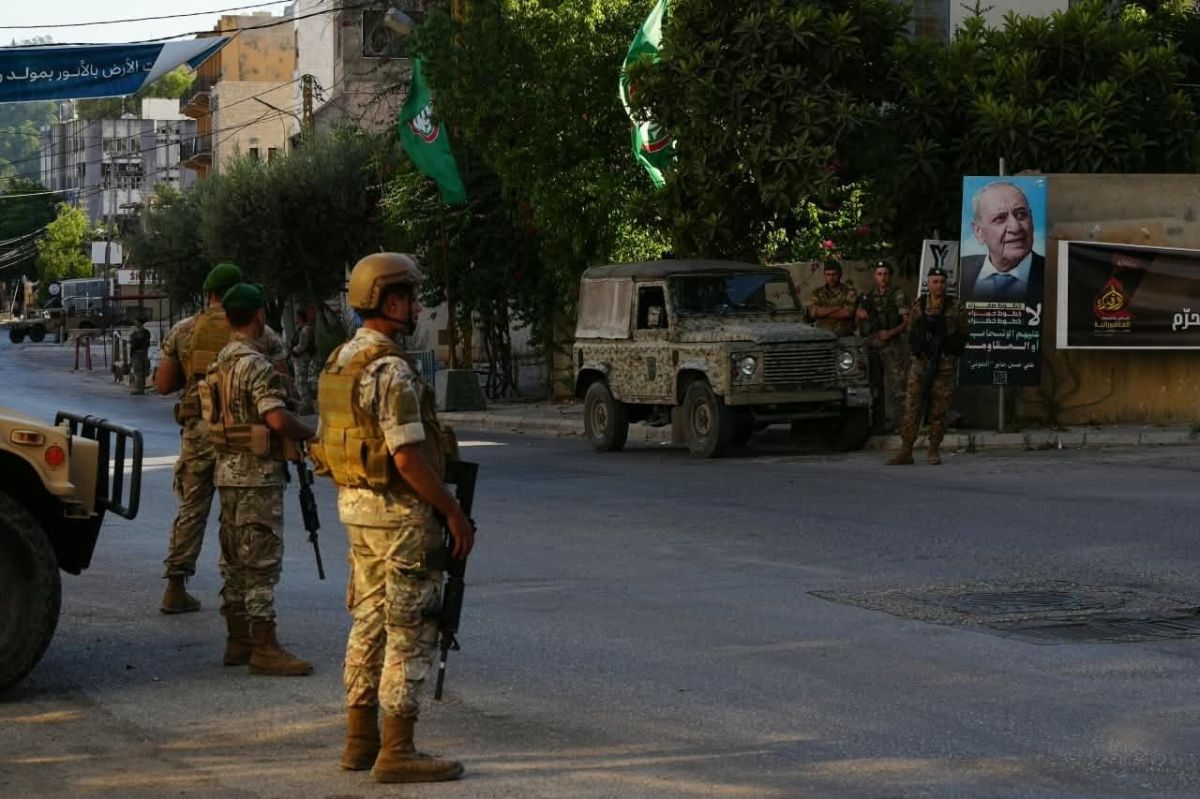
The Lebanese Army reinforced its presence in Nabatieh on Sept. 8, 2026. (Credit: Mohammad Yassine/L'Orient Today)






BEIRUT — In a lengthy statement on Wednesday, the Lebanese Army detailed the missions it has undertaken in then so-called “pilot zones” since the signing of the framework agreement between Lebanon and Israel in late June, adding that a halt to ongoing Israeli attacks is “essential for the army to complete its deployment and carry out its duties under the agreement.”
Among several measures, the army said it had confiscated around 1,818 weapons and pieces of ammunition in the "pilot zones."
The framework agreement’s end goal is for the Israeli army to withdraw from Lebanon in exchange for Hezbollah’s disarmament. However, the process has been slow: Two and a half months after the agreement was signed, Lebanon and Israel remain in the first phase of the "pilot-zones" project. This phase covers only three villages, where the Lebanese Army is tasked with dismantling the Iran-backed group’s military infrastructure.
The army’s statement came a few hours after a security meeting at Baabda Presidential Palace attended by Army Commander Gen. Rodolph Haykal. According to a statement from the presidency, President Joseph Aoun warned that “any security vacuum in the south serves as a pretext for aggression and an attack on national sovereignty.”
It also followed the deployment on Tuesday of more than a dozen army vehicles along Nabatieh’s main streets, after several days of intense Israeli escalation in the region.
‘Israel aims to undermine the army’s credibility’
The Lebanese Army’s statement opened with a condemnation of the Israeli attacks that have escalated in recent days, leaving dozens dead.
“The continuation and escalation of these attacks, alongside the brutal demolition and bombing operations in the south, leave no doubt about Israel’s aggressive intentions. They violate international law, threaten existing understandings and arrangements, hinder the army’s efforts to establish stability, and constitute a blatant violation of Lebanon’s sovereignty and security,” the statement reads.
The recent escalation intensified after Israel announced that it had taken control of the strategic Ali Taher ridge. In Kfar Roummane, in the Nabatieh district, 13 people, including several members of the same family, were killed in Israeli strikes overnight Sunday into Monday. Hundreds attended their funerals on Tuesday.
The army noted that “Israeli occupation forces have failed to adhere to the agreement,” with around 7,700 violations recorded between the signing of the framework agreement on June 26, 2026, and Wednesday.
“Israeli forces have also opened fire near army personnel and patrols,” it added.
According to the army, the repeated attacks and violations, particularly the most recent ones, have caused a new wave of displacement from areas that had previously been considered safe.
“These repeated attacks and violations … confirmed that Israel’s aim is to undermine the army’s credibility domestically and before the international community,” it said.
The army argued that ending the Israeli attacks and violations was essential for it to continue its deployment and fulfill its duties under the framework agreement.
‘1,818 weapons and pieces of ammunition confiscated’
In the same statement, the army detailed the measures it has taken since the agreement was signed.
“The Lebanese Army has demonstrated its full readiness to fulfill its commitments and begun taking the necessary measures to establish operational control in the pilot areas, in coordination with the Lebanon-specific Military Coordination Group and in accordance with a plan prepared by Army Command,” the statement reads.
However, it noted that “the stages of these areas and subsequent steps have not yet been fully agreed upon.”
The measures include establishing six permanent checkpoints and 13 observation posts on roads leading to and within the "pilot zones" of Zawtar Gharbieh, Froun and Srifa, as well as conducting round-the-clock foot and vehicle patrols.
Specialized units have also removed and confiscated weapons and unexploded ordnance and prevented the presence of armed groups and activities not authorized under Lebanese law, the army said.
“The army has so far confiscated around 1,818 weapons and pieces of ammunition, including 10 rocket launchers, seven rockets, six drones, 51 warheads, 10 aerial bombs and 1,560 pieces of small-arms ammunition, in addition to a large number of mines and explosive devices,” it noted.
The army added that it had searched a number of homes “in accordance with Lebanese law and with the consent of their owners,” with residents fully cooperating with measures aimed at removing sources of danger and remnants of war.
The issue of searching private property has been a major challenge since the agreement was signed. While Israel has insisted that the Lebanese Army inspect residents’ homes to dismantle Hezbollah’s arsenal, the army has proceeded cautiously because of security considerations, constitutional safeguards and fears of provoking tensions with the local population.
Military units have also taken measures to facilitate residents’ safe return by clearing rubble and reopening roads, while activating civil-military cooperation efforts to provide basic necessities. The army said it had cleared approximately 12 kilometers of roads and participated in recovering victims’ bodies.
“These measures have enabled the army to establish operational control and control movement into and out of the area of operations,” the statement reads.
According to the army, around 70 percent of Zawtar Gharbieh’s residents have been able to return to the village and inspect their properties. However, only 16 percent — or around 60 families out of 450 — have been able to resettle there.
The army said Israeli forces had completely destroyed 85 percent of the village’s homes and partially destroyed the remaining 15 percent.
Security meeting at Baabda
During Wednesday’s security meeting at Baabda Presidential Palace, Aoun said the army’s deployment in Nabatieh was linked to the Lebanese state’s commitments and its position in negotiations with Israel.
“Maintaining internal security strengthens the official Lebanese position,” he said, according to the presidency.
Aoun called on the security services to assume their responsibilities and maintain “permanent” coordination, stressing that “the security of Nabatieh and the regions not under Israeli occupation is an integral part of the security of a unified Lebanon.”
During another meeting on Wednesday, Aoun addressed national loyalty and the negotiations with Israel, saying that everyone’s allegiance must be to Lebanon.
“Whoever seeks the support of foreigners against their domestic rivals loses, because the foreigner will eventually abandon them,” he said, in an apparent reference to Hezbollah, which staunchly opposes the prospect of disarmament under the framework agreement.
“No war in Lebanon has had a winner: Everyone lost, and the country with them,” Aoun added.
He also defended the decision to negotiate with Israel, saying it had been made in Lebanon’s interests rather than to satisfy foreign powers.
“We chose negotiation because we are a sovereign state. This decision was made in Lebanon’s interest and not to satisfy anyone abroad,” he said.
Salam hails army’s efforts, Geagea expresses concern
Prime Minister Nawaf Salam on Wednesday praised the army’s work and the measures taken to strengthen its deployment in unoccupied villages and towns.
“We salute the efforts of the Lebanese Army and the measures it is taking to strengthen its deployment in unoccupied villages and towns, which helps reassure citizens, consolidate stability, facilitate residents’ return and ensure the proper functioning of government institutions and services,” he said in a statement.
Salam said he was closely following developments in Nabatieh and the surrounding area and remained in contact with the city’s imam, Sheikh Abdel Hussein Sadek, and its mayor, Abbas Fakhreddine.
He also denied reports that a planned visit to Nabatieh on Saturday had been canceled, explaining that no such visit had been scheduled for this week. He nevertheless expressed hope that he would visit the city “as soon as possible.”
Salam also discussed with Aoun the measures taken by the army to reinforce its deployment in unoccupied villages, reassure residents and allow public administrations to resume their work.
Lebanese Forces leader Samir Geagea, meanwhile, expressed concern about Nabatieh’s fate, saying he hoped it would not meet the same fate as other southern areas razed by Israel.
Geagea warned that the city could “meet the same fate as Ali Taher, the Chqif area and other border villages.”
“Nabatieh holds major historical, economic and cultural significance and remains densely populated. A considerable number of its inhabitants have made a clear appeal to the Lebanese state to take responsibility under these difficult circumstances,” he said.
Geagea called on the authorities to implement cabinet decisions, particularly the March 2, 2026, decision declaring Hezbollah’s military and security branches illegal.
“The authorities are called upon to enforce this decision immediately, at least in the city of Nabatieh and its surroundings, by dismantling all illegal armed groups present, neutralizing their infrastructure and notifying U.S. authorities of the Lebanese Army’s actions so they can help put an end to the fighting that is ravaging Nabatieh and its surroundings,” he said.
According to Geagea, the army’s presence in the city was not sufficient on its own.
“Deploying the Lebanese Army is not enough; all illegal military and security structures present in areas where the army is stationed must be dismantled, and the army must fully exercise its authority, in accordance with Lebanese government decisions,” he said.

 1 p.m. recap: Salam in Nabatieh; up to 10,000 more US troops heading to Middle East