






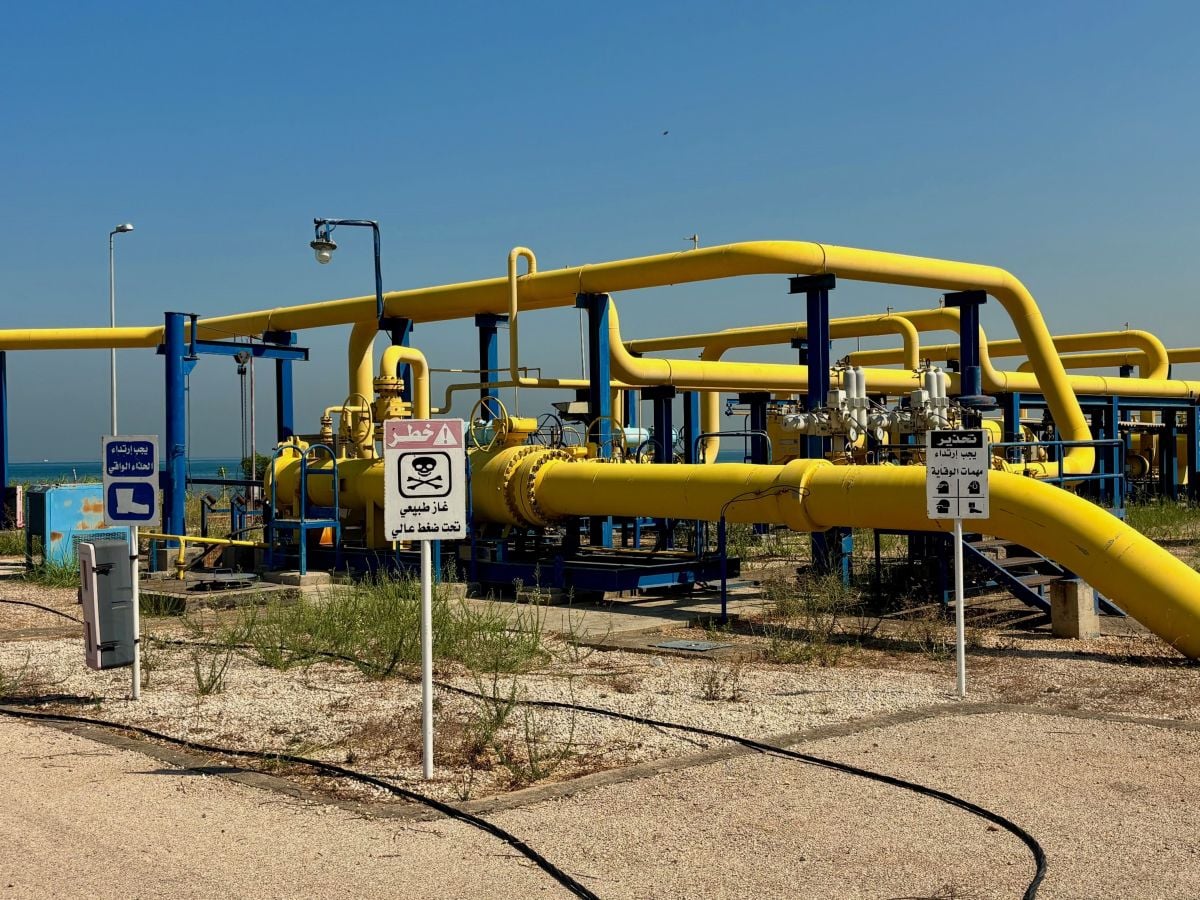
The Deri Ammar gas terminal, on the site of the oil installations, Aug. 10, 2026. (Credit: Philippe HAGE Boutros/L'Orient-Le Jour)






BEIRUT — A plan to supply Electricité du Liban (EDL) with natural gas via Jordan and Syria is moving forward, with technical work underway on the pipeline linking North Lebanon to Syria and contracts awaiting approval by the Lebanese government. The project, announced as being on track at the beginning of August by Energy Minister Joe Saddi, has taken on added urgency as the prices of fuel oil and diesel used by power plants and private generators soar.
Meeting in Amman on Sept. 6, the Jordanian government approved "a plan to supply natural gas to Lebanon via the floating storage and regasification unit (FSRU, which allows natural gas to be liquefied to facilitate its transport) located in Aqaba, and transported via Syria," according to a report cited by the Jordan News Agency (Petra). The decision was made "with the aim of strengthening regional energy cooperation," while "the mechanism adopted is the same as the one currently used by Jordan to supply Syria."
Under this mechanism, Jordan would import gas from a given supplier, then regasify it in Aqaba before transporting it via the Arab Gas Pipeline to Syria and then to Lebanon.
However, there will be two differences. First, Lebanon and Jordan will jointly purchase the gas, with part of it to be delivered to Lebanon. Second, since the section of the Arab Gas Pipeline connecting Lebanon and Syria is not operational, the three countries have adjusted the mechanism so that Syria supplies Lebanon via another gas pipeline linking the Homs region to northern Lebanon, with a quantity of gas equivalent to what Lebanon will have purchased together with Jordan.
Repairs and contracts
At this stage, two major steps remain before the project can materialize. The first is technical: the Egyptian-Jordanian company TGS (Technical Company for Gas Pipeline Operation Services) has begun rehabilitation work on the section of more than 30 kilometers stretching from the Deir Ammar site in North Lebanon to the Syrian border.
Saddi told L'Orient Today that the company had detected and repaired a leak in recent days and was preparing to carry out a new air injection to check whether the section was properly sealed. If another leak is detected, it will also need to be repaired. Otherwise, the company will proceed with a complete cleaning of the section, an operation that could take four to five weeks. Once this is done, it will be operational. The minister added that he had also been informed that the necessary repairs had been made in recent days to the Syrian section as well.
The second step is a mere formality, as the three countries have already agreed in principle to the cooperation in several technical meetings held since last spring. According to the minister, finalized contracts will need to be officially signed. He said he has sent the documents to the Lebanese government, which will first have to approve them.
An effective solution?
The energy minister believes that completing the project will bring EDL one step closer to conversion, as its already outdated and inefficient plants use fuel oil. The price of this fuel has skyrocketed due to the closure of the Strait of Hormuz.
Some energy experts, such as Jessica Obeid, have expressed concerns, pointing out that only one Lebanese power plant can currently operate on natural gas — the Deir Ammar plant, with a capacity of 450 megawatts, while demand is around 3,000 MW — and that Lebanon does not have the infrastructure to distribute or store gas elsewhere in the country.
The cost argument is more debatable, however, since prices related to the transport and refining of petroleum products are also likely to rise in the current context.
Obeid also pointed out that the cost of importing gas could be higher than expected due to several additional fees, including those related to transport via Syria and maintenance, and that the gas market, where Qatar is a major player, is also affected by the closure of the Strait of Hormuz. The global shortage of gas turbines, which are a key component of this type of power plant, is another factor that could undermine the effectiveness of the plan supported by the minister.
Arguments in favor of the minister's solution include the possibility for the Deir Ammar units to operate more efficiently on natural gas than on liquid fuels, as well as the fact that natural gas prices have recently proven more resilient compared to rising energy prices than oil, even if this does not itself guarantee a lower supply cost for EDL.

 2 p.m. recap: Pit discovered north of Beirut, Hezbollah warns of ‘imminent explosion’ in the streets, settlers arrested in West Bank