





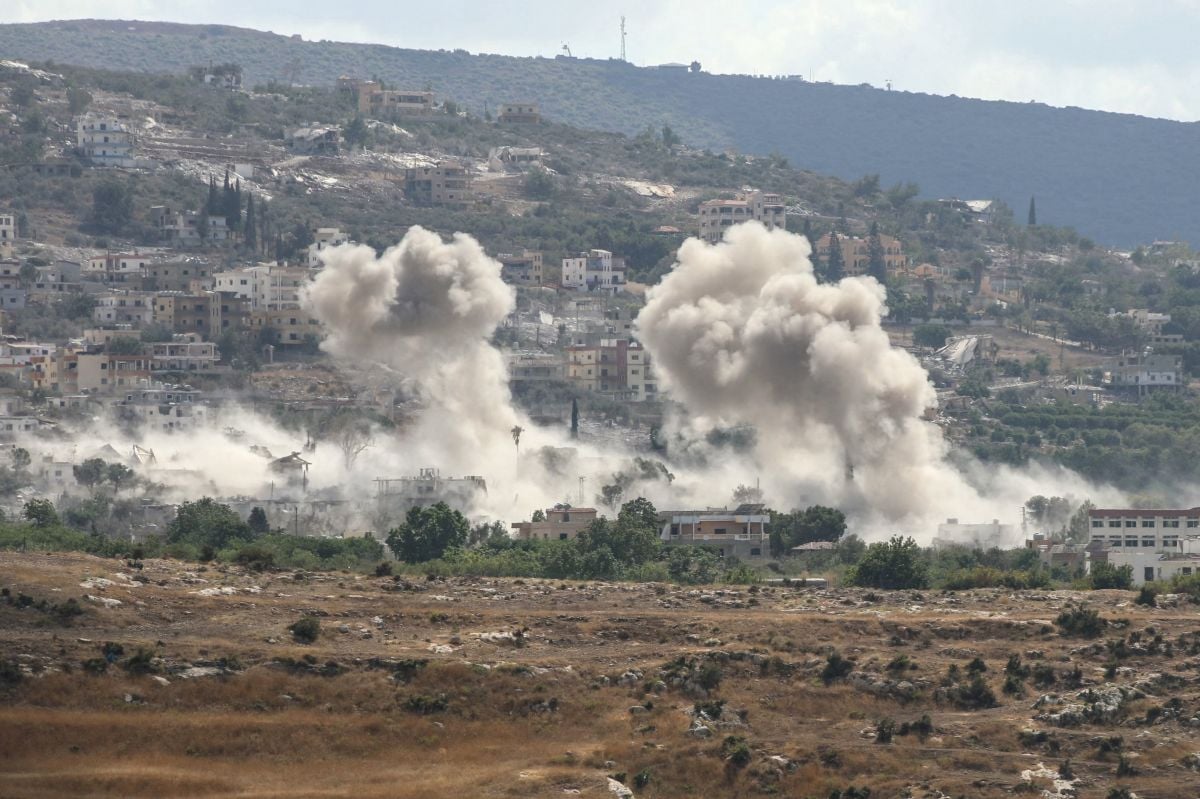
Smoke rising from the site of controlled explosions by Israel in Hennieh, a village neighboring Mansouri, on Sep. 5, 2026. (Credit: Kawan Haju / AFP)






Hezbollah on Saturday condemned what it called Israel’s continued escalation in Lebanon, accusing the United States of supporting the attacks and the Lebanese government of failing to protect the country.
In a statement, Hezbollah said Israel was continuing its campaign of ‘‘killings, bombings, destruction and systematic demolition of houses and villages,’’ adding that Thursday’s attacks killed four people and wounded dozens.
Hezbollah accused the Lebanese government of a ‘‘total absence’’ in fulfilling its responsibilities and of persisting in what it called ‘‘mistaken choices, marked by submission and capitulation.’’
The group said the ongoing Israeli strikes were being carried out with ‘‘full cooperation, cover and planning by the United States,’’ with the aim of pressuring Lebanese authorities to implement a known agenda, ‘‘even if it means plunging Lebanon into the mire of internal conflicts.’’
Hezbollah said the ongoing direct negotiations between Lebanon and Israel, the framework agreement reached between the two countries, and the continued Israeli occupation, attacks and destruction demonstrated the failure of the process.
The release of some Lebanese detainees was important, Hezbollah said, but ‘‘cannot be used as an excuse to obscure the continuation of aggression, occupation and killing of Lebanese.’’
Negotiations between Lebanon and Israel had reached a standstill until Israel released four detainees Friday who had been captured by the Israeli army, an initiative that could potentially revive talks.
Hezbollah also called on Lebanese authorities to ‘‘reconsider their calculations,’’ set aside their differences and return to what it described as ‘‘unifying national constants’’ that protect Lebanon’s sovereignty. It urged the Lebanese people to ‘‘rally in a unified national position’’ to preserve the country’s strength, sovereignty and ability to counter Israeli attacks.
Ahmad Kabalan criticizes President Joseph Aoun
Jaafarite Mufti Ahmad Kabalan, meanwhile, sharply criticized President Joseph Aoun, calling on him to ‘‘prevent national division rather than deepen internal rifts’’ and warning that ‘‘the tendency toward these divides is at its highest point.’’
Kabalan made the remarks on the fifth anniversary of the death of his father, Sheikh Abdel Amir Kabalan, the former president of the Higher Shiite Council.
His criticism comes as Aoun continues to support negotiations with Israel despite the ongoing occupation and Israeli strikes, arguing that even if talks face obstacles, ‘‘talks are preferable to war.’’
According to Kabalan, the situation requires ‘‘partnership, sovereign solidarity, justice, national trust and a strong presence of all state institutions at the heart of the South, especially in the occupied land strip.’’
He stressed the importance of maintaining national consensus, recalling a principle defended by Sheikh Abdel Amir: ‘‘No community and no external commitment should be placed above the commitments of the national formula and its foundational charters.’’
Kabalan also warned against what he described as efforts to eradicate the Shiite community.
’’There are those who seek to eliminate us, and we will defend ourselves with the utmost national force,’’ he said, asserting that the Shiite community protects ‘‘all of Lebanon.’’
Emphasizing national trust as central to his message, Kabalan said that ‘‘nothing is more important than national trust, which means rejecting exclusion.’’
The Jaafarite mufti also warned against what he called ‘‘the confiscation of the consensual system,’’ accusing the authorities of ‘‘evading their responsibilities in South Lebanon, relinquishing their national role’’ and ‘‘stifling the other.’’
’’From the beginning, the authorities have not protected Lebanon, especially the South,’’ he said, adding that ‘‘a Lebanon without national protection loses its existence and becomes a Zionist colony.’’
’’It is impossible to remain silent in the face of any political configuration that stifles the other,’’ he added, arguing that the authorities’ current choices ‘‘undermine the very foundation of Lebanon’s existence’’ and the ‘‘unifying project of the state.’’
His remarks were a clear reference to the authorities’ decision to call on Hezbollah to disarm and submit to the Lebanese state and army, a move the Shiite group continues to reject amid the destruction in southern Lebanon caused by Israeli attacks.
’’The resistance achieves what the state fails to do and, in doing so, protects national sovereignty, the country and its institutions,’’ Kabalan said.
Addressing the authorities again, the mufti rejected any substitution of external support for internal consensus.
’’Washington and Tel Aviv are no substitute for national consensus. Lebanon is a national formula that rises above communities without abolishing them,’’ he said, directly criticizing the United States and Israel, which have made Hezbollah’s disarmament a condition for ending the war.
Finally, Kabalan denounced the tripartite framework agreement between Israel and Lebanon, brokered by the United States, which he accused of seeking to ‘‘eliminate the most powerful sovereign national force of recent decades.’’
According to Kabalan, ‘’the tripartite framework agreement not only stole security from the occupied strip, it stole all of Lebanon and stripped away the national character of the government that submitted.’’

 Evening recap: Netanyahu announces West Bank offensive; 7 killed in Jordan church shooting; tents burned in south Lebanon
 US strike on Iran this weekend? ‘Absolutely,’ says Barrack; ‘I have no idea,’ says Trump