


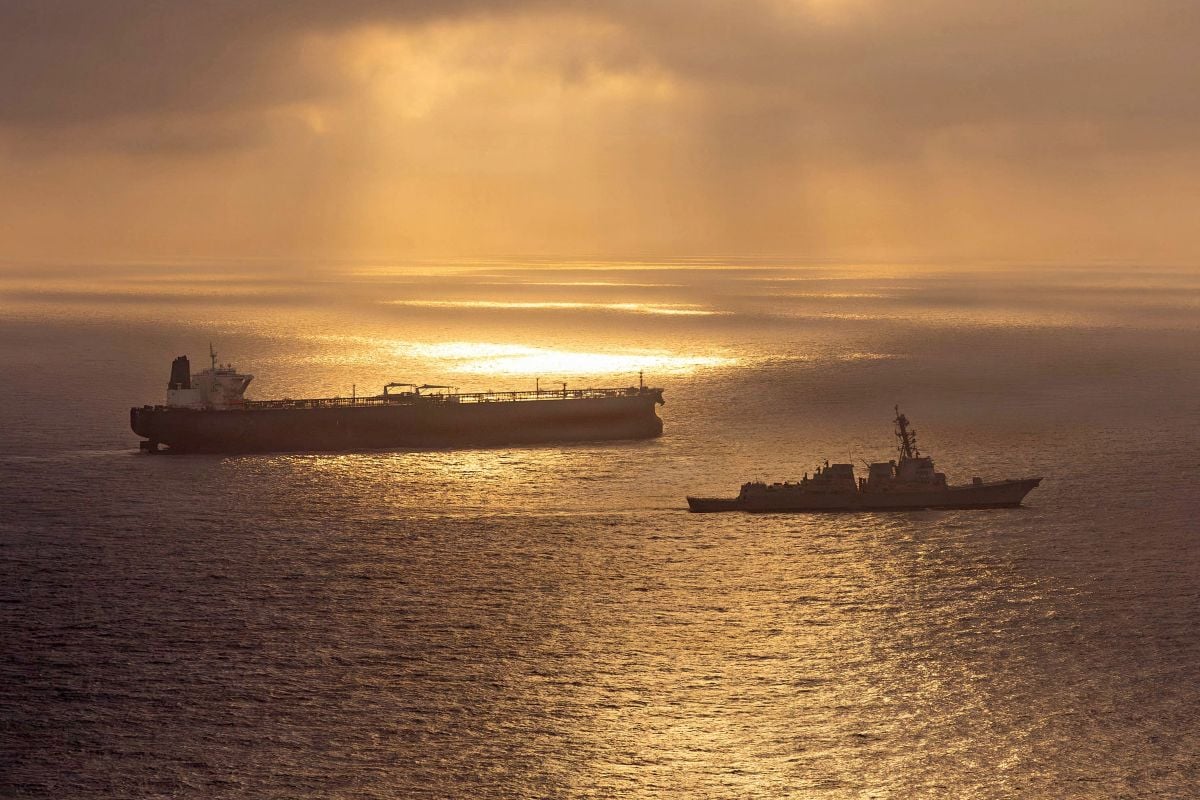
This photo, released by the US Navy on May 8, 2026, by the press service of the United States Central Command, shows the Arleigh Burke-class guided missile destroyer, USS Rafael Peralta (DDG 115), implementing a maritime blockade against the Iranian tanker Herby, as the latter attempted to reach an Iranian port, on April 24, 2026. (Credit: US Central Command Public Affairs/ AFP)






BEIRUT — Following the USS George Washington, the USS Abraham Lincoln and the USS Gerald Ford, the USS Theodore Roosevelt will soon be deployed again to the Gulf, within the U.S. Central Command (CENTCOM) area of operations.
U.S. aircraft carriers have been rotating through record-length deployments for nearly a year, prompting considerable discussion in the United States as the war launched by Washington and Tel Aviv against Iran on Feb. 28 approaches its six-month mark. Fighting is largely on hold, but no major diplomatic progress is in sight. The two sides remain particularly at odds over control of the Strait of Hormuz, a strategic passage for global oil supplies that Tehran is using as leverage. In recent months, U.S. aircraft carriers deployed in the region have launched strikes against Iran and helped enforce a blockade of Iranian ports.
According to the U.S. Naval Institute, a private association focused on U.S. Navy affairs, which spoke with Chief of Naval Operations Adm. Daryl Caudle and Master Chief Petty Officer of the Navy John Perryman, the Theodore Roosevelt strike group is scheduled for a deployment of “more than seven months.” It is expected to leave San Diego, California, “within the coming weeks” for the CENTCOM area of operations in the Middle East, where it will “relieve” the USS George Washington.

The USS Theodore Roosevelt (CVN-71) is a nuclear-powered Nimitz-class aircraft carrier. It will deploy with an embarked air wing and Carrier Strike Group 11. These groups typically include two guided-missile cruisers, two air-defense ships, and one or two destroyers or frigates specializing in anti-submarine warfare, according to the U.S. Navy.
No end in sight for US deployment in the Middle East
According to Adm. Caudle, again quoted by USNI, the U.S. commitment in the Middle East “does not appear to be ending anytime soon,” creating stress for sailors and their families and requiring better anticipation and planning.
The U.S. Navy recorded its longest deployment since the end of the Cold War with the USS Gerald R. Ford, at 326 days, although this included several port calls, notably in the Mediterranean. The Abraham Lincoln is expected to remain deployed for more than 300 days without making a port call.
On Aug. 14, the USS George Washington was heading to the Middle East to relieve the USS Abraham Lincoln, whose living conditions had recently raised concerns among U.S. lawmakers and sailors’ families. The USS George H.W. Bush is also in the Arabian Sea with the U.S. Navy’s Fifth Fleet, according to U.S. Central Command (CENTCOM) reports from last July. In May, the USS Gerald Ford left the Mediterranean after suffering a series of technical failures, a departure that reduced U.S. military capabilities in the Middle East.
The rotation between the USS Lincoln and USS Washington had been scheduled before concerns about conditions aboard the Lincoln became public, one U.S. official interviewed by the Wall Street Journal said.
The U.S. Navy has 11 aircraft carriers in active service, all of which require significant maintenance periods after deployments. According to Bryan Clark, a former Navy officer and researcher at the Hudson Institute, the operational demands stemming from the war against Iran could leave the fleet needing up to three years to return to optimal availability.

