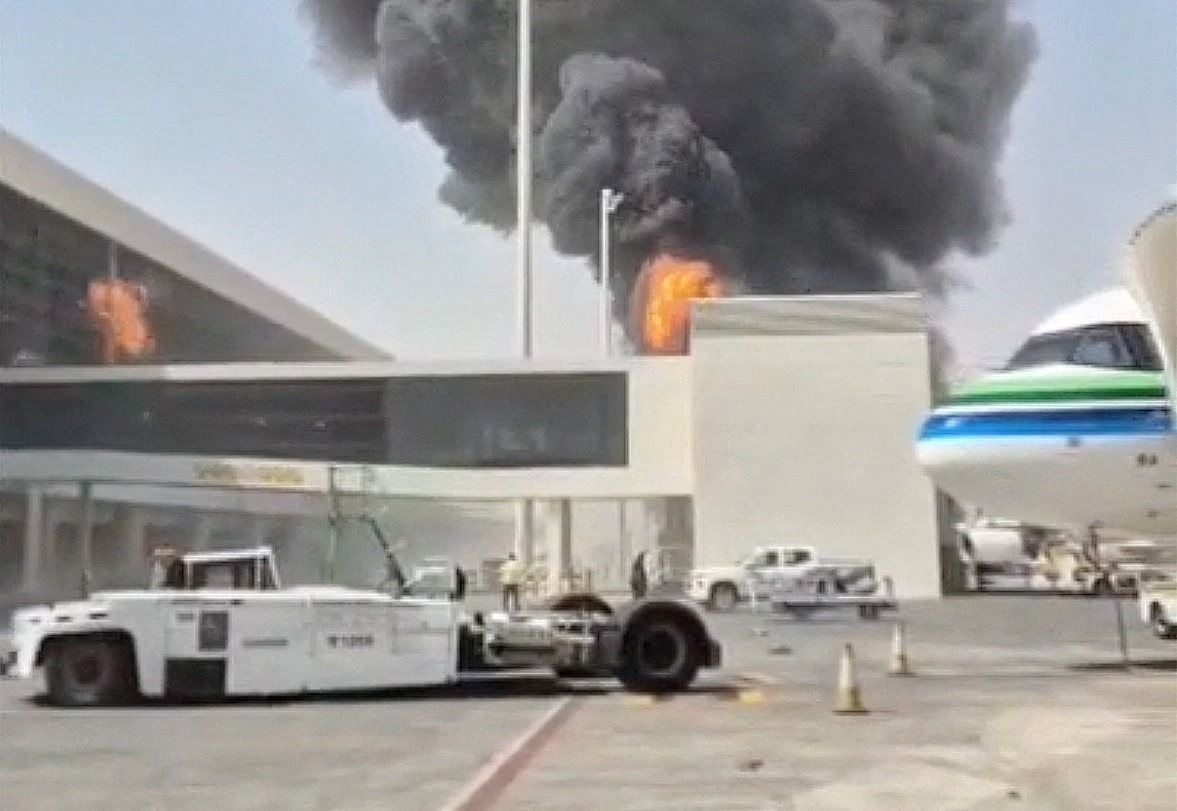
Smoke and flames rise from King Khalid International Airport in Riyadh on Oct. 8, 2026, after the Houthis announced they had attacked the airport. Image taken from a video posted on social media/via Reuters.






Today's news
The Saudi-led military coalition reported a new attack on Riyadh airport on Sunday, a day after an earlier attack killed at least 12 people and injured more than 300.
Coalition spokesperson Gen. Turki al-Malki said in a statement that an “unidentified projectile” struck Terminal 4 at King Khalid International Airport, causing a fire. In a separate statement posted on X, Malki said air defenses had “intercepted and destroyed a cruise missile” near the airport.
On Sunday, the Houthis claimed responsibility for the attack and renewed threats to Riyadh's airspace. Meanwhile, Al-Masirah, a television channel run by the Houthis in Yemen, reported that a strike it attributed to Saudi Arabia targeted Sanaa International Airport on Sunday.
Why it matters
Saturday's attack on Riyadh airport was the deadliest in Saudi Arabia in a decade and comes amid the broader regional war involving Iran and the United States.
Against this backdrop, the Israeli daily Maariv reported Sunday on deliberations in Washington and Jerusalem over a possible future attack on Iran, saying that “the Americans are confused and no longer truly know what they want.”
“The situation changes every day. One day, they’re preparing for an attack, and the next, the president announces he won’t strike Iran before the midterm elections,” an Israeli official told the newspaper. Israeli Prime Minister Benjamin Netanyahu has not ruled out a strike on Iran, Maariv added.
On Thursday, The New York Times reported that the United States could strike Iran within 72 hours. The potential targets included Iran’s missile and drone arsenals, energy facilities, command posts and Islamic Revolutionary Guard Corps headquarters.
What to watch for
In Lebanon, the seizure on Saturday of several hundred kilograms of explosives from a vehicle at a checkpoint in Dahr al-Baidar, in the Bekaa, continues to draw reactions from political circles. Authorities arrested two alleged Hezbollah members in connection with the case.
The incident has reignited debate over the military arsenal of the pro-Iran group, which Lebanon has pledged to dismantle as it pursues direct negotiations with Israel. It has also revived fears of further attacks and assassination plots that could destabilize the country.
Contacted by L'Orient-Le Jour, Nabih Berri's Amal Movement, Hezbollah's closest ally, declined to comment, saying it was “awaiting the outcome of the investigation and the official position” of the party. The group has yet to issue an official statement on the case.
In other news
- A retired soldier was killed Sunday by Israeli artillery fire near Yater while harvesting olives in his field. Earlier in the morning, another man died when ordnance exploded in Froun, near the Israeli-occupied area of southern Lebanon. Israeli aircraft and artillery also carried out several strikes throughout the day.
- Army commander Gen. Rodolph Haykal expressed hope that Lebanon would reinstate compulsory military service to strengthen national cohesion. Haykal also stressed that the army had never stopped fighting terrorism, drug trafficking, illegal weapons and smuggling, whether along the borders or elsewhere in Lebanon. He urged citizens to report suspicious activity, saying the army had stepped up security vigilance and continued its efforts to promote stability and security.
- Pope Leo XIV will provide school and university scholarships to children from disadvantaged Christian families in Lebanon, Syria and Iraq, the Vatican announced. The Dicastery for the Eastern Churches will oversee the initiative, which will cover beneficiaries' annual tuition fees.