





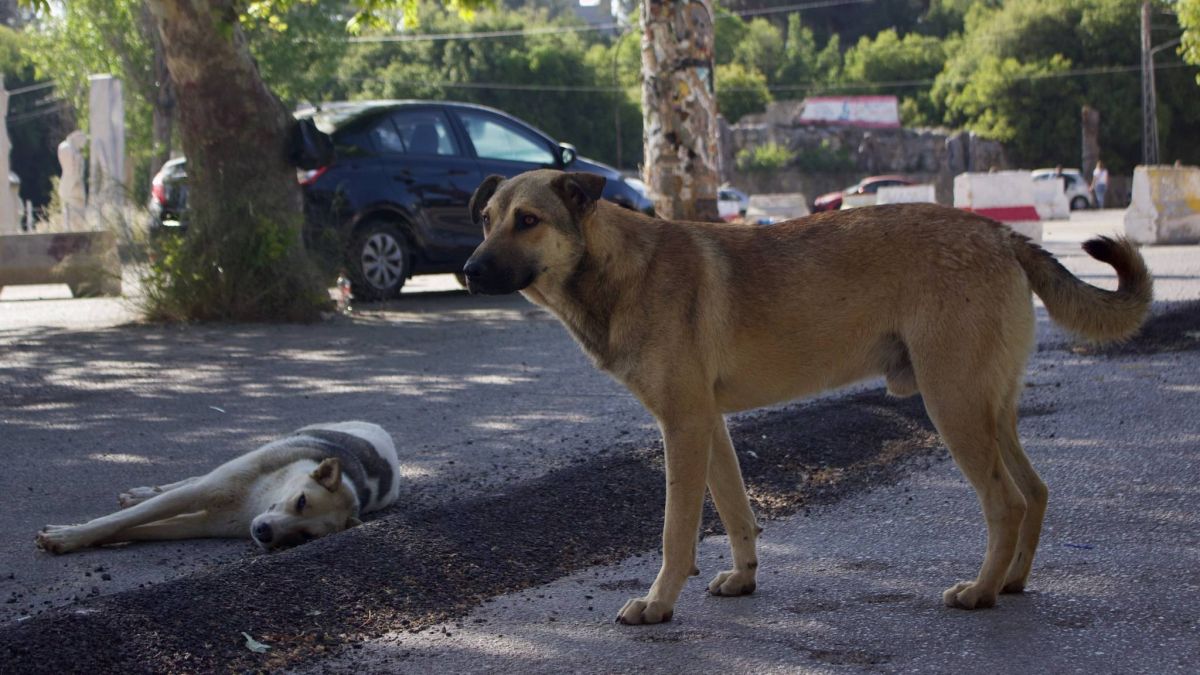
Two stray dogs in the Ras el-Jabal neighborhood, in Aley, after a wave of animal poisonings in the area, May 25, 2023. (Credit: Richard Salameh/L'Orient-Le Jour)






The city of Baalbeck and surrounding villages are grappling with an increasing number of stray dogs. ‘’The situation is very serious,‘’ MP Ali Mokdad warned Friday at a press conference held at the Baalbek municipality, highlighting the dangers associated with the phenomenon. According to him, about 3,500 stray dogs are present in the region.
The conference, which brought together the presidents of the municipalities of Baalbeck, Nahleh, Makneh, Younine, Iaat and Majdaloun, was held a day after an attack in Nahleh that led to the hospitalization of five people, including a young girl.
’’A single dog’’ attacked five people on a road at the entrance to the village, according to Nahleh municipal council President Hussein Yazbeck, who was contacted by L’Orient-Le Jour. The injured were admitted to Baalbek Government Hospital. An 8-year-old girl and a 30-year-old man had to undergo surgery, the official said.
’’The man is doing better and has been able to leave the hospital. The girl is also recovering but remains under medical supervision,’’ he said. ‘’We were surprised because this type of incident is extremely rare in our village. The dog involved fled after the attack,’’ he added. Since then, an emergency hotline has been set up, and municipal police have been closely following the case.
The government hospital treats ‘’three to four cases related to stray dog attacks’’ every day, according to Dr. Abbas Chokr, the facility’s director, who was contacted by L’Orient-Le Jour. ‘’These cases mainly come from the city of Baalbek, as well as neighboring villages within about a 10-kilometer radius,’’ he said. Twenty days ago, the hospital had already treated 13 patients from the city of Baalbeck, he added.
During the press conference, Baalbek municipal council President Ahmed Zouhair Toufaïli recalled that the crisis has persisted ‘’for several years’’ in the Baalbeck-Hermel region. He urged the Ministry of Finance and other ‘’competent ministries’’ to release funds owed to municipalities so they can ‘’fulfill their obligations to address this problem, as well as other crises.’’
He said Baalbeck municipality is currently working on solutions that will be announced soon. ‘’But these solutions require time, while the attacks and bites suffered by citizens that put their lives in danger require immediate responses,’’ he continued, while calling for any solution to avoid killing the animals.
Only one rabies case reported
Mokdad, for his part, said that ‘’about 3,500 stray dogs’’ are present in the region and ‘’pose a very significant danger to the population.’’ He said the canine population is behind ‘’several attacks per day’’ and warned that bites can cause infection, hemorrhaging or mutilation.
He also said that ‘’only one case of rabies has been detected so far.’’ Calling for increased funding for municipalities, he thanked the Ministry of Agriculture for providing logistical and human resources support, and the Ministry of Health for providing rabies vaccines.
Participants at the conference recalled a decision by the governorate in 2023 to create a shelter and a reserve for stray dogs. The plan has not been implemented because of the economic crisis and delays in municipal funding payments.
In 2025, the Ministry of Agriculture announced the launch of the ‘TNVR’ plan, Trap, Neuter, Vaccinate, Return, aimed at addressing Lebanon’s stray dog problem ‘’in a scientific, humane and sustainable manner’’ by sterilizing stray animals.
The system relies on cooperation between the Ministry of Agriculture, the veterinarians’ syndicate and municipalities, which are legally responsible for managing the issue.
Veterinarian Yehya Khattar, head of the Health Quarantine Department at the Ministry of Agriculture, said municipalities mostly respond after incidents rather than taking preventive measures.
’’The Baalbeck-Hermel municipalities have shown a willingness to implement it and will take charge of capturing the dogs. As a ministry, we will provide them with vaccines and identification collars,’’ he told L’Orient-Le Jour.
Lebanon has about 60,000 stray dogs. Since the plan was launched, about 2,500 have been treated, a modest number that Khattar attributed to the consequences of the recent war.
’’We initiated the plan in several regions, and many municipalities have followed it. We have seen a clear improvement: Once sterilized and vaccinated, stray dogs completely stop being aggressive,’’ Khattar said.
Other municipalities, however, have not implemented the plan, citing ‘’financial reasons.’’
’’The argument is valid, but above all, it is a matter of public safety,’’ he said, also pointing to a ‘’lack of awareness’’ as another obstacle.
’’Some kill the dogs or place them in shelters. We oppose this practice: A dog has the right to exist in its natural environment, as long as it does not threaten public safety.’’
Due to the security situation, southern Lebanon remains out of reach for the time being. ‘’Once the situation stabilizes, this region will be the ministry’s top priority,’’ Khattar said.

 Evening recap: Netanyahu announces West Bank offensive; 7 killed in Jordan church shooting; tents burned in south Lebanon
 US strike on Iran this weekend? ‘Absolutely,’ says Barrack; ‘I have no idea,’ says Trump