





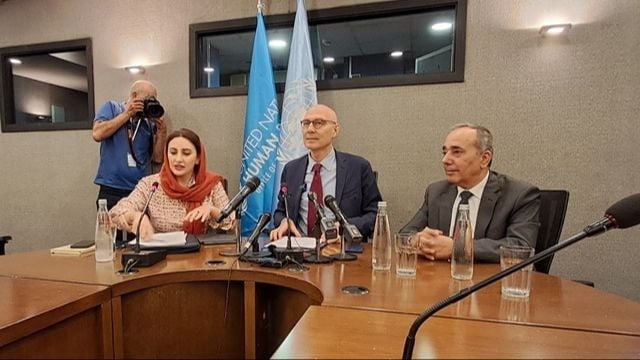
The U.N. High Commissioner for Human Rights, Volker Turk (center), during his press conference at the United Nations House building in Beirut, on July 27, 2026. (Credit: NNA)






BEIRUT — U.N. High Commissioner for Human Rights Volker Turk warned Monday that the conflict between Israel and Hezbollah has been marked by widespread violations of international law, including possible war crimes, as he concluded a visit to Lebanon.
"My office has documented widespread violations of international humanitarian law, some of which could constitute war crimes and, in certain circumstances, also crimes under international law," he said. He declared himself "deeply shocked by the scale of the destruction and suffering" he had witnessed.
"Shock, discouragement and despair are palpable, but I heard victims clearly calling for justice," he added, stating that those responsible for the destruction and losses, primarily the Israeli army, must be held accountable.
The U.N. official referred to interviews with some of the victims, as well as a visit to a shelter for the displaced in a school, accompanied by Social Affairs Minister Haneen Sayyed. "Some told me they had tried to return home but found their villages completely devastated," he continued. He went on: "I heard how entire villages were razed south of the Litani to make them uninhabitable, where relentless Israeli strikes have destroyed everything."
Asked about the possibility of holding Israel accountable, at a time when Prime Minister Benjamin Netanyahu continues to elude responsibility, Turk said that "there are international processes allowing for prosecution of aggressors in states that uphold the principles of international law," which is why documenting these crimes is important.
He also voiced hope "in the ongoing negotiations [between Lebanon and Israel], especially the meeting scheduled for Aug. 4 in Rome, aimed at reducing tensions and ensuring respect for international law, with a view toward an Israeli withdrawal from southern Lebanon."
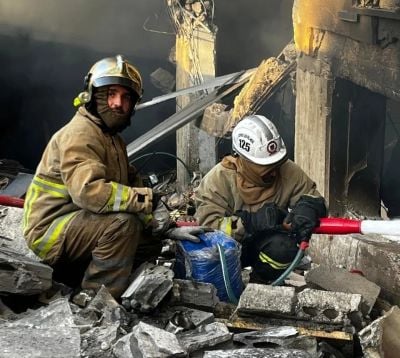
The war between Hezbollah and Israel resumed on March 2, when the Shiite group opened a support front with Iran, targeted by the United States and Israel. Since then, the Israeli army has occupied a vast area of southern Lebanon, dozens of villages have been destroyed, more than 4,500 people killed and 12,000 injured, and over a million people remain displaced. The relative calm of recent weeks (while Israeli attacks continued despite the cease-fire on the Hezbollah side) has not allowed the displaced to return home.
The Lebanese authorities have engaged in direct negotiations with Israel under American sponsorship since April, resulting in the signing of a framework agreement on June 26, symbolized by the deployment of the Lebanese Army in the southern village of Zawtar Gharbieh last Tuesday. This process faces obstacles, however, due to Israel's refusal to make large-scale withdrawals until Hezbollah is disarmed, and Hezbollah's own stance that negotiations on behalf of Lebanon should instead be led by the Iranians.
Justice for the victims of Aug. 4
Turk also addressed the Aug. 4 explosion, for which the indictment has still not been published by the investigating judge due to numerous obstacles. "Justice must be served in this case and the perpetrators punished," he insisted, just days before the sixth anniversary of the tragedy that destroyed half of Beirut, killed more than 220, and injured over 6,000 people, when several hundred tons of ammonium nitrate exploded in a warehouse. The U.N. official called for more reforms within the Lebanese justice system.
Turk also welcomed progress toward abolishing the death penalty in Lebanon, called for respect for the rights of homosexuals, and urged improved integration of people with disabilities into Lebanese society.
Received by Aoun and Berri
The U.N. High Commissioner for Human Rights was received earlier in the day by President Joseph Aoun at Baabda Presidential Palace. On the sidelines of the visit, Aoun condemned the ongoing demolition of homes and villages by Israel in southern Lebanon, warning that these actions could jeopardize the implementation of the framework agreement concluded a month ago with Israel.
"The ongoing destruction of homes and bulldozing of villages in the south are a direct violation of human rights and a blatant breach of international laws and standards," Aoun said, as quoted in a post on the Lebanese presidency's X account.
The president called for international intervention to end these practices, denouncing that "Israel has targeted religious and heritage sites, which shows a deliberate intent to harm both people and property," adding that such places "are not military sites and shelter no armed presence."
Turk was also received by Parliament Speaker Nabih Berri. Their discussion concerned "the general situation in Lebanon and the region, developments on the ground, the repercussions of Israeli attacks against Lebanon, and the issue of displaced people," according to the state-run National News Agency.

 Evening recap: Netanyahu announces West Bank offensive; 7 killed in Jordan church shooting; tents burned in south Lebanon
 US strike on Iran this weekend? ‘Absolutely,’ says Barrack; ‘I have no idea,’ says Trump