






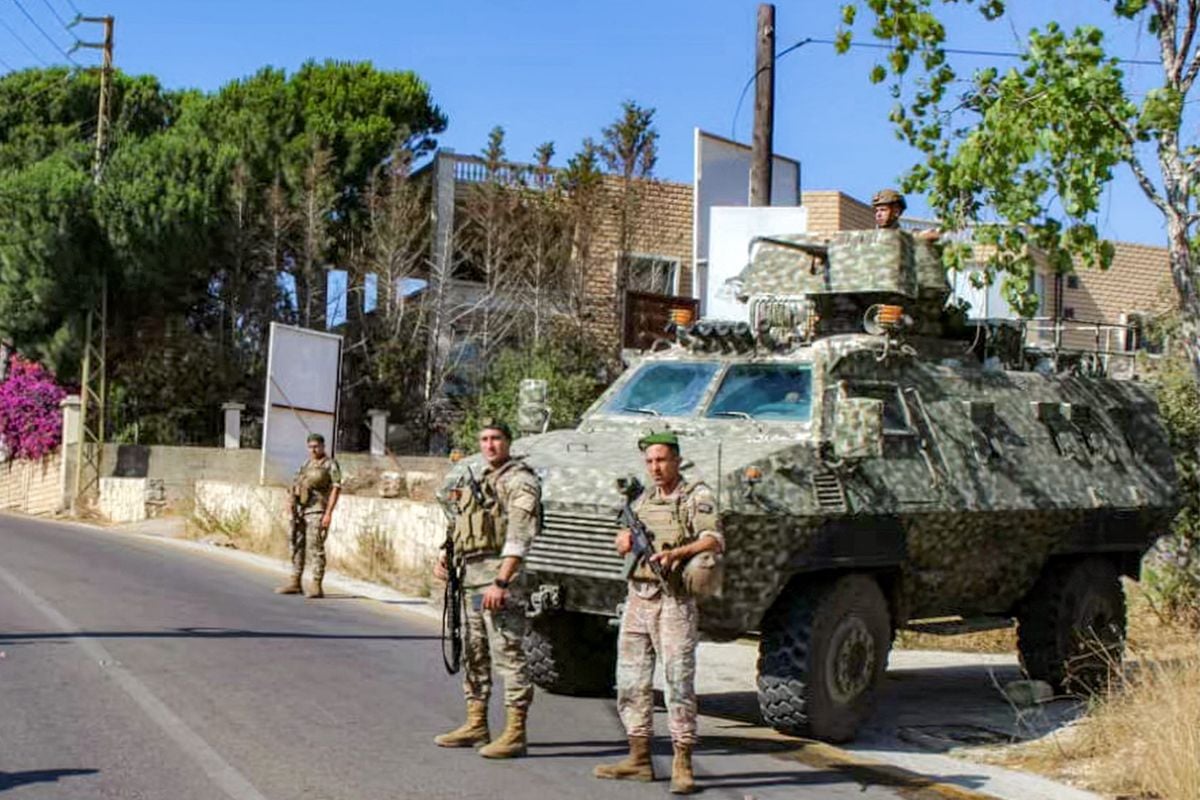
Lebanese Army soldiers set up a checkpoint in southern Lebanon. (Credit: Photo released July 15, 2026, by the Lebanese Army Press Service/AFP)






Jean Arnault, acting chargé d'affaires at the Office of the United Nations Special Coordinator for Lebanon, and Jean-Pierre Lacroix, the U.N. under-secretary-general for peace operations, presented an update Thursday to the U.N. Security Council on the implementation of Resolution 1701, adopted in 2006 after the war between Israel and Hezbollah.
With the mandate of the United Nations Interim Force in Lebanon (UNIFIL) set to expire in less than six months, Arnault emphasized the central role of the Lebanese state in stabilizing the country, describing the Lebanese Army as a "national institution that commands broad trust" and an "essential pillar" of this process.
Referring to the "escalation of hostilities between Israel and Hezbollah on March 2," as well as the "continued Israeli presence and military activities on Lebanese territory," Arnault highlighted "the scale of destruction, population displacement and humanitarian needs," calling on the international community to help address "the challenges of reconstruction."
The diplomat also referenced "ongoing diplomatic efforts, notably the trilateral framework agreement reached between Lebanon, Israel and the United States on June 26," affirming the U.N.'s support for initiatives aimed at "reducing tensions" and helping the parties reach arrangements that would end "decades of conflict."
The trilateral framework mentioned by Arnault follows several rounds of talks among Beirut, Tel Aviv and Washington.
Under the agreement, Israel is expected to gradually withdraw from areas of southern Lebanon it has occupied since its last war with Hezbollah.
Arnault also praised "the efforts of the Lebanese government to extend and reinforce the authority of the state throughout the entire territory," arguing that their success will depend on "the state's ability to provide security and services to its people."
In this context, he said "the Lebanese Army, as a national institution that enjoys broad trust, will constitute an essential pillar of this process."
He reiterated "the United Nations' commitment to supporting the implementation of Resolution 1701 and continued support for the security, stability and territorial integrity of Lebanon."
These diplomatic efforts come as the cease-fire that took effect after the last war between Hezbollah and Israel remains fragile.
Hezbollah reopened a front on March 2 by resuming fire against Israel in support of Iran, leading to a fresh escalation.
Since then, the Israeli army has continued carrying out limited strikes in southern Lebanon and demolition operations in the villages it occupies.
Separately, German Foreign Minister Johann Wadephul on Thursday proposed sending a European Union mission to replace UNIFIL after its mandate expires.
According to comments reported by the Deutschland news network, Wadephul called for examining a European mandate to avoid a security vacuum after the U.N. mission ends.
He argued that such an initiative could create the conditions for an Israeli army withdrawal "without the return of Hezbollah" to border areas.
The German minister also said the stability of the Lebanese government represented an opportunity that should be supported, adding that the European Union should play a greater role in maintaining Lebanon's security and political trajectory.
The proposal comes as the Israeli news site Ynet reported discussions around what it called the "Italian initiative," which would involve deploying Italian forces to southern Lebanon to oversee disarmament and prevent Hezbollah fighters from returning to the area, replacing UNIFIL.
