



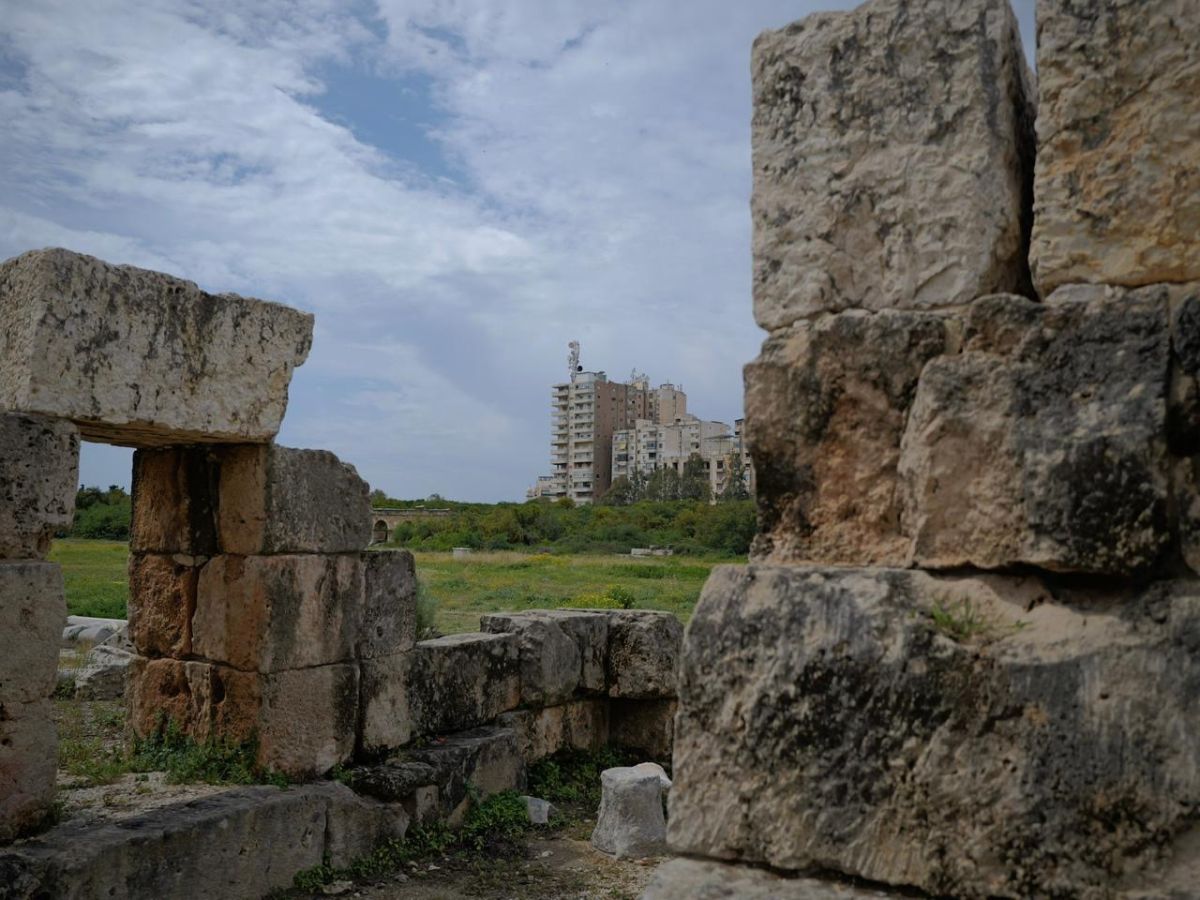
The archaeological site of Sour, a UNESCO World Heritage site threatened by the ongoing war on Lebanon, March 23, 2026. (Credit: Mathieu Karam/L'Orient-Le Jour)






The Lebanese Committee for the Safeguarding of Sour and the International Association for the Safeguarding of Sour, or AIST, which is accredited by UNESCO, have issued an urgent appeal to protect the exceptional heritage of the southern Lebanese coastal city, which Israel has heavily bombarded since March 2.
The groups notably called for Sour's inclusion on the List of World Heritage in Danger. The ruins of Sour have been on UNESCO's World Heritage List since the 1980s.
Maha al-Khalil Chalabi, president of the Lebanese Committee for the Safeguarding of Sour, held a news conference Friday at the entrance to the main archaeological site facing the sea, ahead of the UNESCO World Heritage Committee meeting in South Korea on July 19.
She was accompanied by several local dignitaries and the chief of staff of the United Nations Interim Force in Lebanon, French Maj. Gen. Paul Sanzey.
Chalabi called for "the immediate inclusion of the city of Sour on the List of World Heritage in Danger," stressing that Israeli bombardments had come dangerously close to the ancient ruins and damaged buildings in the surrounding area.
Sour has been among the cities most heavily bombed by the Israeli army since the current war began on March 2.
Israel has repeatedly said it is targeting "Hezbollah infrastructure" in the city.
The Culture Ministry had already requested on June 25 that the ruins of Sour be classified as an endangered site.
Technical support for the city's rehabilitation
The NGOs' appeal also called for the restoration of the historical and archaeological perimeter officially adopted by the World Heritage Committee in 1984.
It also called for the reactivation of UNESCO's International Campaign for the Safeguarding of Sour and its region, launched in 1996 during another war with Israel; the establishment of a multidisciplinary international mission to assess the damage and develop a comprehensive emergency plan; and the mobilization of scientific, technical and financial support for the city's rehabilitation and the sustainable protection of its cultural heritage.
Chalabi also called on Lebanese residents and expatriates, as well as universities, researchers, cultural institutions and friends of Lebanon around the world, to mobilize for the city.
"The safeguarding of Sour is not solely the responsibility of the Lebanese state. It is the responsibility of an entire nation and, beyond that, of the whole human community," she said.
She concluded: "We are deeply convinced that if the world were to lose Sour, it would not only be Lebanon that would be deprived of one of its greatest cities, but all humanity would lose an irreplaceable cultural heritage."
 7 p.m. recap: Iran defies Washington over Hormuz; Bab al-Mandeb ignites, Israel strikes the Bekaa