






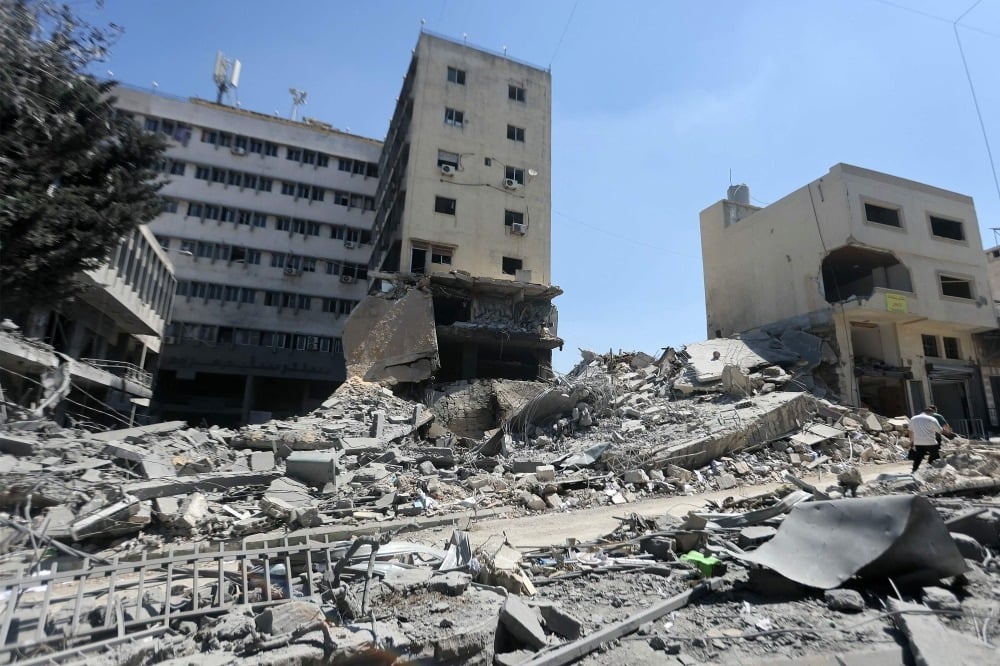
Rubble from a building destroyed in an Israeli airstrike is seen in Nabatieh, southern Lebanon, June 21, 2026. (Credit: Mahmoud Zayyat/AFP)






Economy Minister Amer Bisat said during a visit to the district of Nabatieh in the South on Friday that the government is seeking to accelerate reconstruction work, despite noting that progress on restoring electricity and energy is slow, as is the case with water and telecommunications.
Accompanied by the Ministry’s Director General, Mohammad Abu Haidar, Bisat toured Nabatieh to assess the scale of destruction and damage caused by the Israeli offensive, particularly in the economic and commercial sectors.
Bisat was received in the Nabatieh municipality by Amal Movement MPs Hani Kobeissi and Nasser Jaber, as well as Mayor Abbas Fakhr al-Din.
The mayor presented a list of 11 proposals to Bisat aimed at revitalizing the city’s economic cycle. Among them, Fakhr al-Din called for declaring Nabatieh an economically devastated area to grant it priority in any support, funding, or recovery programs. The mayor also called for conducting a comprehensive official economic damage assessment.
"The government is taking action toward the South and is committed to its reconstruction," Bisat said. "This is a pivotal and important role that has begun, despite obstacles," he added.
Bisat noted that "progress on restoring electricity and energy is slow, as is the case with water and telecommunications." However, he noted that "within the government’s limited means — due to declining revenues and the high cost of the war on the budget and treasury, as well as the heavy burden of aid and displaced persons — the government is working on multiple levels to secure revenues and assistance to support residents."
"We are seeking to accelerate reconstruction work despite risks stemming from the fragile security situation and ongoing daily attacks," the minister said, adding that there are "serious efforts to secure external assistance."
Meanwhile, MP Kobeissi addressed Bisat, saying: "Your visit, Minister, carries a political message first and foremost — that the government is present and assuming responsibility toward its people."
In May, Jaber noted that this year's war between Israel and Hezbollah is expected to shrink Lebanon's economy by at least 7% this year and could cost the country an estimated $20 billion.
