





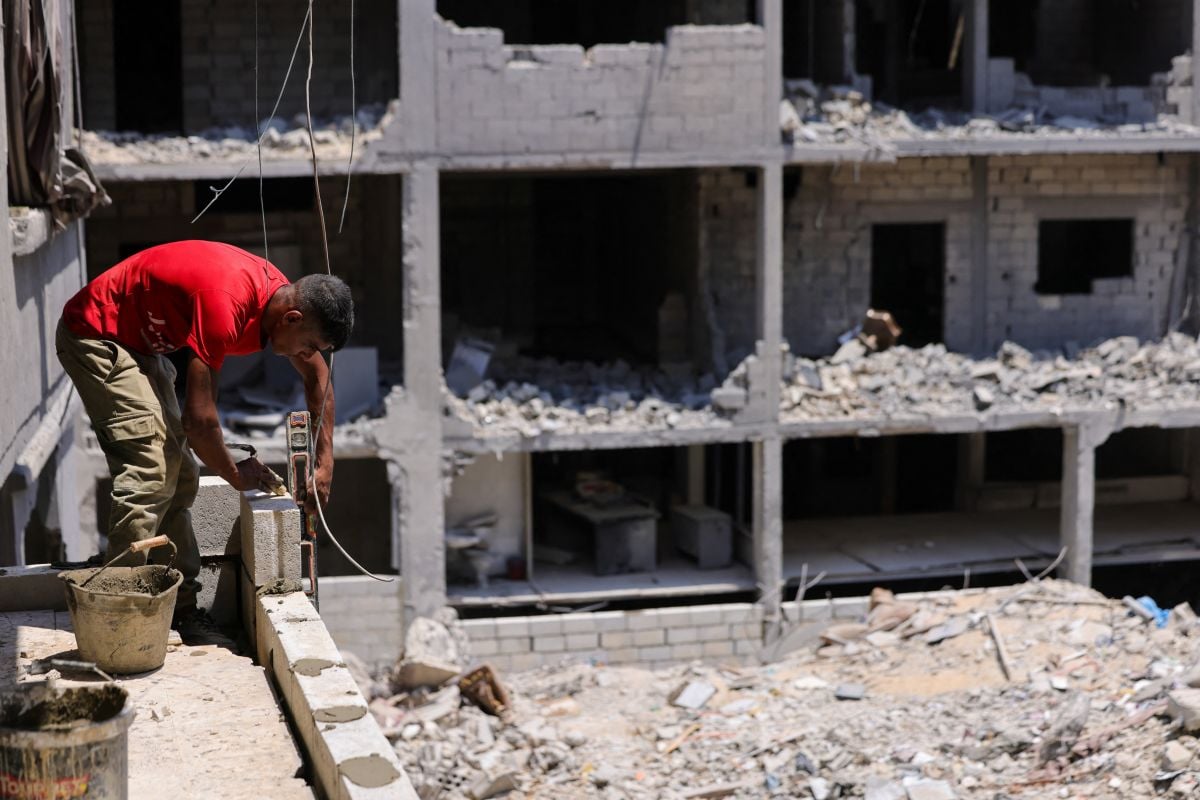
A bricklayer restores a balcony of a building destroyed in an Israeli airstrike, to allow the owner's family to return home after displacement during the war, following the Israel-Lebanon deal, in Sour, southern Lebanon, July 5, 2026. (Credit: Zohra Bensemra/ Reuters)






BEIRUT — Lebanese president Joseph Aoun, once again defended on Wednesday the authorities' decision to launch direct negotiations with Israel, which led to the signing of a U.S.-brokered framework agreement on June 26. He said that "the majority of Lebanese" support the decision, including, according to him, members of the Shiite community.
Hezbollah categorically rejected these talks, calling the agreement "null and void." The party maintains that the conflict must be resolved as part of a broader agreement between Washington and Tehran, while the protocol agreement between those two countries was deemed "obsolete" by U.S. President Donald Trump following renewed violence in the Gulf.
Speaking before a delegation of business leaders, Aoun said he had chosen to negotiate with Israel "to avoid standing by as [his] country is led to the brink for the interests of another country," referring to Iran.
Hezbollah reopened the front against Israel on March 2 in solidarity with the Islamic Republic after the assassination of former Supreme Leader Ali Khamenei at the start of the U.S.-Israeli offensive against Iran.
"I had to take an initiative that could stop the Israeli machine of destruction and extermination, limit the loss of human life and the destruction of villages, and ultimately bring an end to the occupation," he added.
Meeting with Trump 'will bring positive results'
Aoun said the negotiations have "the support of the majority of Lebanese, including within the Shiite community, which has paid the highest price in the wars in the South."
He ruled out abandoning the diplomatic track, urging the Lebanese people to "keep faith."
"I am convinced that things are moving in the right direction, despite obstacles and difficulties, and nothing is impossible in our vocabulary," he said.
The president also said he expects his visit to Washington at the end of July, during which he is scheduled to meet Donald Trump, "will bring positive results for Lebanon." He praised what he described as the United States' "unprecedented" attention to Lebanon and its support for efforts "to find a lasting solution" to the conflict with Israel.
The renewed war between Hezbollah and Israel has killed more than 4,300 people in Lebanon since March 2, according to the Health Ministry's official figures. The conflict resumed after a 15-month cease-fire that had been undermined by daily Israeli attacks since November 2024, following 13 months of war that began on Oct. 8, 2023.
Earlier in the day, Aoun met with Prime Minister Nawaf Salam to discuss the country's overall situation and developments in south Lebanon, particularly government efforts to "secure roads, clear debris and restore infrastructure to facilitate the return of residents to areas now secured following the Israeli withdrawal."
Both men stressed "the need to consolidate the cease-fire and accelerate the Israeli withdrawal from the affected areas." Salam informed Aoun of his upcoming official visit to Turkey, where the NATO summit is taking place. The two also discussed preparations for Thursday's Cabinet meeting at the Grand Serail.
The framework agreement with Israel provides for the Israeli army's withdrawal from two pilot areas within the more than 620 square kilometers of Lebanese territory it currently occupies in the South, alongside the deployment of the Lebanese Army to those areas. A new round of negotiations is scheduled to take place next week in Rome.
Rajji: Israel deal shows negotiations are 'exclusively Lebanese'
On Thursday, Foreign Minister Youssef Rajji said the framework agreement signed between Lebanon and Israel under U.S. auspices demonstrates that such decisions are a matter for the Lebanese state alone.
Speaking during a visit to Cyprus, Rajji said the deal "has demonstrated to everyone, first and foremost Iran, that negotiations are an exclusively Lebanese responsibility, to be decided by no one other than the Lebanese state."
As part of the interim deal with the United States, Iran insisted on Israel's withdrawal from southern Lebanon and an end to its months-long attacks.
Lebanon's Western-backed government and Hezbollah have exchanged angry words, and the group's supporters have blocked major roads in protest. One Hezbollah MP said the country would plunge into civil war if the government tried to force the group's disarmament, as demanded by Israel.

 7 p.m. recap: Iran warns Egypt, Israeli soldiers vote in south Lebanon, Haret Hreik responds to Kataeb