



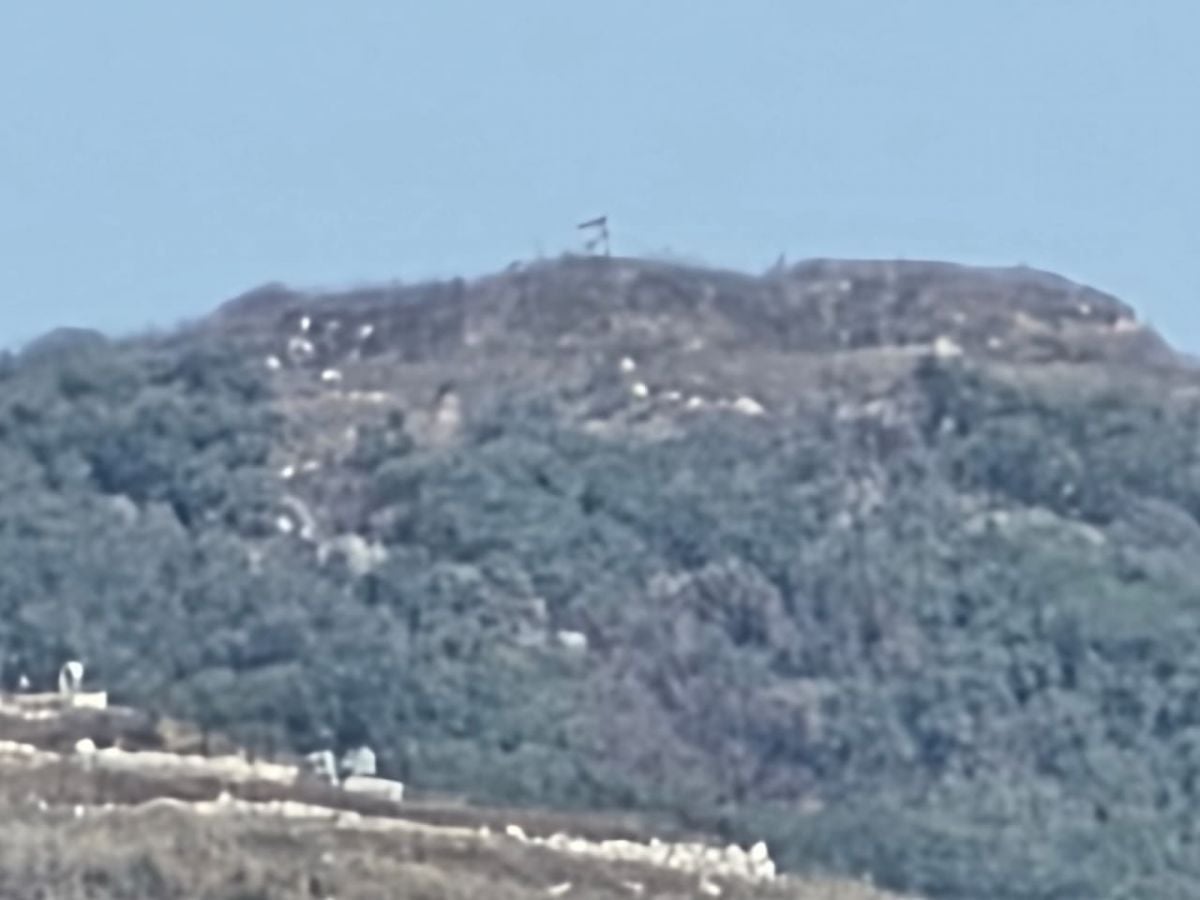
An Israeli flag over Ali al-Taher hills (Nabatieh) last week. (Credit: Photo taken by Ali Omeis and sent to L'Orient Today)






SOUTH LEBANON — An Israeli flag was raised on Ali Taher hill in southern Lebanon on Tuesday, according to images obtained by L'Orient Today's correspondent. This was the most notable development to emerge from south Lebanon by Tuesday evening in a day marked by a fragile calm.
Israeli military vehicles were spotted near the strategic hill, which the Israeli army had attempted to capture for several days before the signing of the framework agreement on June 26 between Lebanon and Israel.
The agreement sets out a roadmap that is intended to lead to the withdrawal of Israeli forces from areas they occupy in southern Lebanon and to Hezbollah’s disarmament. Direct negotiations under U.S. auspices are expected to continue next week in Rome, as confirmed by Israeli Foreign Minister Gideon Saar, who reiterated that Israel has “no territorial ambitions in Lebanon.” On Monday, Israel’s ambassador to the United States, Yechiel Leiter, mentioned the dates of July 14 and 15 during remarks before the Council on Foreign Relations in Washington.
The new round of talks was welcomed by Italian Foreign Minister Antonio Tajani, who recalled that Rome had expressed to the Lebanese and Israeli governments last April its willingness “to host the negotiations.” The newly appointed acting United Nations Special Coordinator for Lebanon, Jean Arnault, meanwhile began an official visit to Israel on Tuesday, where he is expected to discuss the importance of consolidating the cease-fire and implementing Security Council Resolution 1701, adopted in 2006.
The realities on the ground
In Lebanon, the legitimacy of the framework agreement and direct negotiations continues to divide opinion. Foreign Minister Joe Rajji said Tuesday that Lebanon would continue negotiations with Israel, saying the country had “no other choice,” while describing himself as “cautiously optimistic.” He made the remarks alongside Armenian Deputy Foreign Minister Vahan Kostanyan, who was visiting Beirut to deliver $150,000 in humanitarian aid from the Armenian government.
President Joseph Aoun, who is preparing for a meeting with U.S. President Donald Trump by the end of July, again acknowledged in a public statement that the framework agreement was “not ideal.” He nevertheless said it was justified by a number of realities on the ground, including a balance of power in the south that currently favors Israel. He added, however, that this should not prevent Lebanon from defending its rights and recovering occupied territories.
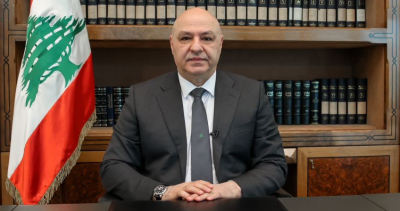
During a meeting in Baabda with the head of state, a National Bloc delegation led by its secretary-general Michel Helou expressed support for “the negotiation process that led to the tripartite framework agreement, considered a gateway to resolving outstanding issues, particularly the complete Israeli withdrawal, the exercise of state authority over the entire national territory and the restoration of the state's monopoly over weapons through legitimate institutions.” Earlier in the day, the Kataeb Party had stressed “the need to accelerate the implementation of the framework agreement.”
Conversely, Hezbollah MP Hussein Hajj Hassan once again criticized the agreement, accusing it of bypassing the protocol agreement concluded between Tehran and Washington in June. Under that document, Iran had called for ending hostilities in Lebanon as one of the conditions for agreeing to negotiate a lasting cessation of hostilities. Druze leader Walid Joumblatt described the framework agreement as “a unilateral agreement imposed by Israel on a Lebanese team with limited expertise in law and diplomacy.”
Receiving Sheikh Ali al-Khatib, vice president of the Supreme Islamic Shiite Council in Lebanon, in Tehran, Iranian Foreign Minister Abbas Araghchi said Tuesday that no agreement between Tehran and Washington would be reached before the withdrawal of Israeli forces from Lebanon. He said negotiations with the United States would not resume “as long as the first component of the protocol agreement concerning Lebanon has not been implemented.” Finally, the German foreign minister, during a visit to Jerusalem, urged Lebanese authorities to end Hezbollah’s “control” over southern Lebanon.
Photos taken a week ago
On the ground, Israeli military operations continued sporadically, including demolitions in the towns of Deir Siryan and Kounin, as well as artillery fire on Beit Yahoun, while the mystery surrounding the images of the Israeli flag on Ali Taher hill remained unresolved.
The images of the Israeli flag sent by our correspondent were taken around a week ago by photojournalist Ali Omeis. It is unclear whether the Israeli flag is still present at the site, however earlier reports indicated the presence of Israeli forces near the hill. According to available information, there is no confirmation that Israeli soldiers have occupied Hezbollah facilities in the area.
Informed sources said these sites had previously been targeted by airstrikes, which reportedly blocked their entrances or caused them to collapse. It is therefore difficult to determine their current condition, whether they have been fully evacuated or whether people remain inside.
Regarding the Israeli flag, sources interviewed by our correspondent put forward two possibilities. The first is that an Israeli infantry unit reached the site and raised the flag. The second is that the flag was placed there by a drone.
At the end of June, the Israeli army said it had surrounded a Hezbollah underground complex on Ali Taher hill, which it said trapped dozens of fighters inside. The hill holds both symbolic and strategic importance. Located north of the Litani River, it is considered a key point because it overlooks much of southeastern Lebanon, including Beaufort Castle and the neighboring valley, as well as the Nabatieh district, Iqlim al-Tuffah and Jabal Rihane in the Jezzine district. At the end of May, the Israeli army said it had seized Beaufort Castle in Nabatieh and raised the Israeli flag there.
Finally, funerals were held for the three women recently killed in an Israeli drone strike in Nabatieh Fawqa on July 7, 2026. Prime Minister Nawaf Salam offered his condolences to the residents of Nabatieh.
Reporting contributed by L'Orient Today's regional correspondent in the south, Muntasser Abdallah.