








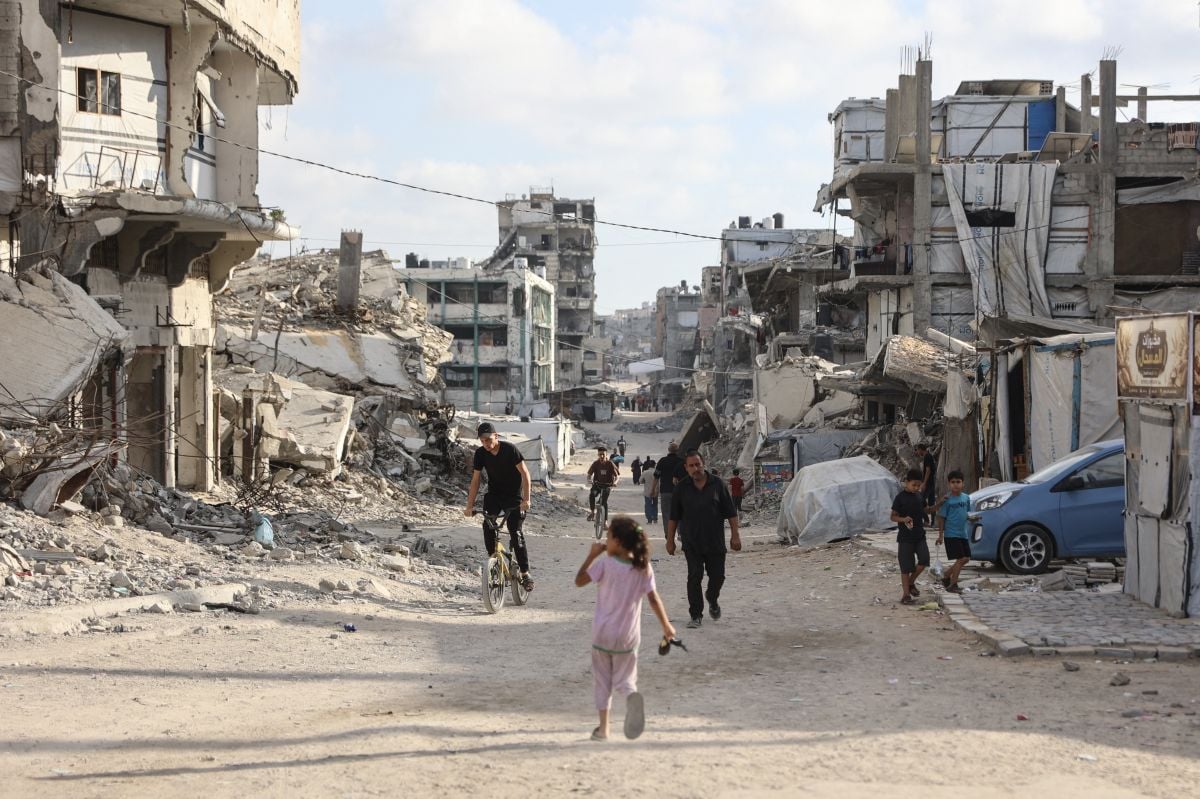
Palestinians cycle and walk along a street lined with damaged buildings near the al-Shati refugee camp, west of Gaza City, on July 1, 2026. (Credit: Omar Al-Qattaa / AFP)






Badar Salem is a Palestinian writer, editor, and translator. In 2025, she won the Samir Kassir Award for Freedom of the Press for “On the Normalization of Sumud in Gaza,” a critique of how Palestinian suffering gets repackaged as resilience.
"We didn’t see it coming" is the standard refrain after every disaster: a war, a political collapse, a market crash. No one expected the destruction to be this extensive. No one imagined the conflict would last this long. The consequences were miscalculated. It was never thought it would get this bad.
For ordinary people navigating an unpredictable world, such helplessness is understandable. The future lies largely beyond their control. It is another matter, however, when the inability to think beyond the immediate present becomes an organizing principle of leadership. Those who wield power, political, military, or economic, are entrusted not only with managing today’s crises, but shaping tomorrow’s conditions. Politics is, at its core, a relationship to the future. Governing means more than responding to events as they unfold ; it requires acting with an awareness of the world one's decisions will create. Leadership is therefore measured not only by its management of crises but by its capacity to preserve a future in which society can continue to exist.
No government can predict the future with certainty, and every political system operates within constraints. But there is a fundamental difference between failing to foresee every consequence and ceasing to treat the future as a political obligation. The former is inevitable ; the latter is a failure of governance itself.

Even under the most brutal conditions, under occupation, war, or profound instability, politics cannot exist solely in the present tense. It must answer a simple but indispensable question: what comes after this ?
In the Palestinian case, that question has steadily disappeared. Gaza today isn’t only a landscape of ruin; it is a political case study in the collapse of the idea of a future as a governing horizon.
Who is accountable for the future ?
There is no disputing Israel’s direct responsibility for the devastation of Gaza, a catastrophe born of occupation, military force, and a long-standing system of domination. But to end the analysis there is to evade a more difficult question: what obligations do Palestinian political actors bear toward the society they claim to represent ?
Accountability cannot stop with the occupying power ; it must also extend to Palestinian leadership, assessed by what it owes to the people in whose name it acts. The central question is not whether political decisions achieve military or ideological objectives, but whether they preserve the conditions under which ordinary life can continue.
Once political action becomes detached from the question of what follows, politics ceases to be the stewardship of a community. It becomes the management of perpetual conflict.
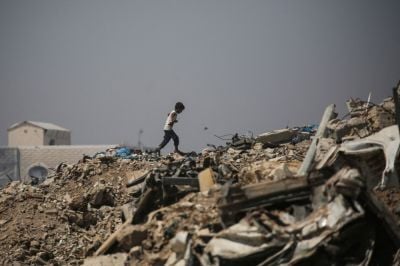
This is where Hamas represents more than a strategic failure. It illustrates a different political temporality.
For years, the Islamic movement and Gaza’s de facto governing authority has championed a narrative in which resilience, sacrifice, and endurance function as virtues in their own right. Yet these virtues are never accompanied by a coherent political vision of the society meant to emerge once the immediate cycle of violence subsides. Resistance possesses a rich vocabulary; reconstruction, governance, and civilian flourishing do not.
The devastation following Oct. 7 was therefore not simply the consequence of a single decision, not an isolated rupture, but part of a longer trajectory. It exposed a longer political logic in which emergency becomes permanent and confrontation becomes the primary framework through which politics is understood. Within this framework, questions of ordinary life — economy, education, personal freedoms — are consistently deferred in favor of an endless struggle whose temporal horizon never arrives.
As the historian Roel Meijer argues in "The Problem of the Political in Islamist Movements," many Islamist movements approach political reality as a condition of permanent decay. Within such a worldview, political life is stripped of incremental possibility, and history offers little room for gradual reform or accumulated progress. The existing order is not something to be reshaped over time but something that must be dismantled before any ideological future can begin. As a result, the immediate confrontation becomes the meaningful register of politics.
The problem, then, is not merely ideological. It is temporal.

Movements that sever themselves from the future inevitably compress politics into the present, where the only legible space is the battlefield. A long-term civilian horizon — institution-building, economic development, and civilian life — falls outside their frame of reference. History ceases to unfold as an open-ended process and becomes a singular, dramatic showdown, where death and martyrdom completely eclipse the value of living.
In such a framework, the well-being of society is no longer the ultimate aim of politics. Civilian life becomes instrumental, secondary to the demands of an overriding struggle. Consequently, mass casualties and large-scale destruction are not necessarily interpreted as political failure, but are recoded as "necessary sacrifice," tolerable cost, or even historical inevitability.
Two failures of political time
Yet this crisis extends beyond Hamas.
The Palestinian Authority, despite its radically different ideology, embodies another form of political short-sightedness. If Hamas operates under a logic of permanent emergency and friction, the Authority governs by deferring the future, substituting the maintenance of an unstable status quo for any meaningful political horizon.
The contrast is revealing.
The Authority remains, however constrained, an expression of the modern state form. It operates through institutions, legal frameworks, and a continuous administrative timeline that presumes the continuation of political life. Even if that future appears increasingly hollow, it remains the implicit horizon against which the Authority can be judged.
It can be evaluated from within its own logic, one that assumes the existence of a governable future. Its failures are measured in its inability to build a more stable life, protect society, or deliver on its political promises.
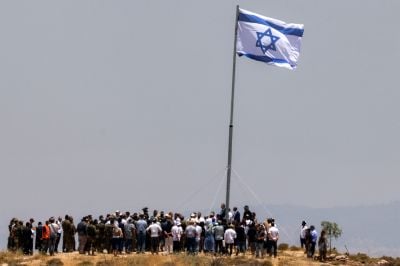
Hamas inhabits a different temporal framework altogether. Although it governs territory and maintains bureaucratic institutions, the horizon guiding its actions is not that of statecraft. Instead, it is shaped by an ideological temporality that frames history as a succession of existential confrontations, an extended limbo suspended between wars and fragile truces. Within this logic, the political timeline ceases to be linear. It becomes a "circular trap": repeated cycles of escalation, pause, tactical repositioning, and renewed conflict.
Despite their differences, both models reveal a politics increasingly detached from the future. One endlessly defers it, the other continually suspends it. And this is exactly what distinguishes tactical failure from temporal failure. Tactical mistakes misjudge events, but temporal failure abandons responsibility for the future itself.
Once the civilian future disappears from politics, accountability begins to disappear with it, and decisions that reshape the lives of millions become detached from responsibility for what follows.
This disconnection between action and consequence enables political actors to externalize the costs of catastrophe. The grueling cleanup of "the day after" — reconstruction, governance, security, basic continuity — is invariably displaced onto external actors: international agencies, donor states, or the exhausted population itself. Once the strike lands, the leadership washes its hands of the aftermath.
This refusal to treat the future as a binding political responsibility reduces governance to a hamster wheel of disaster and repair.
Seen in this light, the refrain "We didn’t see it coming" becomes so revealing: not as a failure of foresight alone, but as evidence of a deeper abandonment of responsibility toward the people. When the future disappears as a category of political thought, destruction becomes the easiest outcome to produce.
Those who refuse to think beyond the next confrontation make the destruction of the future structurally easier. And those who see history only as an endless battlefield can never imagine a society built to survive it.
This article was originally published in Arabic by L'Orient-le Jour and translated to English by Mira El-Hayek.

 7 p.m. recap: Iran warns Egypt, Israeli soldiers vote in south Lebanon, Haret Hreik responds to Kataeb