






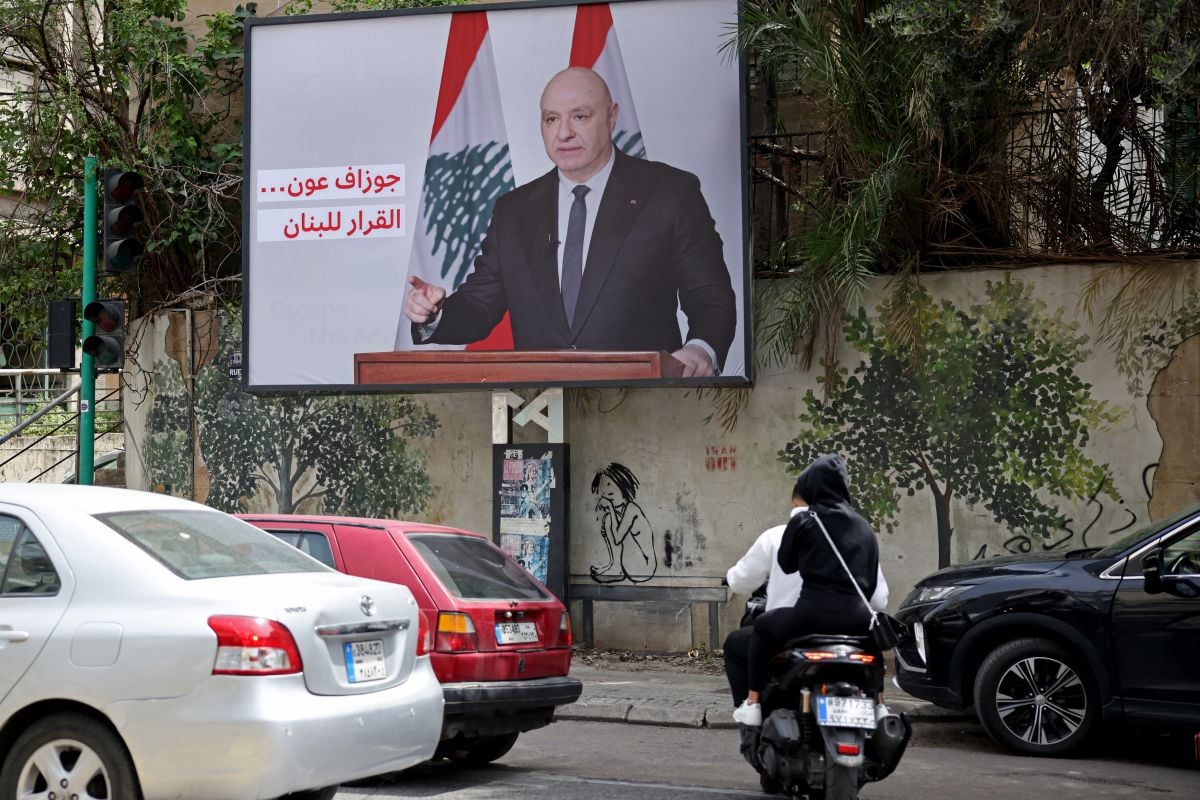
A poster bearing the image of President Joseph Aoun in a street in Beirut, with the inscription "The decision belongs to Lebanon," on April 24, 2026. (Credit: Anwar Amro/AFP)






BEIRUT — President Joseph Aoun said Wednesday that the framework agreement concluded with Israel last week is "neither a capitulation nor a concession" and preserves Lebanon's rights "both legally and operationally."
"The framework agreement reached through the Washington negotiations reflects the logic of the state through its provisions and preserves Lebanon's rights on the legal and operational levels," Aoun told delegations from the Beirut and North Lebanon bar associations at Baabda Presidential Palace. "It is neither a capitulation nor a renunciation of our rights."
Article 13 of the agreement, which commits both countries to "cease all hostile or prejudicial acts in international political or legal forums" against one another, has sparked intense political and legal debate. Critics argue that the provision could prevent Lebanon from pursuing cases against Israel before international courts over alleged war crimes and violations of international law committed in Lebanon since the war first began in October 2023, and Israeli attacks continued daily after the November 2024 cease-fire.
The president also welcomed recent remarks by Parliament Speaker Nabih Berri that he said were intended to prevent internal discord. Berri, despite sharply criticizing the framework agreement as a point of contention among Lebanese, has called for preserving national unity.
"We all agree that discord is unacceptable and that it is forbidden to undermine the army," Aoun said.
He also dismissed what he described as "rumors" about the possible dismissal of Lebanese Army Commander Gen. Rodolph Haykal and other security chiefs. The claims were circulated in recent days by Hezbollah political figure Nawaf Moussawi.
Aoun met with Haykal in Baabda on Tuesday and stressed "the army's essential role in maintaining security and consolidating the state's sovereignty."
"Lebanon is a sovereign state negotiating in its own name. We chose the path of negotiations because it is the best option after the failure of wars," Aoun said.
"The people of the South, from all communities, have the right to live in safety and no longer pay, time and again, the heavy price of death, destruction and displacement," he added.

 8 p.m. recap: Israel again threatens Beirut’s south suburbs; 2 ships hit near Hormuz; Riyadh football matches canceled