






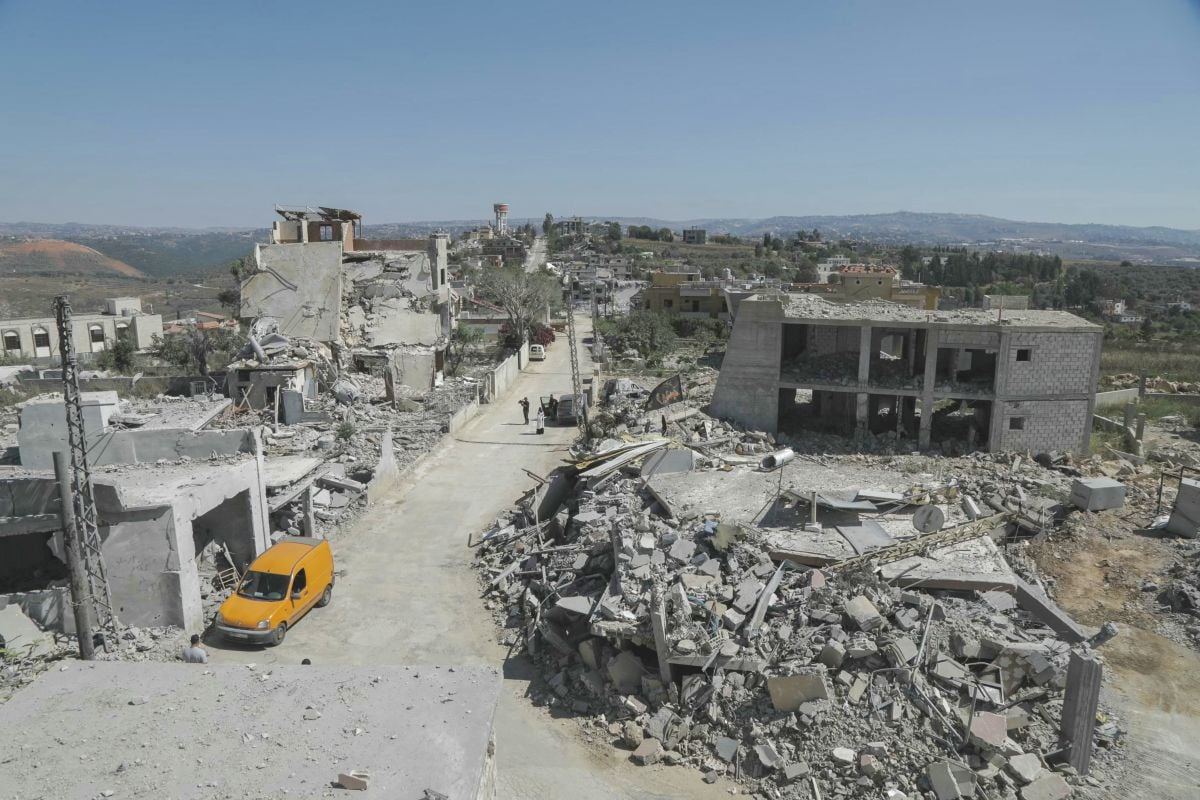
A man walks past destruction in the southern Lebanese village of Froun on June 30, 2026. (Credit: Kawnat Haju/AFP)






Israeli Prime Minister Benjamin Netanyahu on Wednesday hailed Israel's occupation of south Lebanon's historic Beaufort Castle, located in Arnoun, in the Nabatieh district.
"From now on, we are the ones looking over Lebanon from a strategic height," Netanyahu said during a ceremony for Israeli soldiers killed in the war against Hezbollah.
Netanyahu claimed that Israel had killed over 9,000 Hezbollah fighters since the war began in October 2023, saying that the "vast majority" of the group's roughly 150,000 missiles and rockets had been destroyed, along with "a significant portion" of what he described as Hezbollah's "terrorist villages" in south Lebanon.
The Israeli prime minister also said the framework agreement signed with Lebanon last Friday represented "a military and diplomatic achievement whose magnitude cannot be underestimated," dealing a blow to Hezbollah and Iran.
According to Netanyahu, the agreement with Lebanon is a "historic" breakthrough that "separates the Lebanese front from the Iranian front" and recognizes Israel's right to maintain a buffer zone in Lebanon until Hezbollah no longer poses a threat to Israeli security.
He warned Iran, which had sought to force Israel to withdraw from south Lebanon, "will not see that happen."
Netanyahu claimed that Israel had taken "an important step toward ending the war" and would do "everything possible" to eventually reach a peace agreement with Lebanon.
Israeli attacks on Lebanon since March 2 have killed over 4,297 people and injured 12,196 others, according to the Health Ministry. The death toll has been steadily climbing as rescuers recover bodies from the rubble in areas Israel had previously blocked off access to.
According to the prime minister, Israel has demonstrated "two things" to Hezbollah: first, that "Israel will not be held hostage by the operational arm of the Iranian regime," and second, that it is not "as weak as a spider's web," referring to a speech by former Hezbollah leader Hassan Nasrallah, who was killed by an Israeli strike in 2024.
"Israel is as strong as steel webs," Netanyahu said.
Referring to the more than 600-square-kilometer Israeli-dubbed "buffer zone" occupied by the Israeli army in south Lebanon, extending up to 10 kilometers deep, Netanyahu said Israeli forces would remain there "as long as necessary."
"The buffer zone for Gaza is now in Gaza. The buffer zone for Lebanon is now in Lebanon, not in northern Israel. That is an essential lesson," he said.
'We must deal with the remnants of the Iranian axis'
In an interview Tuesday evening with Israel's Channel 14, Netanyahu said Israel must still "deal with the remnants of the Iranian axis and seize the opportunities for peace agreements," according to The Times of Israel.
"There are contacts with other countries. I cannot say more," Netanyahu added when asked about the possibility of peace between Israel and Saudi Arabia.
Saudi Arabia has repeatedly said normalization with Israel remains contingent on the establishment of an "irreversible process" toward the creation of a Palestinian state, a position it reaffirmed during Arab and Muslim summits in Riyadh in November 2023 and November 2024 following the war in Gaza.
Asked whether Israel's wars against "Iran, Hamas and Hezbollah" could now be considered over, Netanyahu replied: "It is never over. If you want to live in the Middle East — and in the world — you have to be very strong."
"Israel is stronger than ever, and we have pushed back these threats. We have significantly weakened them. But we still have work to do," he said.
Israeli Defense Minister Israel Katz repeatedly said throughout June that Israeli troops would remain in south Lebanon, southern Syria and Gaza despite the announcement in mid-June of a U.S.-Iran agreement aimed at ending the war in the Middle East.

 8 p.m. recap: Israel again threatens Beirut’s south suburbs; 2 ships hit near Hormuz; Riyadh football matches canceled