






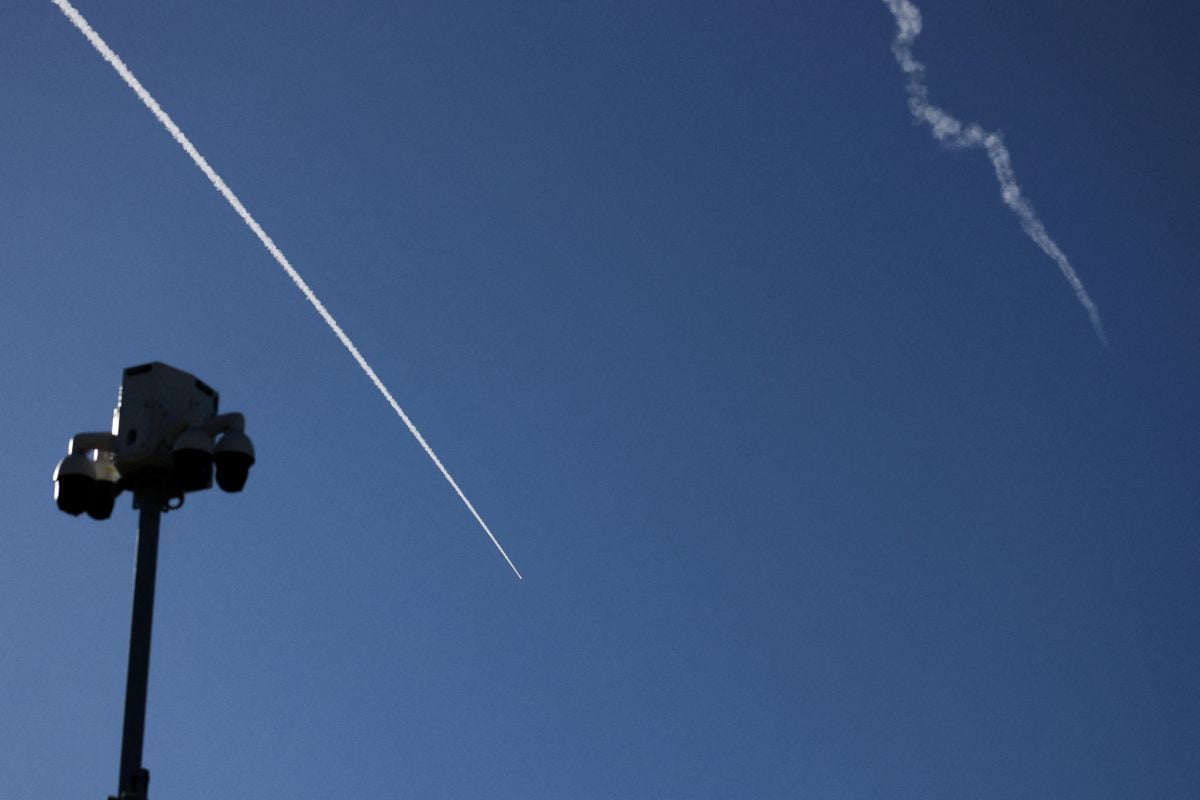
Israel's Iron Dome anti-missile system operates for interceptions over the Israel-Lebanon border, as seen from northern Israel, June 10, 2026. (Credit: Ammar Awad/Reuters)






BEIRUT — Israel sold advanced military equipment, including missile defense systems for VIP aircraft and components for F-15 fighter jets, to Qatar and Saudi Arabia between 2020 and 2022, according to the Israeli daily Haaretz. These sales come despite the fact that those two countries have not normalized relations with Israel. While security ties between Israel and Gulf states have reportedly developed behind the scenes over the past decade, no Israeli sale has ever been confirmed by the parties.
Based on official documents and an analysis of publicly available photographs, Haaretz reported that three of the 11 aircraft in the Qatari royal family's fleet — two Boeing 747s and one Airbus A340-500 — were specifically equipped with the C-MUSIC antimissile protection system, made by the Israeli company Elbit Systems. The plane used by Emir Tamim bin Hamad al-Thani during his trip to Tehran last year was among the aircraft equipped, according to the Israeli daily's article, which relies on an analysis of photos. These systems were installed at various times between 2020 and 2022, while the aircraft were undergoing maintenance in Basel, Switzerland.
Mounted under the rear section of the aircraft, the C-MUSIC system detects the launch of a heat-seeking surface-to-air missile and emits an infrared beam that disrupts its lock on the target. It is particularly effective against shoulder-fired missiles like MANPADS.
Contracts worth several hundred million dollars
Haaretz also reveals that Elbit Systems and other Israeli companies participated in Qatar’s F-15QA “Ababil” fighter jet program, according to a U.S. Department of Defense contract signed with Boeing. In 2017, the American aircraft manufacturer had won a contract worth several billion dollars to supply these aircraft to the Qatari air force, which received 36 in 2023. According to the contract, Israeli companies secured subcontracting agreements with Boeing valued between $150 million and $250 million to supply advanced parts and systems for Qatari planes.
These contracts included the supply of 160 JHMCS combat helmets, estimated at about $200,000 each, as well as AN/AVS-9 night vision goggles. Other contracts were awarded to Israel Aerospace Industries, TAT Technologies and Beth-El Industries for the supply of aeronautical components and onboard systems.
Haaretz also claims that Saudi Arabia, an indirect client of Israeli defense companies, received similar equipment as part of its F-15SA fighter acquisition program with Boeing. While normalization with Israel had appeared close before Oct. 7, 2023 — the day the Gaza war began — it is no longer considered imminent, with the Riyadh making any such agreement conditional on the establishment of an independent Palestinian state or, at a minimum, on clear and credible Israeli commitments to this end.
According to U.S. Department of Defense documents, Riyadh received 462 JHMCS combat helmets and 462 AN/AVS-9 night vision goggles, identical to those sold to Qatar. Images posted online reportedly show these helmets in service with the Saudi air force. Sales of these helmets to Riyadh alone are estimated at nearly $100 million.
During the recent war in the Middle East, which broke out on Feb. 28 following the joint U.S.-Israeli attack on Tehran, Tel Aviv sent air defense systems, including the Iron Dome, and personnel to operate them to the United Arab Emirates — a country that has normalized relations with Israel. This represented an unprecedented level of military, security and intelligence cooperation between Tel Aviv and Abu Dhabi since the signing of normalization agreements between the two countries in 2020.
