






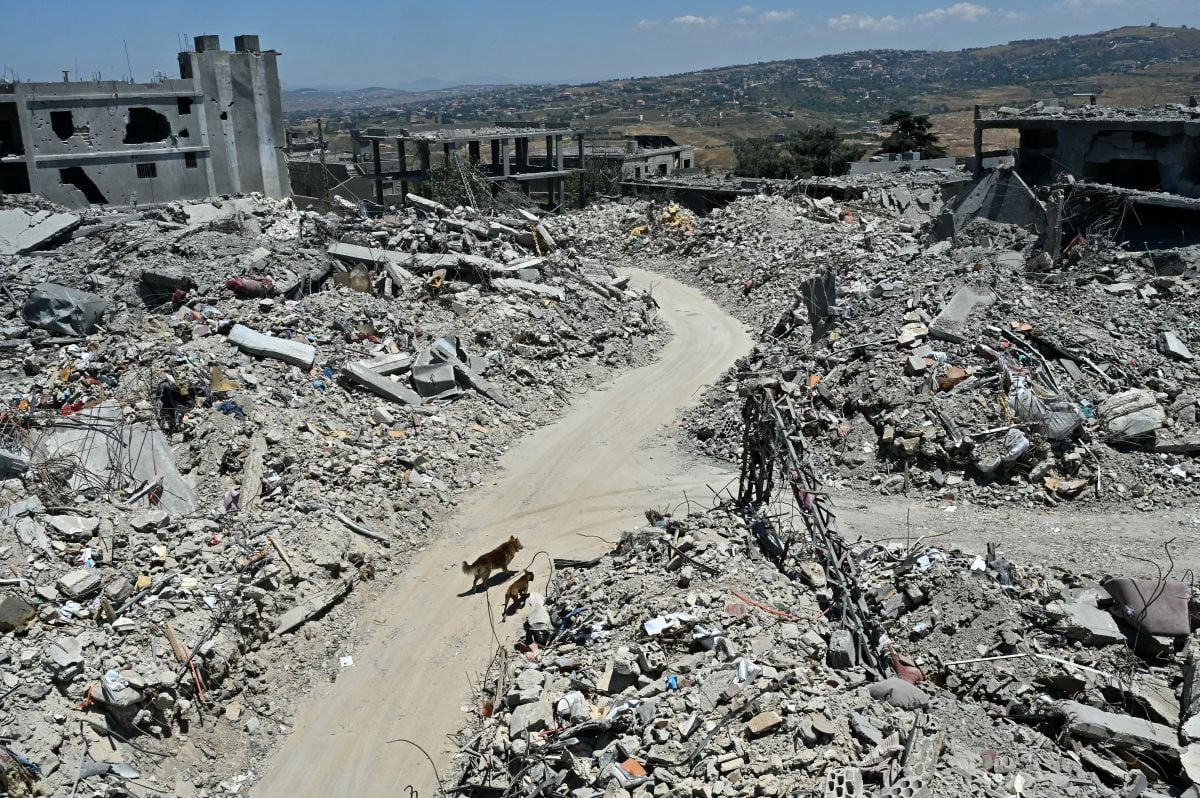
Stray dogs roam through the rubble in Tibnin, in the Bint Jbeil district of southern Lebanon, on June 24, 2026. (Credit: Fadel Itani/AFP)






SOUTH LEBANON — Israeli and Lebanese senior officials on Thursday denied reports that the Israeli army had withdrawn part of its troops from the “buffer zone” in occupied southern Lebanon, following claims by a U.S. official that such a partial pullback had taken place as a “gesture of goodwill toward the Lebanese government.”
Israel and Lebanon have been holding talks in Washington for two days on a US-backed proposal under which Israeli forces would transfer “pilot areas” of currently occupied territory to the Lebanese army, a move that could mark an initial step toward restoring Lebanese control over these regions. The negotiations are expected to continue on this issue as well as the broader question of maintaining the cease-fire in Lebanon, even as they appear increasingly overshadowed by Iranian efforts to place the Lebanese file at the center of its own discussions with the United States.
It is within this context that a U.S. State Department official said the “pilot zone” plan aims to ensure the complete and verifiable destruction of Hezbollah’s weapons and infrastructure and the dismantling of non-state armed groups. “Israel has already taken a concrete step by withdrawing from part of its 'buffer zone.' This is a significant gesture of goodwill toward the legitimate government of Lebanon,” the official, quoted by Reuters, said.
The Lebanese Army must “now deploy in this area and carry out the verifiable elimination of terrorist weapons and infrastructure. This model will be replicated across southern Lebanon, allowing the safe return of displaced families, the reconstruction of the south, and the restoration of full Lebanese sovereignty,” the official added.
However, no withdrawal has been observed so far. Lebanese security sources told several media outlets that no pullback had taken place. A senior Lebanese military official said developments on the ground in recent days “show exactly the opposite of a withdrawal,” adding that Israeli forces continue to enforce their buffer zone and prevent anyone from approaching it, including Lebanese Army personnel.
A senior Israeli defense official told Reuters that Israel’s policy is clear and that the army will not withdraw from what it calls its “buffer zone” in southern Lebanon. The zone, unilaterally established by Israel and preventing displaced residents from returning, spans around 620 square kilometers, with dozens of villages reportedly razed by the Israeli military. An Israeli army source also told Haaretz they were unaware of any such movement, saying: “I am not aware of anything like that,” and adding that “in fact, we have not withdrawn from any location so far.”
Asked on Wednesday evening about a possible Israeli withdrawal from the South, U.S. Ambassador to Lebanon Michel Issa said it would “eventually happen, but not tomorrow.” Israeli Prime Minister Benjamin Netanyahu also said the same day that Israel would not withdraw from the south “as long as I am Prime Minister.” Issa, speaking to al-Jadeed after the second day of talks in Washington, said the atmosphere in the discussions was “good” and that he expected a “declaration of intent” between the two countries at the end of the round of talks on Thursday evening.
“I think everything will end well,” with “in principle” the “selection of pilot areas and the publication of a declaration of intent,” he said, adding that a “blockage” had emerged between the Israeli and Lebanese delegations on this issue.
On the ground, a fragile calm continues in southern Lebanon. The night remained relatively quiet despite limited Israeli violations, including artillery fire near border towns, according to our correspondent in the south. Earlier, Israeli forces killed two people on Wednesday afternoon in a drone strike on Kfar Roummane in the Nabatieh district. Hezbollah condemned what it called a new “flagrant” violation of the cease-fire. “For the second time in less than 48 hours, the Israeli army deliberately targeted Lebanese civilians inspecting their home in the Doha Kfar Roummane area,” the group said in a brief statement overnight. It described the attack as a “blatant violation of the ceasefire to which the resistance has adhered.”
In addition to the two men killed in Kfar Roummane, identified as Ahmad and Mahmoud Asseily, two others were killed on Tuesday in Nabatieh Fawqa in the same region.
Reporting contributed by our correspondent Muntasser Abdallah.
