



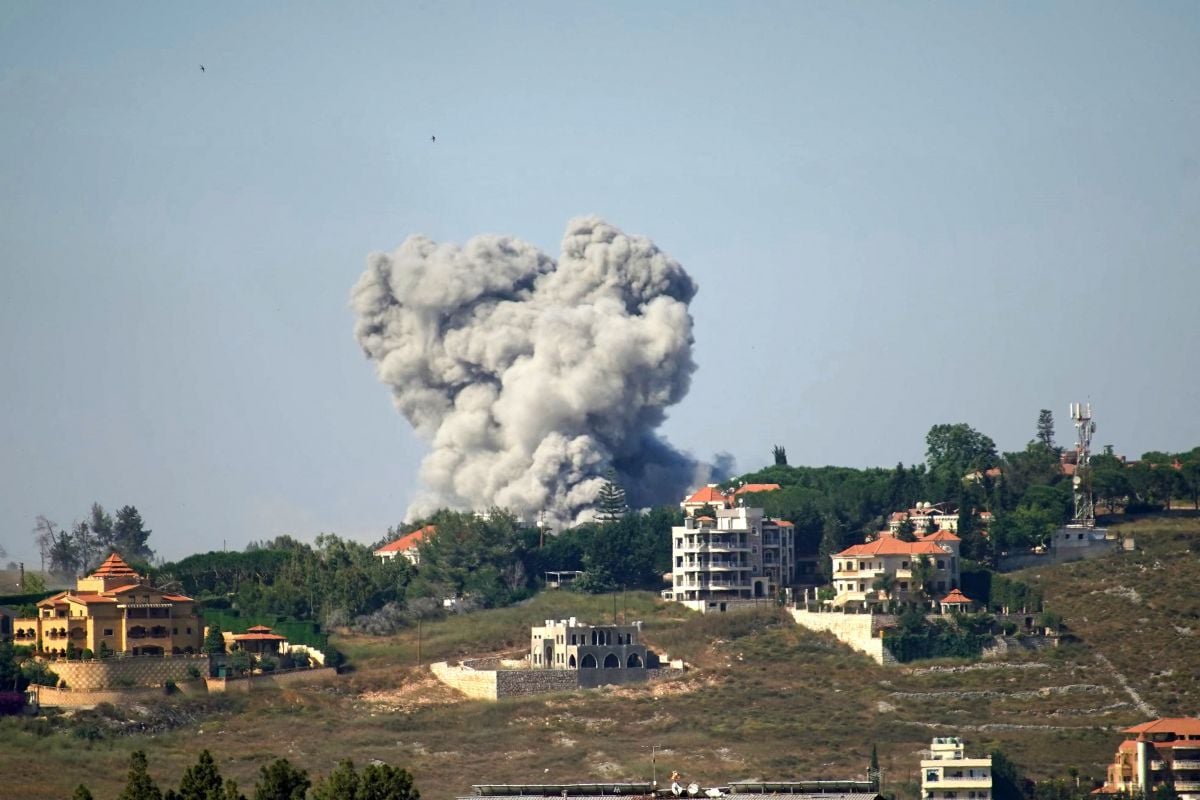
Smoke rises from the site of a series of Israeli airstrikes that targeted the Lebanese city of Nabatieh on June 20, 2026. (Credit; Abbas Fakih/AFP)






The cease-fire announced Friday afternoon between Israel and Hezbollah, following U.S. pressure on Israel, proved short-lived. In southern Lebanon and the Bekaa, escalation remains the dominant reality on the ground, with the death toll continuing to rise. The renewed violence followed inflammatory remarks by Israeli Finance Minister Bezalel Smotrich, who called to “open the gates of hell in Lebanon,” as well as statements from the Israeli army indicating it would continue military operations in southern Lebanon.
The result was at least 38 people killed on Saturday alone after 70 air strikes and 18 drone strikes across southern Lebanon, following a particularly violent night. Rescue teams were still searching newly hit areas, according to our correspondent in the region. Among the victims were a soldier on the Kfar Roummane-Nabatieh road, a woman in Shahour (Sour district), four members of the same family in Arab Salim (Nabatieh district), and a man in Nmeirieh (Nabatieh district).
The deadliest strike of the day hit Qanarit, in the Saida district, killing nine people and wounding 22 others, most of them women and children. All of the victims were residents of the town. Located north of the Zahrani River, the area had long been considered relatively safe and had hosted displaced people from more heavily affected regions, with a shelter established for that purpose. Another deadly strike targeted Sohmor in western Bekaa, killing four members of the Qalaaji family, according to our correspondent.
Battle for the strategic Ali al-Taher site
Military developments in southern Lebanon suggest that the escalation is concentrated primarily around the Nabatieh area and the strategic Ali al-Taher heights, due to what our correspondent describes as “repeated Israeli attempts to change realities on the ground in order to impose a new equation.”
Lebanon’s Civil Defense reported 16 deaths in the Nabatieh area by midday alone.
For several days, dozens of airstrikes and hundreds of artillery shells have pounded the region in what is being described as the most intense offensive in months. Ali al-Taher hill is considered one of the most strategic locations in southern Lebanon. Beyond its significance to the Israeli military’s “buffer zone” strategy, the site overlooks Nabatieh, Iqlim al-Tuffah, the Jezzine heights, the Khardali Valley, Marjayoun and Kfar Tibnit. It also carries symbolic weight, as it was the last position evacuated by Israeli forces in 2000.
Israeli troops have repeatedly attempted to advance uphill from several directions, particularly from Kfar Tibnit toward the southern slopes of Ali al-Taher. According to our correspondent, Hezbollah fighters have repelled those advances and inflicted casualties on the attacking forces.
These operations have been accompanied by strikes carried out by fighter jets, drones and artillery across large parts of southern Lebanon, including Nabatieh, Nabatieh al-Fawqa, Kfar Roummane, Kfar Tibnit, Harouf, Nmeirieh, Arab Salim, Kfar Joz, Shoukin, Habboush, Zibdine and Kfar Sir in the Nabatieh district; Jabal al-Rafih and the Jabbour heights in Jezzine; Qabrikha in Marjayoun; Kawthariyet al-Rez in Saida; Burj Qalaway in Bint Jbeil; and Berghoz in Hasbaya.
As a precaution, the Lebanese Army closed the road at the Amrieh checkpoint south of Sour because of the military escalation. Strikes also targeted western Bekaa, including Sohmor, according to our correspondent, as well as Maaliyeh south of Sour and Qanarit in the Saida district, north of the Zahrani River.
More than 50 projectiles fired by Hezbollah
While previous days had seen a significant decline in Hezbollah operations, Friday night marked a sharp increase in attacks by the party.
According to the Israeli military, “Hezbollah fired more than 50 projectiles at Israeli forces in southern Lebanon” overnight. The army said it responded with strikes against Hezbollah targets.
Hezbollah MP Hassan Fadlallah said Saturday morning that the group had “the right” to respond to Israeli attacks.
“There is talk of a cease-fire. For us, what matters is that the enemy fully and completely respects this cease-fire and does not try to attack our country and our villages, or occupy new positions,” he said, adding that “the resistance has every right to confront this enemy when it attacks us, because it is the aggressor and the occupier.”
Other Hezbollah officials echoed similar messages throughout the day. Baalbek MP Hussein Hajj Hassan criticized what he described as the “erroneous policies” of Lebanese authorities seeking to continue direct negotiations with Israel. Meanwhile, MP Ali Ammar said the current phase was “delicate and dangerous” and required “internal cohesion and unity in the face of the enemy,” in an apparent reference to divisions within the Lebanese political scene.
Reporting by our correspondent in the South, Muntasser Abdallah