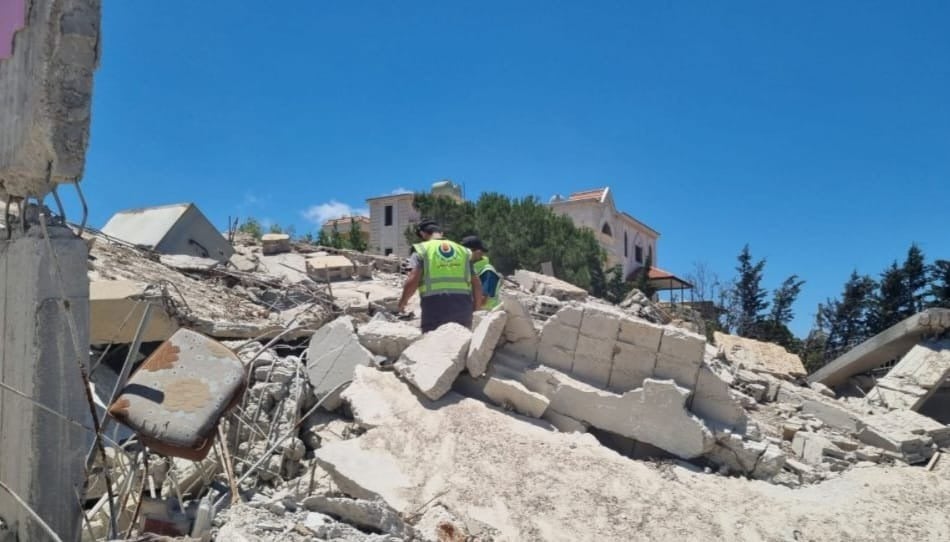
Rescue workers inspect rubble in the locality of Kafra, in southern Lebanon, on June 18, 2026. (Credit: Muntasser Abdallah)






As the return of forcibly displaced people and rescue operations continued Thursday across southern Lebanon, Israel continued to fire toward civilians, rescuers, and soldiers in Haddatha (Bint Jbeil), hampering search operations and forcing the re-evacuation of the area.
Israel also continued its strikes across the south of the country, killing at least four people in the Nabatieh and Jezzine districts, where the Israelis continue their attempts to advance toward a "strategic" hill.
The occupation of the South is, according to Israeli sources cited by Reuters, the subject of "intense" discussions between Tel Aviv and Washington, which is demanding an end to Israeli operations as provided for in the memorandum of understanding concluded with Tehran.
On the ground, three people were killed in two Israeli drone strikes on the outskirts of Nabatieh, in Zibdine (west of the city) and Kfar Tibnit (southeast), in the morning, according to information from our correspondent.
Two people, a Lebanese and a Syrian, were also wounded in Beit Yahoun, in the Bint Jbeil district, when an Israeli army drone fired a bomb near civilians in the village.
In recent hours, Israeli attacks have concentrated in the Nabatieh region, as exchanges of fire have taken place between occupying forces and Hezbollah.
Throughout the day, residents of villages in several regions tried to return home, as they have since Monday, to clear roads and search for the remains of victims of Israeli attacks — operations that have sometimes been interrupted by gunfire.
Residents of Haddatha who managed to reach the village square and the eastern neighborhoods Thursday morning, escorted by the Lebanese Army and rescuers from the Islamic Mission Scouts (al-Rissala) and the Islamic Health Committee (rescuers), also came under fire and faced the dispatch of remotely operated vehicles by Israel in their direction, according to our correspondent.
Work was interrupted by the targeting of an excavator. Residents then fled the area. Clearing operations were also launched in the villages of Shaqra, Kafra and Dibbiyeh, also in the Bint Jbeil district. In Nabatieh Fawqa, an Israeli army drone dropped a stun grenade at a family who had just arrived in front of their home, our correspondent reports. The family took refuge inside before being evacuated to the city of Nabatieh by rescue teams.
Shooting at an Israeli helicopter
During the night from Wednesday to Thursday, our correspondent reported an attempt by Hezbollah to bring down an Israeli helicopter conducting a reconnaissance mission near the strategic Ali Taher hill, which overlooks the entire region and which Israelis are trying to seize.
The helicopter was targeted by a surface-to-air missile, forcing it to withdraw from the area, according to local sources. Several missiles were also fired at Israeli vehicles near Kfar Tibnit. Hezbollah did not claim these attacks.
Also in this region, the localities of Kfar Roummane, Habboush and Kfar Joz were targeted during the night by artillery fire that caused fires. At midnight, Israeli forces fired machine guns at the Wadi Slouki area and the outskirts of Houla (Marjayoun).
The Israeli army meanwhile announced Thursday morning the death of one of its soldiers the previous day in an incident in southern Lebanon in which seven other soldiers were wounded. The soldier, a 29-year-old staff sergeant, "fell in combat in southern Lebanon," the Israeli army said in a statement, without specifying the location of the incident.
‘Small disagreement’ between Trump and Netanyahu on Lebanon
The Israeli army has also officially advanced beyond the "buffer zone" initially claimed at the start of its ground offensive in southern Lebanon, notably north of Bint Jbeil, on the coast south of Sour, and toward the so-called Ali Taher hills, by publishing an updated map of its "area of operations" in Lebanese territory.
This comes as Tel Aviv seeks to convince Washington to allow its army to hold positions seized in recent weeks in southern Lebanon. Two Israeli officials, including one close to Prime Minister Benjamin Netanyahu, told Reuters anonymously that negotiations were ongoing between Washington and Tel Aviv for the Israeli army to maintain its "deployment" in southern Lebanon, even though the protocol between Iran and the United States provides for an end to hostilities in Lebanon and a commitment from both parties to "guarantee [its] territorial integrity and sovereignty."
One of these Israeli sources said Israel would not back down on its positions, particularly its maintenance of forces deployed south of the Litani River. A second Israeli official said the outcome of discussions would ultimately depend on President Donald Trump's willingness to "force the issue," particularly by threatening Israel with consequences if it did not respect the terms of the protocol agreed with Iran.
According to this source, everything will therefore depend on Trump's decision to apply — or not — direct pressure on Israel to comply with the commitments outlined in this agreement. From the G7, Trump said he had a "tremendous partnership" with Benjamin Netanyahu, referring to their disagreement over Lebanon as a "small disagreement."
On "the Lebanese side, it's something we'll have to work on a bit," Donald Trump acknowledged from Evian, as the Iranians are demanding Israel halt its strikes against Hezbollah in Lebanon. "It's actually a very small piece of the puzzle, but it still makes a lot of noise," he added.
Lebanon was drawn into the conflict after Hezbollah fired rockets at Israel on March 2. Despite a cease-fire established April 17, the war continues in southern Lebanon, where the Israeli army has launched a ground offensive and now occupies part of the territory.
In its latest war casualty report published Wednesday, the Lebanese Health Ministry recorded 3,912 killed and 11,873 wounded — an increase of 28 dead and 17 wounded in 24 hours — despite the decrease in Israeli attacks since Sunday following the announcement of the agreement between Iran and the United States.